
PART 3
Under the photographs, written in Wendell’s careful handwriting, were three words:
“For Mama’s comfort.”
I felt something tighten in my chest.
“Wendell?”
My voice sounded smaller than I expected.
The radio continued playing. Somewhere deeper inside the house, a saw buzzed for a few seconds before falling silent.
Then I heard his voice.
“Just a minute!”
I should have left. I knew that. A woman doesn’t walk into a man’s garage uninvited and start studying his photographs.
But I had already come forty minutes down a back road because my son had convinced me the man I cared about was trying to steal from me.
I wasn’t going to drive home without knowing the truth.
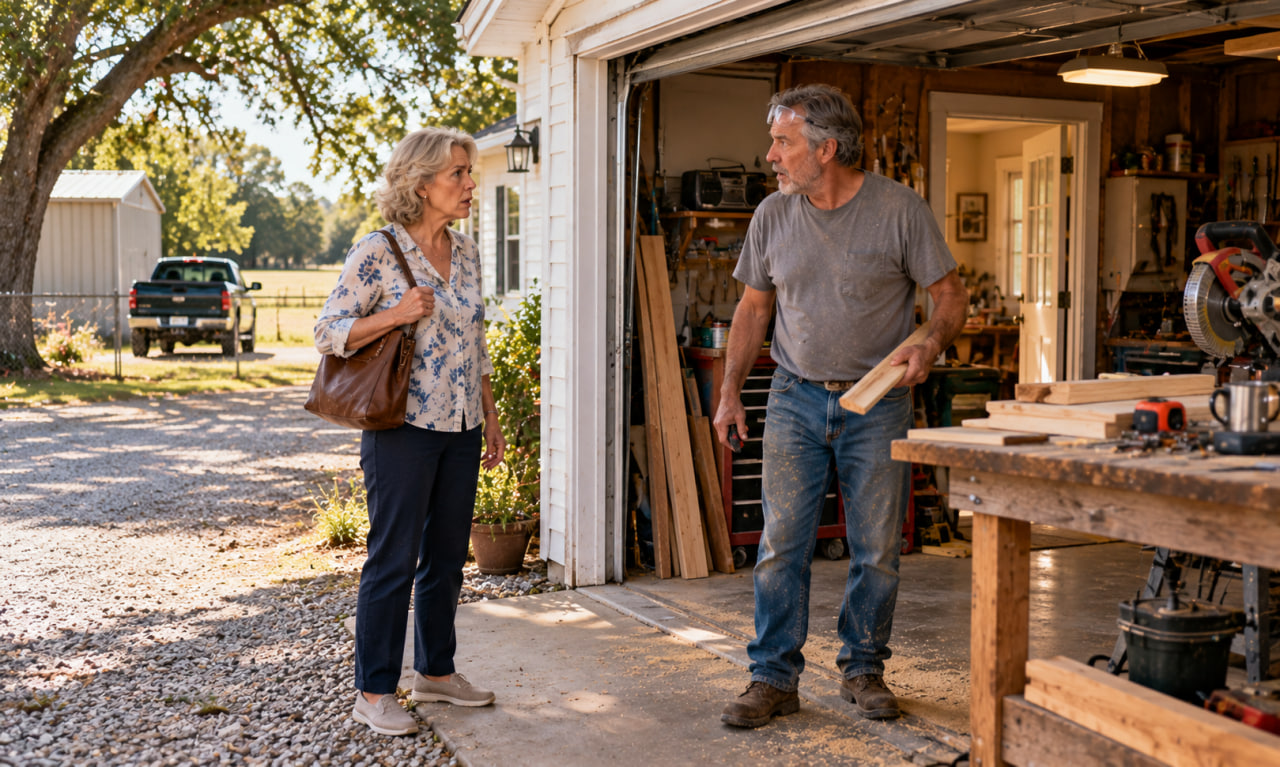
Wendell appeared in the doorway wearing an old gray T-shirt, faded jeans, and a pair of safety glasses pushed up onto his forehead.
When he saw me, he froze.
“Winnie?”
He looked at the car behind me, then at the photographs on the wall, then back at me.
His face changed.
Not the guilty expression I had expected.
Something closer to heartbreak.
“You came out here.”
“I did.”
He took off his glasses.
“Well,” he said quietly, “I suppose you deserve to know.”
I crossed my arms, trying to keep my voice steady.
“Know what, Wendell? Whether you have a wife? Whether there’s some woman inside this house who doesn’t know you’re having Sunday supper with me?”
His eyes widened.
Then he let out a breath and shook his head.
“No, ma’am. There isn’t.”
“Then why won’t you let me see your house?”
He looked down at his hands.
Those big, careful hands that had repaired my porch light. The hands that carried groceries into my kitchen without making me feel helpless. The hands that had gently moved a heavy flowerpot for me when my knees hurt too badly to bend.
“I wanted to finish something first,” he said.
“Finish what?”
He glanced toward the ramp.
I followed his eyes.
And suddenly, the pieces began to fall into place.
The paint.
The sawdust.
The questions about Mama’s yellow kitchen.
The way he had asked about my knees and whether I could manage the three steps from my back porch into my house.
I stared at him.
“Wendell, what are you building?”
He rubbed the back of his neck.
“A house I can be proud to show you.”
“That’s not an answer.”
“No,” he admitted. “It isn’t.”
He moved aside and gestured toward the open garage.
“Come inside, Winnie. Please.”
I hesitated.
Then I walked past him.
The house smelled of fresh paint, wood, and coffee. It was modest, with old-fashioned furniture and clean curtains. Nothing about it looked suspicious.
There was no second woman’s purse on the counter. No unfamiliar shoes by the door. No hidden life waiting to be discovered.
Instead, I saw a small living room with a wide doorway, a bathroom with grab bars beside the toilet, and a kitchen with newly installed lower cabinets.
The walls were painted the softest shade of yellow.
Buttercup yellow.
I stood in the middle of that kitchen, unable to speak.
Wendell remained near the doorway, looking as though he had been waiting for a verdict.
“My mother spent the last six years of her life in a wheelchair,” he finally said. “After my father died, I brought her here. I thought I could take care of her.”
He paused.
“I didn’t understand how much a house could make a person feel trapped.”
I looked at the wide doorways.
“The bathroom,” I whispered.
“Too narrow for her chair. The kitchen counters were too high. She couldn’t reach anything. The front steps meant she had to wait for me every time she wanted to go outside.”
His voice roughened.
“I worked all day at the co-op and came home exhausted. Sometimes she’d ask me to sit with her, and I’d tell her I had repairs to do. Sometimes I’d get impatient when she needed help.”
He swallowed.
“She never complained. That’s what made it worse.”
I knew that look. I’d seen it on the faces of family members who had spent years trying to be strong until the regret finally caught up with them.
“When she died,” he continued, “I promised myself I’d make the place right. Not just for another person. For me, too. So I could remember her without thinking about all the things I should’ve done differently.”
He pointed toward the kitchen.
“I found those pictures in a box. That was the color she wanted for her kitchen. I never got around to painting it while she was alive.”
I touched the yellow wall.
It was warm beneath my fingertips.
“And the ramp?”
Wendell looked at me.
“Your knees, Winnie.”
I couldn’t move.
He rushed to explain.
“You told me once that you were afraid of ending up like your mother. I didn’t want to embarrass you by talking about it. I figured if you ever wanted to spend time here, you’d be able to get inside without worrying about stairs.”
I turned toward him.
“You’ve been rebuilding this house for me?”
“Not just for you,” he said quickly. “I needed to do it for myself, too.”
Then he looked away.
“I know how it sounds. Maybe I should have told you. But I wanted to surprise you at Christmas. I wanted to have everything finished before I invited you over.”
I looked around the little kitchen.
For the first time since Dwight died, I felt something unfamiliar rising inside me.
Not guilt.
Not grief.
Hope.
Then I noticed the folded papers on the counter.
A bank envelope sat beneath them, along with a receipt from a lumberyard.
I didn’t mean to look.
But one number caught my eye.
$18,400.
I stared at it.
“Wendell, what’s this?”
He glanced at the papers and quickly gathered them.
“Just bills.”
“That’s a lot of lumber.”
He gave a tired laugh.
“More than I expected.”
“Have you been borrowing money?”
“No.”
“Then how are you paying for all this?”
He hesitated.
“I sold my fishing boat. Cashed out some savings. I’ve been doing small repair jobs for people in town.”
I thought about the way he had fallen asleep in Dwight’s recliner.
The tiredness I’d mistaken for a man growing old.
“You’ve been working yourself half to death.”
“Not quite.”
“Wendell.”
He smiled faintly.
“All right. Maybe a little.”
I wanted to be angry. I wanted to tell him he had no business wearing himself out over a promise to his dead mother and a woman he’d only known for a few months.
But I couldn’t.
Because I understood something about unfinished promises.
I’d spent two years dusting around Dwight’s recliner as if leaving it untouched could keep part of him alive.
Wendell had spent years trying to make peace with the things he couldn’t change.
Neither of us had figured out how to move forward without carrying the past.
I sat down at his kitchen table.
“Have you eaten?”
He blinked.
“What?”
“Have you eaten today?”
“Winnie, I—”
“That’s what I thought. You have eggs?”
He laughed, a surprised, almost boyish sound.
“Yes, ma’am.”
“Then cook them. I’ve driven forty minutes, and I’m not leaving until somebody in this house gets a proper meal.”
For the first time since I’d arrived, his shoulders relaxed.
And as he moved around the kitchen, I noticed something else.
On the refrigerator was a handwritten list.
Things to finish before Christmas:
Complete ramp.
Install bathroom rails.
Finish kitchen.
Fix back door.
Ask Winnie to dinner.
I stared at the last item.
Then I smiled.
Because, for the first time in a long time, somebody had written my name on a list of things worth looking forward to.
I didn’t know yet how much trouble that little list would bring.
I didn’t know that before the week was over, my son would drive to Wendell’s house.
And I certainly didn’t know that the man accusing Wendell of stealing my husband’s insurance had already begun making plans for that money himself.
But I would learn.
Soon enough.
And when I did, the truth would change my family forever.
I returned home that afternoon feeling lighter than I had in months.
I had promised Wendell I wouldn’t tell anyone about the surprise renovations before Christmas. He had looked so hopeful when he asked that I couldn’t bring myself to ruin it.
But there was one thing I hadn’t anticipated.
Zach had installed a banking alert on my phone.
He’d insisted it was for my protection after a neighbor of his lost several thousand dollars to a phone scam. I had agreed because I trusted my son.
That evening, while I was preparing supper, my phone rang.
“Mama, where were you today?”
I looked at the screen.
“Hello to you, too, Zach.”
“Don’t play games. I stopped by your house this afternoon, and you weren’t home.”
“I had errands.”
“What errands?”
“Since when do I have to submit a schedule to you?”
There was a long silence.
Then he said, “You went to see him, didn’t you?”
I put down my knife.
“Who?”
“Wendell.”
I stared at the kitchen wall.
How had he known?
“Did you put a tracking app on my phone?”
“What? No! I just know you, Mama.”
It was a terrible lie.
I knew my son. I knew the little pause before he lied, the way his voice rose at the end of a sentence when he wanted to sound innocent.
“Zachary, I’m hanging up now.”
“Wait. Did he ask you for money?”
“No.”
“Did he show you his bank statements?”
“Good night, Zach.”
I ended the call.
My hands were shaking.
For years, I had told myself Zach was protective because he loved me. His father had died unexpectedly, and perhaps my son was frightened of losing me, too.
But protection shouldn’t feel like imprisonment.
The next morning, I called my bank.
I asked to speak to someone about the account access permissions.
The woman on the phone was patient and professional. She explained that Zach had been given viewing access and that several notifications were going to his email address.
“Would you like to change those settings, ma’am?”
I hesitated.
He was my son.
I had carried him when he was a baby. Sat beside him through fevers. Stayed awake waiting for him to come home as a teenager. Helped him buy equipment for his body shop when business was slow.
How did a mother begin protecting herself from her own child?
“Yes,” I said finally. “I’d like to change them.”