
Every time I’d accepted their explanation because I wanted to believe them.
I had never asked for receipts.
I had never demanded repayment.
I had never treated my son like someone I needed to protect myself from.
Maybe that had been my mistake.
I stood.
“What should I do?”
Daniel’s answer came immediately.
“Do nothing directly.”
I looked at him.
“Nothing?”
“Don’t confront your son again.”
“Why?”
“Because if someone has already submitted a false document, we need to know whether there are other documents.”
My stomach tightened.
“You think there could be more?”
“I think we should assume nothing.”
He gathered the papers into a folder.
“Change your passwords. Secure your financial records. Don’t sign anything without showing it to me first. And most importantly, don’t tell them what we know.”
I nodded.
As I walked out of his office, my phone rang.
My son.
I stared at the screen.
For the first time in my life, I let it ring.
He called again.
Then again.
Then a text appeared.
Mom, please answer.
I didn’t.
Another message arrived.
We need to talk.
I turned off my phone.
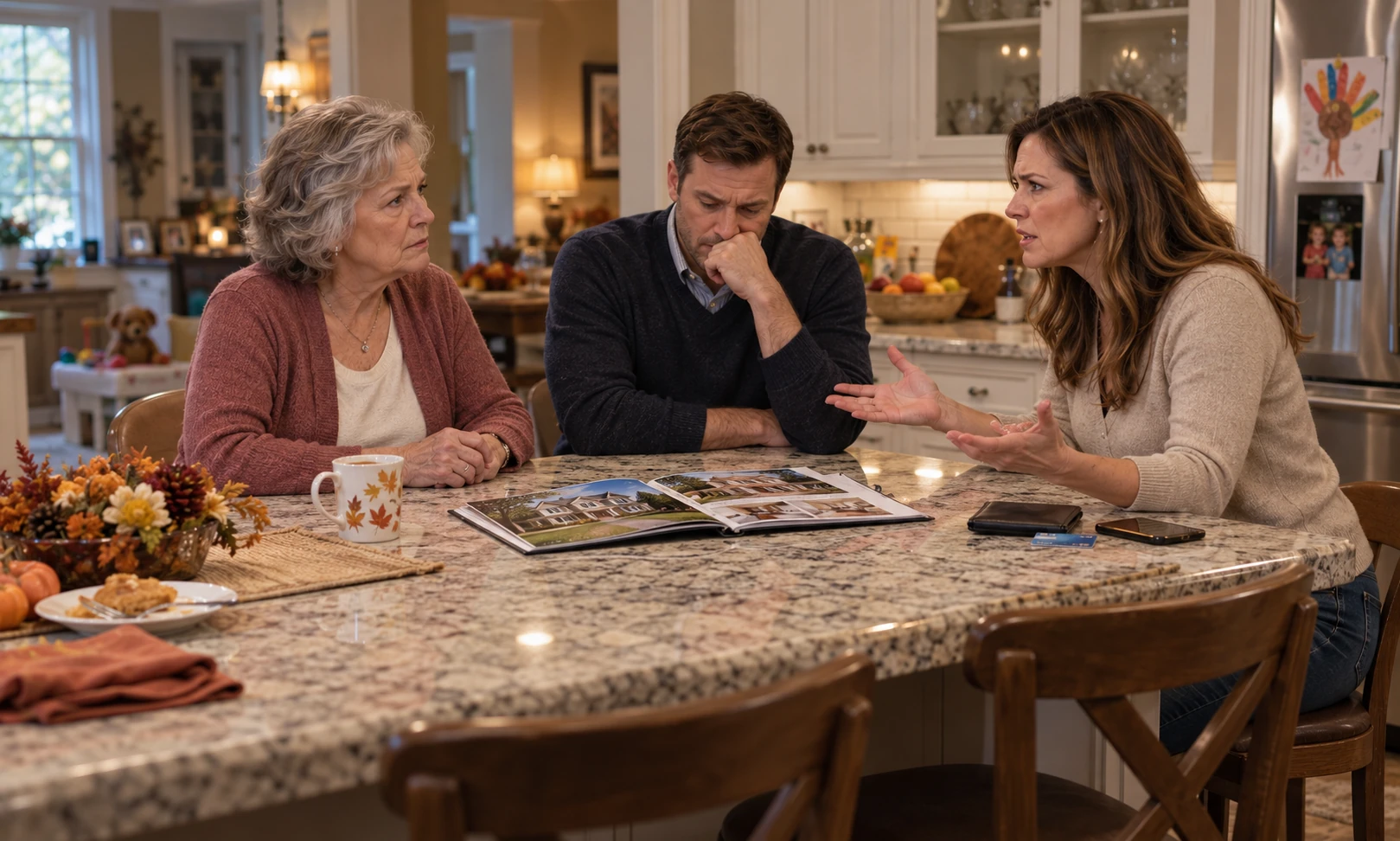
That evening, I sat alone at my kitchen island.
The same place where Rachel had placed the real-estate folder.
The same place where my son had sat silently beside her.
I opened the drawer and pulled out an old photograph.
My husband and my son were standing beside a fishing boat.
My son had been twelve.
His front tooth was missing.
His father had one hand resting on his shoulder.
I smiled despite myself.
“Where did I lose you?” I whispered.
The question wasn’t really directed at the photograph.
It was directed at my son.
Because I still couldn’t reconcile the man I knew with the person who had submitted that document.
At 8:43 p.m., someone knocked on the front door.
I didn’t move.
Another knock.
Then my son’s voice.
“Mom?”
I stood slowly.
He was alone.
I could see him through the glass.
His shoulders were slumped.
He looked exhausted.
For one brief moment, every warning Daniel had given me disappeared.
He looked like my little boy again.
I opened the door but didn’t step aside.
“What do you want?”
He swallowed.
“To talk.”
“You should have called.”
“You weren’t answering.”
“I know.”
He looked at me.
“Can I come inside?”
I hesitated.
Then I opened the door.
He walked into the kitchen.
His eyes landed on the island.
The folder wasn’t there.
He looked back at me.
“Mom…”
“Why did you submit a document with my signature?”
His face went completely still.
I watched the color drain from it.
“I didn’t.”
“Daniel says you did.”
“I didn’t forge anything.”
“I didn’t say you forged it.”
He looked away.
“Then what are you saying?”
“That you submitted it.”
He rubbed both hands over his face.
“Mom, I need you to believe me.”
“Then tell me what happened.”
He sat down.
I remained standing.
“I gave Rachel some documents.”
“What documents?”
“Copies of the account statements.”
“Why?”
“She said the lender needed them.”
My chest tightened.
“And my signature?”
“I never signed that.”
“Did you see it?”
He looked at me.
“No.”
“Did you submit anything that contained my signature?”
“No.”
“Then how did it get there?”
He shook his head.
“I don’t know.”
I wanted to believe him.
God help me, I wanted to.
But there was something about his answer that didn’t sound like a complete answer.
“What did you give Rachel?”
“Some financial records.”
“Which ones?”
“I don’t remember.”
“You don’t remember?”
“I was trying to help get the paperwork together.”
“Because of the house?”
“Yes.”
“When did you first learn that the money for the down payment was connected to my accounts?”
He looked at the floor.
“Months ago.”
“How many months?”
“Maybe six.”
My heart sank.
“Six months?”
“Yes.”
“And you never told me you were planning to use it?”
“We thought we’d ask you.”
“You thought?”
“Rachel thought you would say yes.”
I stared at him.
“And you?”
He didn’t answer.
“Did you think I would say yes?”
“I thought you’d help us.”
“That isn’t what I asked.”
He finally looked up.
“I didn’t know.”
I nodded slowly.
That answer hurt.
Because if he truly didn’t know, then he hadn’t been paying attention to me.
And if he did know, he had been hoping I wouldn’t say no.
“Did Rachel tell you she contacted the bank?”
He hesitated.
“Yes.”
“When?”
“A few weeks ago.”
“Why?”
“She said she was trying to understand the accounts.”
“Without me?”
“She said she wanted to know what paperwork was needed.”
“And you were okay with that?”
“I didn’t think she was doing anything wrong.”
I sat down across from him.
“Did you know she had asked about my beneficiary information?”
His head snapped up.
“What?”
“Did you know?”
“No.”
“Did you know she had submitted anything using my name?”
“No.”
“Did you know there was a document connected to the house that appeared to contain my signature?”
He shook his head.
“No.”
I studied his face.
For the first time since he had arrived, he looked genuinely afraid.
“Mom, I swear to you, I didn’t sign anything.”
“I believe you.”
He exhaled.
Then I added,
“But I don’t know whether I can trust you.”
His eyes filled with tears.
That broke something inside me.
He looked down.
“I know.”
We sat in silence.
Then he said something I hadn’t expected.
“Dad warned me.”
I looked up.
“About what?”
“About money.”
My heart stopped.
“What did he say?”
“When I got married.”
I remembered the wedding.
My husband had pulled our son aside that evening.
I had assumed he was giving him marriage advice.
“What did he tell you?”
My son rubbed his eyes.
“He said never mix family love with financial dependence.”
I almost laughed.
Not because it was funny.
Because it was painfully ironic.
“He said if you ever needed help, ask for help. But don’t build your life around someone else’s money.”
My throat tightened.
“Why didn’t you listen?”
“I thought I was.”
He looked at me.
“Until everything got more expensive.”
He began listing the things that had happened.
Childcare.
Medical bills.
Car repairs.
Credit cards.
A business idea that failed.
A loan that had gone bad.
A period when Rachel hadn’t been working.
Then another.
And another.
I listened.
For the first time, I understood how quickly a family could become financially trapped.
One emergency became another.
One borrowed dollar became another.
One promise to repay became a stack of unpaid promises.
But understanding didn’t erase what had happened.
“Why didn’t you tell me?”
He laughed bitterly.
“Because every time I thought about telling you, I was ashamed.”
I looked at him.
“You could have told me.”
“I know.”
“You could have said you were struggling.”
“I know.”
“You didn’t have to let it get this far.”
“I know.”
His voice cracked.
“I thought I could fix it before you noticed.”
That sentence stayed with me.
“Before I noticed what?”
He looked at the floor.
“How bad it was.”
“How bad?”
He reached into his jacket.
Then he placed several papers on the table.
Credit-card statements.
Loan notices.
Overdue bills.
I looked at the numbers.
My heart sank.
They weren’t struggling.
They were drowning.
The house wasn’t the solution.
It was an escape plan.
A bigger house.
A bigger mortgage.
A larger monthly payment.
And money they didn’t actually have.
I looked at my son.
“Why would you buy an $890,000 house?”
He swallowed.
“Because Rachel said we needed to move before the kids got older.”
“That’s not an answer.”
“She said our current neighborhood wasn’t good enough.”
I closed my eyes.
There it was.
The thing no spreadsheet could explain.
They weren’t buying a house they could afford.
They were buying a life they wanted other people to believe they could afford.
My son looked at me.
“I thought the down payment would give us enough time.”
“Enough time for what?”
“To fix everything.”
I shook my head.
“Debt doesn’t disappear because you move into a bigger house.”
“I know that now.”
I looked at him.
“And Rachel?”
His expression changed.
“What about her?”
“Did she know how bad things were?”
“Yes.”
“How much?”
“All of it.”
I was silent.
Then he said,
“But Mom, there’s something else.”
“What?”
“She had another reason for wanting the house.”
I waited.
He looked toward the window.
“She wanted to sell our current house.”
“That makes sense.”
“No.”
His voice was quiet.
“She wanted to sell it before you could find out what was really happening.”
I stared at him.
“Why?”
He hesitated.
Then he reached into his pocket and pulled out his phone.
“I found something.”
He opened an email.
I read it.
Then read it again.
It was a conversation between Rachel and someone whose name I didn’t recognize.
The messages were short.
But one sentence made my hands go cold.
Once the house closes, she won’t be able to interfere anymore.
I looked at my son.
“Who is this?”
“I don’t know.”
“Why were you reading her messages?”
“I wasn’t.”
“Then how did you get this?”
“She left her laptop open.”
I looked at the screen again.
There were more messages.
Another line.
The old accounts have to be cleaned up before closing.
And then:
Edith can’t know about the second account.
I stopped breathing.
“The second account?”
My son nodded.
“I didn’t know what it meant.”
I looked at him.
“Do you know where it is?”
“No.”
“Then find out.”
He stared at me.
“How?”
I stood.
“Because if someone has been moving money without my knowledge, we need to know where it went.”
My son looked terrified.
“Mom…”
“What?”
“What if it’s worse than we think?”
I looked toward the photograph of my husband.
“I think it already is.”
The next morning, my attorney obtained the bank records.
By noon, we had an answer.
There was another account.
It had been opened seven months earlier.
The account was not in my name.
It was not in my son’s name.
And it wasn’t in Rachel’s name either.
It belonged to a company.
A company none of us had ever heard of.
The first transfer into the account had come from an emergency fund connected to me.
The amount was $18,500.
The second was $11,200.
Then $7,400.
Then $5,000.
Small enough to avoid immediate attention.
Large enough to become something much bigger over time.
I stared at the total.
$67,300.
My hands went cold.
Daniel looked at me.
“Edith, there’s more.”
He slid another statement across the table.
The company had received payments from several other sources.
My son looked at the document.
Then he whispered,
“That address.”
“What?”
He pointed to the business address.
“I know that place.”
“Where is it?”
He looked at me.
“It’s Rachel’s brother’s office.”
Silence filled the room.
And suddenly, the house wasn’t a purchase anymore.
It was part of a much larger plan.
A plan involving money.
A hidden company.
A secret account.
And at least $67,300 that had already disappeared.
But the next discovery would be the one that changed everything.
Because when Daniel traced the company registration, we found the person listed as its authorized manager.
It wasn’t Rachel.
It wasn’t her brother.
It wasn’t even my son.
It was someone whose name I hadn’t heard in more than twenty years.
My husband’s former business partner.
A man my husband had once told me never to trust again.
PART 5
A man my husband had once told me never to trust again.
His name was Martin Hale.
I hadn’t heard that name spoken in our house for twenty-three years.
Not since the night my husband came home from work, put his briefcase on the kitchen floor, and told me he had ended a partnership that had nearly destroyed everything he had built.
I remembered the look on his face.
Not anger.
Disappointment.
The kind that goes deeper than anger.
I remembered asking him what Martin had done.
My husband had simply said,
“He thought he could take something that wasn’t his.”
At the time, I hadn’t asked for details.
I had trusted my husband to handle it.
Now Daniel was sitting across from me with a corporate registration document bearing Martin Hale’s name.
My son stood beside the window, staring outside.
“Is he still alive?” I asked.
Daniel nodded.
“Yes.”
“Where?”
“Columbus.”
My son turned around.
“Do you think he’s behind this?”
Daniel answered carefully.
“We don’t know.”
“But the company is his.”
“On paper.”
“What does that mean?”
“It means we need to determine who actually controls it.”
I looked at the documents again.
“How much money has gone into this company?”
“From accounts connected to you?”
“Yes.”
Daniel pointed to the spreadsheet.
“Sixty-seven thousand three hundred dollars that we can trace so far.”
“So far.”
“Yes.”
I felt sick.
My son stepped away from the window.
“Mom, I swear I didn’t know about any of this.”
I looked at him.
“I believe you didn’t know everything.”
His face fell slightly.
“But you knew enough.”
He nodded.
“Yes.”
That was the difference.
He hadn’t created the entire mess.
But he had allowed it to grow.
And somewhere along the way, he had started believing that keeping me in the dark was easier than telling me the truth.
Daniel gathered the documents.
“We need to move quickly.”
“Why?”
“Because whoever is behind this knows you’ve discovered the account.”
I stared at him.
“How do you know?”
“Because the account received a transfer yesterday.”
My heart stopped.
“Yesterday?”
“Yes.”
“From where?”
Daniel looked at my son.
“Your son’s credit card.”
My son went pale.
“What?”
“That isn’t possible.”
Daniel slid the statement across the table.
The transfer was there.
$4,800.
My son stared at it.
“I didn’t make that payment.”
“Did you have your card?”
“Yes.”
“Who else has access?”
He shook his head.
“No one.”
Then he suddenly looked at me.
“Rachel.”
I felt the room go quiet.
“Does she have access to your cards?”
“She knows the numbers.”
“Does she have the physical card?”
“No.”
Daniel asked,
“When did you last use it?”
“Two days ago.”
“Where?”
“At the grocery store.”