
Margaret stood beside her, glowing.
“To new beginnings,” she announced, raising a glass.
My attorney, Daniel Mercer, looked at me.
“You can still let the process happen quietly.”
“No.”
“Claire—”
“She threw my belongings into the street this morning. Tonight she’s spending money she doesn’t own, inside property she doesn’t own, to celebrate a future built on fraud.”
Daniel nodded.
“Then we do it your way.”
The Whitmores had always assumed I was financially insignificant because I rarely talked about money.
Before marrying Ethan, I’d worked as a forensic accountant specializing in trusts, acquisitions, and asset protection.
When my father died, he left me a private investment company through a protected family trust.
I’d never needed Ethan’s money.
But during our marriage, I discovered something unexpected.
The Whitmore estate was drowning in debt.
Five years earlier, Margaret had quietly borrowed against nearly everything—commercial buildings, investment accounts, even the mansion.
When their primary lender threatened foreclosure, my family trust acquired the distressed loan through a holding company.
Margaret never knew.
All she knew was that an anonymous investment firm had saved her.
I allowed the arrangement because Ethan was my husband.
Then, six months earlier, I discovered his affair.
After that, I dug deeper.
What I found was worse.
Ethan and Margaret had been shifting marital assets into shell companies before the divorce.
They concealed nearly twelve million dollars while Ethan claimed in court that our joint estate was “severely diminished.”
Vanessa knew.
There were emails.
Bank transfers.
Recorded calls.
And the day before, Ethan had moved another $2.4 million into an account controlled by Margaret.
The $800,000 celebration had been paid for using funds covered by a court preservation order.
Daniel placed a sealed envelope before me.
Inside were copies of the emergency injunction, lien enforcement documents, evidence disclosures, and confirmation that the district attorney’s financial crimes unit had received our file.
“You understand,” he said, “once you hand this over, there is no going back.”
I sealed the envelope.
“There was no going back when Ethan lied under oath.”
At eight-fifteen, my car stopped outside the estate.
A security guard approached.
“Ma’am, Mrs. Whitmore said you’re not permitted—”
I handed him a copy of the court order.
His expression changed immediately.
“Understood.”
The orchestra was playing inside.
Margaret stood beneath the chandelier holding a microphone.
“And soon,” she announced, touching Vanessa’s stomach, “the Whitmore name will have the heir it deserves.”
Applause filled the room.
Then someone noticed me.
The applause faded row by row.
Margaret’s expression hardened.
“What is she doing here?”
Ethan turned pale.
Vanessa whispered, “Ethan?”
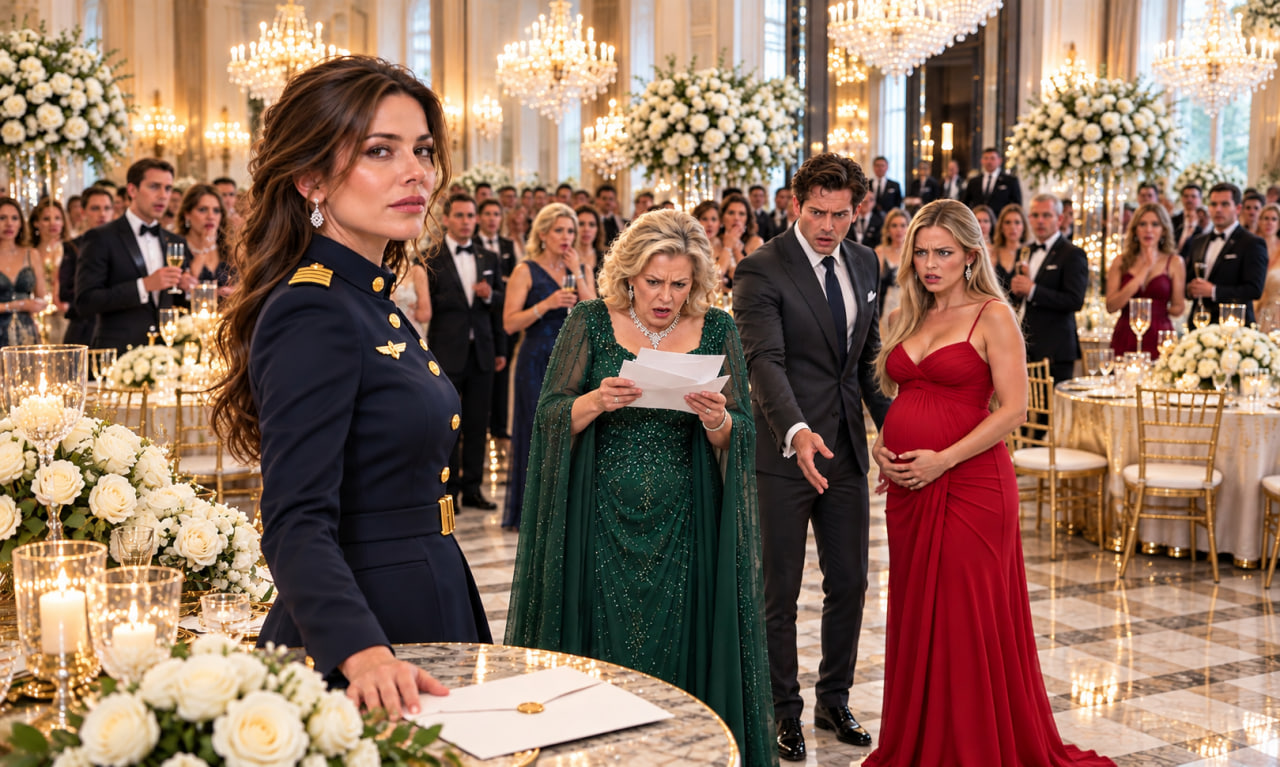
I walked through the crowd holding a single sealed envelope.
Margaret marched toward me.
“You were told never to come back.”
I stopped at the center table.
“No,” I said calmly. “You told me that.”
Then I placed the envelope beside her champagne glass.
“This celebration is over.”
Margaret laughed first.
It was sharp and theatrical, meant for everyone watching.
“You storm into my home with an envelope and expect everyone to tremble?”
“My home,” I corrected.
Silence.
Ethan stepped forward.
“Claire, don’t do this.”
I looked at him.
“You told a court you had disclosed every marital asset.”
His expression changed.
Vanessa stared at him.
Margaret tore open the envelope.
Her eyes moved across the first page.
Then the second.
The color drained from her face.
“What is this?”
“A temporary restraining order freezing the Whitmore accounts,” I said. “An enforcement notice on this property. Evidence of fraudulent transfers. And confirmation that the financial crimes unit has received copies.”