
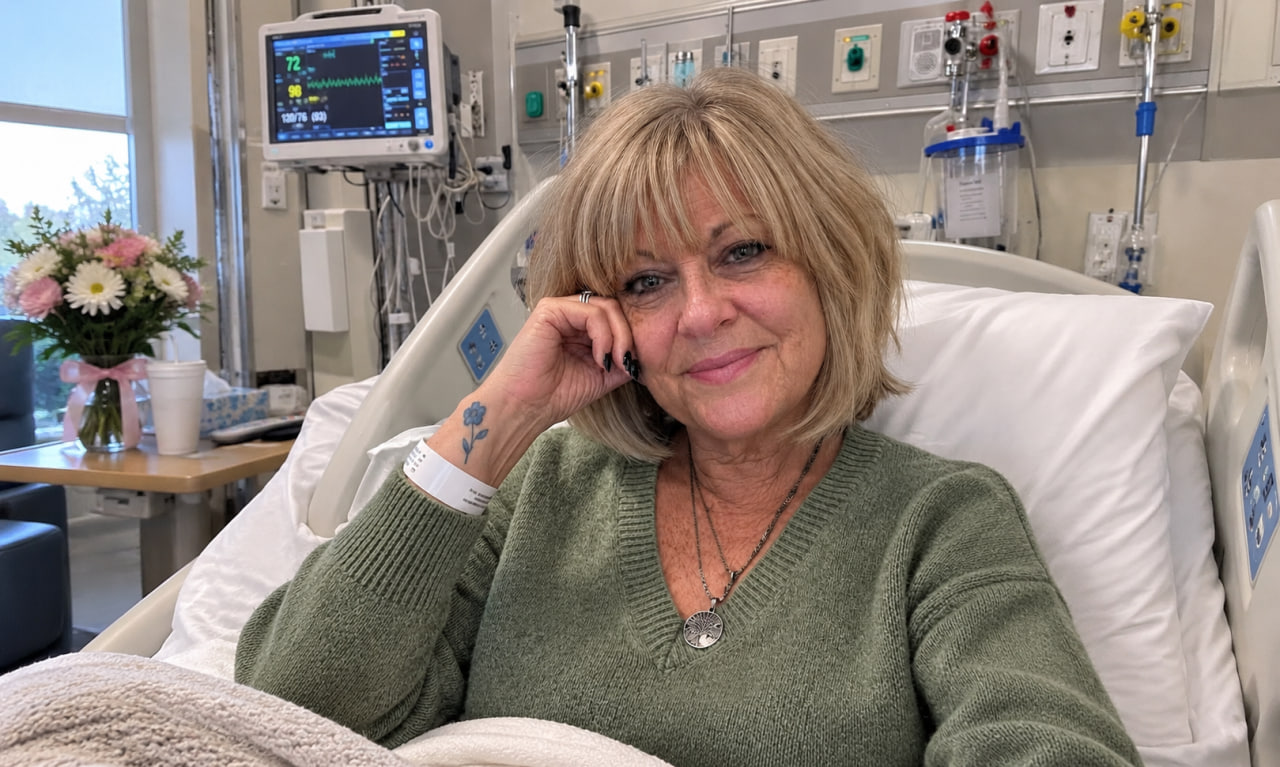
For my entire life, I believed the tiny blue flower tattooed on my mother’s wrist was nothing more than something she had done when she was young.
It sat quietly on the inside of her wrist.
Small.
Faded.
Five little blue petals and a thin stem, no larger than a coin.
When I was a child, I sometimes traced it with my finger.
“What does your flower mean?”
Mom always gave me essentially the same answer.
“I got it when I was young.”
Sometimes she added that she had been young and made a decision.
That was all.
No funny story about friends.
No explanation for choosing a flower.
No memory she wanted to share.
Eventually, I stopped asking.
Mostly.
My mother’s name was Helen.
She was the kind of woman everyone depended on.
If someone was sick, she organized meals.
If someone forgot a birthday, she remembered it.
If a neighbor needed help, she arrived with food, practical advice, and enough patience to listen.
She had worked as a nurse for most of her adult life.
Even after retirement, she still carried herself with the same calm competence.
The blue flower was the only part of her life that seemed completely locked away.
The One Question Mom Never Answered
I asked about the tattoo at different ages.
When I was seven.
Again at eleven.
Again when I was fifteen and briefly thought it would be wonderful if Mom and I someday had matching tattoos.
I even asked in my twenties, when I had become curious about who Helen had been before she became simply “Mom” to me.
Her answer never really changed.
She had been young.
She had made a choice.
End of story.
Only once did I push harder.
I was nineteen and home from college.
We were washing dishes together when I asked why she treated a tiny tattoo like some enormous secret.
Her hands stopped moving in the soapy water.
Something crossed her face.
At nineteen, I couldn’t identify it.
Years later, I understood.
It was sadness.
“Some things are just for me, Emma,” she said softly. “Maybe you’ll understand when you’re older.”
So I let it go.
Eventually I decided that my mother had the right to keep one thing to herself.
The Hospital Visit That Changed Everything
By the time Mom was sixty-three, I was thirty-two.
We were extremely close.
My father had died six years earlier from a sudden heart attack in his sleep, and losing him had brought Mom and me even closer.
After his death, I helped her work through insurance papers, bank accounts, policies, and the countless administrative details that follow forty years of marriage.
I learned all kinds of things about my parents.
Sweet things.
Funny things.
Small details about their marriage.
By the end, I genuinely believed there were no important family secrets left.
I was wrong.
The truth came out because of Mom’s knee.
She had suffered from knee pain for years and constantly minimized it.
Then she fell in her driveway one winter.
Eventually, she admitted she could barely manage the stairs.
Her doctor recommended knee replacement surgery.
Mom prepared for it with characteristic precision.
She checked the insurance.
Asked about costs.
Moved a bed downstairs.
Installed a handrail.
Filled her freezer with meals.
She even selected a physical therapist in advance.
Still, I took the day off to go with her.
Routine surgery or not, she was my mother.
Everything at the hospital seemed normal.
We checked in.
Completed paperwork.
Answered medical questions.
Eventually, a nurse named Patricia brought us into the pre-op area.
She was warm and experienced, with the kind of relaxed bedside manner that made people comfortable immediately.
She reviewed Mom’s medications and allergies and talked with her about recovery.
Then Patricia prepared to start an IV.
She pushed up Mom’s sleeve.
And stopped.
The Nurse Recognized the Flower
The sudden silence made me look up.
Patricia was holding my mother’s wrist.
She was staring at the little blue flower.
Her friendly expression disappeared.
She didn’t look confused.
She looked as though she recognized it.
After several seconds, Patricia carefully pulled Mom’s sleeve down.
“I’ll be back in a moment. I need to check something.”
Then she left.
I looked at Mom.
“That was strange.”
“Yes.”
Mom’s voice sounded calm.
Her hands didn’t.
She had folded them tightly in her lap.
Something in her expression told me she had feared a moment like this for a very long time.
About five minutes later, I noticed two hospital security officers outside.
Then the door opened.
A physician entered with them.
He introduced himself as Dr. Reeves.
He wasn’t Mom’s surgeon.
And his attention went almost immediately to her covered wrist.
“Ma’am, would you mind showing me your wrist?”
Mom hesitated.
Then she slowly pulled back her sleeve.
The blue flower appeared.
Dr. Reeves stared at it.
Finally he asked:
“Where did you get this symbol?”
Symbol.
Not tattoo.
Symbol.
Mom’s face turned pale.
Then she whispered:
“I knew this day would come.”
What the Blue Flower Really Meant
Dr. Reeves sat down.
He explained that the flower wasn’t simply decorative.
About thirty years earlier, a residential program for children called Maplewood House had used the blue flower as an identification mark.