
“Mom says you’re trying to destroy her marriage.”
I stared at the wall beside my desk.
“What does that even mean?”
“She says Dad is blaming her because she was the one who told you to pay my rent.”
I was silent.
For the first time, I wondered whether my parents were finally experiencing the consequences of their own decisions.
Then Chloe said something I hadn’t expected.
“By the way, I need my money back.”
I sat up straight.
“What money?”
“The money you said you’d help me with last month. The two thousand dollars.”
I actually thought I had misheard her.
“I never gave you two thousand dollars last month.”
“You said you would help me when you could!”
“I said I’d look at my budget. I never promised you anything.”
“Well, I made plans based on what you said!”
I pressed my fingers against my forehead.
“Chloe, I cannot be responsible for the plans you make with money you don’t have.”
“You have no idea how hard my life is!”
“Then tell me. Tell me what is actually happening.”
For a moment, she didn’t answer.
When she spoke again, her voice was quieter.
“My landlord has sent me a notice.”
“About the rent?”
“Yes.”
“How much do you owe?”
“That’s not the point.”
“It is if you want me to understand the situation.”
She exhaled sharply.
“I owe two months.”
I closed my eyes.
“How much?”
“Four thousand dollars, plus fees.”
I leaned back in my chair.
There it was.
The real crisis.
Not an unexpected bill. Not a temporary reduction in hours. Not a medical emergency.
Two months of unpaid rent.
“Chloe, what happened to the money you were supposed to use for rent?”
She didn’t answer.
I remembered her shopping posts, her weekend trips, the expensive dinners, and the constant stream of photographs from places that looked far more luxurious than anything I could afford.
“Did you spend it?”
“Don’t judge me!”
“I’m asking you a question.”
“You have always judged me!”
I took a breath.
“I’m not giving you four thousand dollars. But if you want help making a budget, finding a more affordable apartment, or talking to a qualified housing adviser, I’ll help you with that.”
She laughed bitterly.
“So now you’re going to lecture me?”
“No. I’m offering to help you solve the problem without handing you money.”
“I don’t need your help.”
“Okay.”
I expected her to hang up.
Instead, she whispered, “Mom said you’d pay if things got bad enough.”
I stared at the phone.
“What?”
“She said you always give in eventually. She said you just need to be reminded of your responsibilities.”
For a moment, I couldn’t speak.
My mother hadn’t merely expected me to help my sister.
She had taught Chloe to treat my refusal as a temporary obstacle.
Every time I said no, they had assumed they needed to push harder.
Every time I gave in, they learned that my boundaries were negotiable.
“Chloe,” I said slowly, “I’m not your emergency fund.”
She hung up.
I sat at my desk for a long time after the call ended.
Then I opened my banking app and removed the saved payment details I had used for Chloe’s rent transfers.
It was a small action.
But it felt like closing a door that should have been closed years ago.
The following month, Lily was finally beginning to regain some of her energy.
Her follow-up appointments continued, and I kept working with her medical team. She still needed rest, but she was laughing more often and asking to play outside again.
One Saturday morning, we went to a craft store.
She chose a small wooden birdhouse and a packet of blue paint.
“For the backyard,” she explained.
I smiled.
“We’ll have to wait until we can go home.”
She looked down at the birdhouse.
“Do you think the birds will still come?”
“Yes, sweetheart. Birds don’t forget how to find a garden.”
She considered that answer.
Then she asked, “Will Grandma forget us?”
My chest tightened.
“No. But sometimes grown-ups need to learn how to treat each other better.”
“Did Grandma do something bad?”
I knelt beside her.
“What happened that night wasn’t okay. You were sick and tired, and you needed somewhere safe to sleep. You deserved that without having to pay anyone.”
She nodded.
Then she wrapped her arms around my neck.
“I don’t want to sleep outside again.”
“You won’t, baby. I’ll always make sure we have somewhere safe to go.”
I held her for a long time.
And I made myself a promise.
Whatever happened with my parents, I would never again confuse keeping the peace with keeping my child safe.
By the end of the second month, the legal process was moving forward.
My attorney had helped me understand the required notice and next steps based on the arrangement. I followed her advice carefully, kept copies of every communication, and made sure my parents had the information they needed to make their own housing arrangements.
I didn’t want to humiliate them.
I didn’t want them to suffer.
I wanted my house back, and I wanted to stop living in fear of the next demand.
Dad eventually called to tell me they had found a small apartment.
“It’s not what we’re used to,” he said.
“I’m glad you found somewhere.”
“Your mother doesn’t like the neighborhood.”
“I’m sorry to hear that.”
He paused.
“You know, if you had just paid Chloe’s rent, none of this would have happened.”
I looked out the window at Sarah’s backyard.
“No, Dad. If you had opened the door that night, we might have been able to talk about everything differently.”
He sighed.
“Your mother says you owe her an apology.”
“For what?”
“For embarrassing her.”
I closed my eyes.
“I’m sorry she felt embarrassed. But I’m not sorry for protecting Lily.”
Dad said nothing.
Then he hung up.
I wasn’t surprised.
But I was disappointed.
Some part of me had hoped that once the immediate anger faded, my father would recognize what he had done.
Instead, he still wanted me to accept responsibility for his choices.
I had to stop waiting for him to understand before I allowed myself to move forward.
When the day finally came for my parents to leave my house, I didn’t go alone.
Sarah came with me, and my attorney had already explained what I could and could not do during the handover.
The house looked different from the last time I’d seen it.
The living room was cluttered with cardboard boxes. The dining table had been pushed against the wall. Mom’s favorite decorative pillows were piled beside the stairs.
Dad was carrying a box toward the front door when I walked in.
He stopped.
For a moment, neither of us spoke.
Then he looked at Sarah.
“You brought someone?”
“Yes,” I said. “I want the handover to go smoothly.”
He gave a bitter laugh.
“Of course you do. Everything has to be done your way.”
I didn’t respond.
Mom emerged from the kitchen carrying a ceramic bowl.
She stopped when she saw me.
“So you’ve finally come to celebrate.”
“I’m here to collect my house keys and make sure everything is handled properly.”
She laughed without humor.
“Your house. Your house. That’s all I hear anymore.”
I looked around the living room.
“Mom, I bought this house three years before you moved in. I paid for it. I maintained it. I let you stay here because I wanted us to help one another.”
“And we helped you!”
“How?”
“We were here!”
I looked at her sadly.
“Being here isn’t the same as helping.”
Her eyes flashed.
“You think you’re so much better than us now.”
“No. I think I have the right to decide what happens in my home.”
She placed the bowl in a box and turned away.
I walked through the rooms, checking that my belongings were still there. Lily’s bedroom had been left untouched except for a few missing toys.
I found her purple night-light in a cardboard box near the stairs.
But Bunny was nowhere to be seen.
I searched the closet, the bed, and the boxes stacked near the hallway.
Finally, I asked Mom.
“Where is Lily’s stuffed rabbit?”
She looked at me blankly.
“What rabbit?”
“Her favorite one. The little brown bunny she sleeps with.”
“Oh. That old thing.”
My stomach tightened.
“Where is it?”
Mom shrugged.
“I don’t know. I may have put it in the donation bag.”
I stared at her.
“You donated her stuffed animal?”
“It was worn out. She’s seven years old. She doesn’t need baby toys anymore.”
I felt anger rise so quickly that I had to grip the edge of a box.
“Bunny helped her sleep when she was scared.”
Mom looked away.
“Well, I can’t keep track of every little thing.”
For one moment, I wanted to scream.
Instead, I took a slow breath.
“Please tell me which donation center you used.”
She gave me an address.
I wrote it down.
Then I walked out of the house without saying another word.
The donation center was scheduled to close in forty minutes.
I called ahead while Sarah drove.
A kind employee checked the collection area and asked me to describe the stuffed rabbit.
When we arrived, she led me to a shelf near the back.
And there it was.
A small brown rabbit with one floppy ear and a faded blue ribbon around its neck.
I picked it up and pressed it against my chest.
I hadn’t realized how badly I needed that small victory until the employee smiled at me.
“Is this the one?”
“Yes,” I whispered. “It is.”
She placed the rabbit in a clean paper bag.
“You’re lucky we hadn’t sorted that batch yet.”
I thanked her repeatedly.
On the drive back, I called Sarah’s house and asked her to put Lily on the phone.
“Mommy?”
“Guess what I found.”
There was a pause.
Then she gasped.
“BUNNY?”
I laughed through my tears.
“Bunny is coming home, sweetheart.”
She started cheering so loudly that I could hear Sarah laughing in the background.
For the first time in months, I felt something inside me loosen.
My parents had taken away a sense of safety that should never have been conditional.
But they hadn’t taken everything.
I still had my daughter.
I still had my home.
And I was learning that I could rebuild our lives without asking anyone’s permission.
When Lily and I finally returned to our house, she ran into her bedroom and threw herself onto the bed.
Her own bed.
Her own pink blanket.
Her own little night-light glowing beside the dresser.
She hugged Bunny tightly and looked up at me.
“We’re home.”
I sat beside her.
“Yes, baby. We’re home.”
She smiled.
“Can we paint the birdhouse now?”
I laughed.
“Absolutely.”
That afternoon, we sat in the backyard painting a small wooden birdhouse blue. Lily got paint on her fingers, on her shirt, and somehow on the tip of her nose.
For a little while, the world felt wonderfully ordinary.
But when I checked my phone that evening, I saw a message from Chloe.
Mom says you got your house back. I hope you’re happy.
I read it twice.
Then I typed a response.
I am happy that Lily and I are safe. I hope you find a way to make your own life stable, too.
I sent it.
She didn’t reply.
I put the phone away and helped Lily wash the paint from her hands.
That night, she fell asleep holding Bunny.
I sat in the doorway for several minutes, listening to the quiet rhythm of her breathing.
I had spent years believing that love meant giving until there was nothing left.
I had thought a good daughter paid her parents’ bills, a good sister rescued her younger sibling, and a good person swallowed every hurt to keep the family together.
But that wasn’t love.
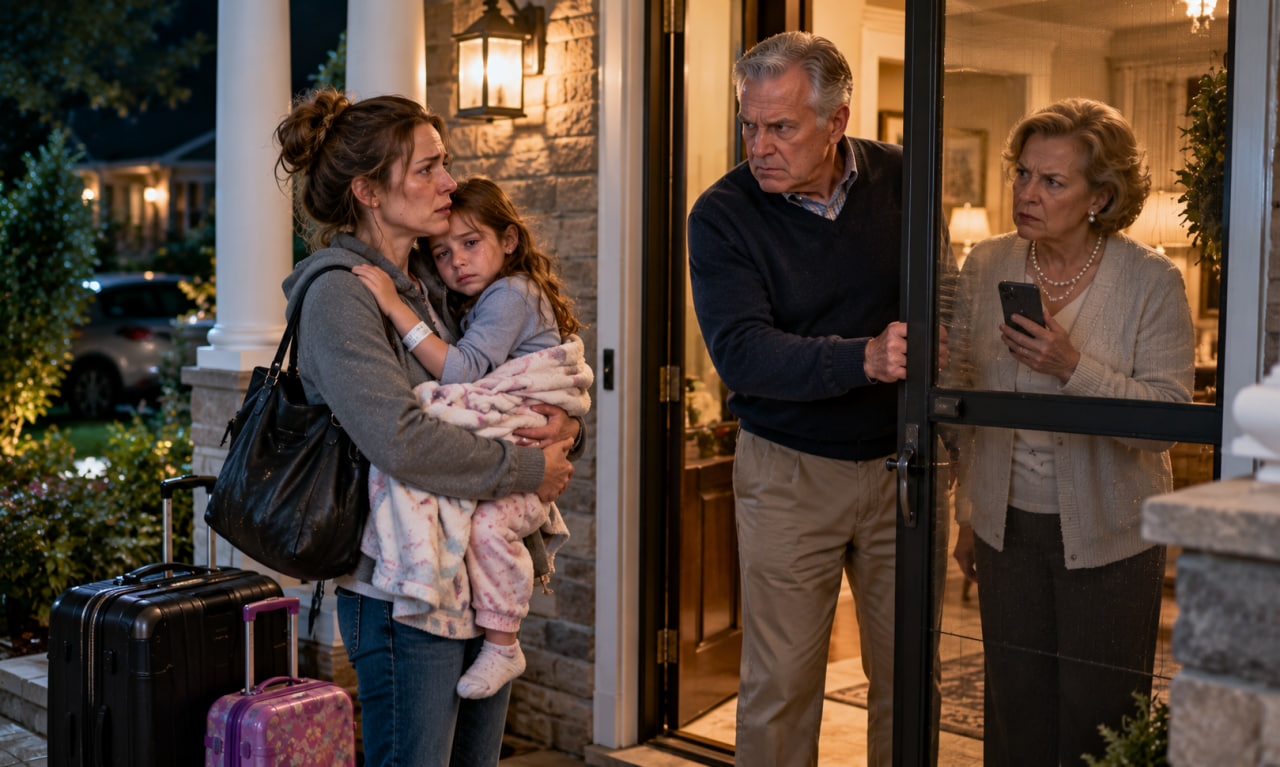
Love didn’t require a seven-year-old to beg for a bed.
Love didn’t turn a mortgage into a weapon.
Love didn’t make one person’s security depend on another person’s endless sacrifice.
I was still sad about my parents. I still wished they had chosen differently.
But I no longer needed to destroy my peace to protect their pride.
And for the first time in a very long time, I slept through the night.
PART 4: The Price of Being the Family’s Favorite Victim
Three months after we returned home, I received a letter from my mother.
It arrived on a Tuesday afternoon, tucked between a medical bill and a grocery store advertisement.
The envelope was cream-colored, and my name was written in her familiar handwriting.
For a few minutes, I simply stared at it.
I wondered whether she was finally ready to apologize.
Perhaps she had thought about Lily standing on the porch. Perhaps she had remembered the years I spent helping her without expecting anything in return. Perhaps she had realized that a mother should never make her daughter’s access to her own home conditional on a payment to someone else.
I opened the envelope carefully.
Inside was a handwritten letter.
Dear Daughter,
I never imagined that a disagreement about money could destroy our family. Your father and I have been through a very difficult time because of your decision to put us out of your house.
We are living in a small apartment now, and things are not as comfortable as they used to be.
Chloe is struggling, too. She says she has been having trouble sleeping because of what happened.
I hope that one day you will understand that parents sometimes have to make difficult decisions. We were trying to teach you responsibility and remind you that family comes first.
You have always been the strong one. We expected more from you because we knew you could handle it.
I hope you will consider helping us financially again. We are not asking for much, only enough to make things easier.
Your mother.
I read the letter twice.
There wasn’t a single sentence apologizing for what had happened to Lily.
Not one.
Instead, my mother had written a long explanation of how difficult my decision had made their lives.
I folded the letter and placed it on the kitchen table.
Then I sat down and cried.
Not because I wanted to send them money.
Not because I wanted to return to the way things had been.
I cried because some small, stubborn part of me had still hoped my mother would recognize what she had done.
I wanted her to say, I was wrong.
I wanted her to say, Lily deserved better.
I wanted her to say, I’m sorry I made you choose between protecting your child and keeping my approval.
But the apology never came.
That evening, after Lily had gone to bed, I called Sarah.
She listened while I read the letter aloud.
When I finished, she was quiet for a moment.
“Do you want my honest opinion?”
“Yes.”
“She still thinks the problem is that you stopped giving them money. She hasn’t even acknowledged why you stopped.”
I wiped my face.
“I know.”
“Then don’t answer until you know what you want to say.”
I looked at the letter again.
For years, I had responded to my mother’s disappointment by trying harder. I explained myself, apologized for things I hadn’t done, and gave money I couldn’t comfortably spare.
I had treated her approval like a prize I could earn if I just made enough sacrifices.
But I was tired of auditioning for a place in my own family.
The next morning, I wrote a response.
It was only four paragraphs.
I told my parents I hoped they were settling into their new apartment. I told them I was not going to resume paying their expenses or Chloe’s rent. I explained that I was willing to maintain respectful communication, but any future relationship would need to be built on mutual respect rather than financial pressure.
I ended with one sentence.
I love you, but love does not mean I must accept being mistreated.
Then I mailed the letter.
For the first time in my life, I didn’t spend the next several days wondering whether my mother would be angry.
I had finally said what I needed to say.
What she chose to do with it was no longer mine to control.
A month later, Chloe lost her apartment.
I found out from a mutual acquaintance, not from my sister herself.
Her landlord had followed the applicable legal process after months of unpaid rent. Chloe had to move her belongings into a friend’s garage while she searched for another place to live.
When I heard the news, my first reaction was guilt.
I thought about the money I could have transferred.
I thought about the emergency savings sitting in my account.
I thought about how easy it would have been to send a few thousand dollars and tell myself that I had saved my sister from embarrassment.