
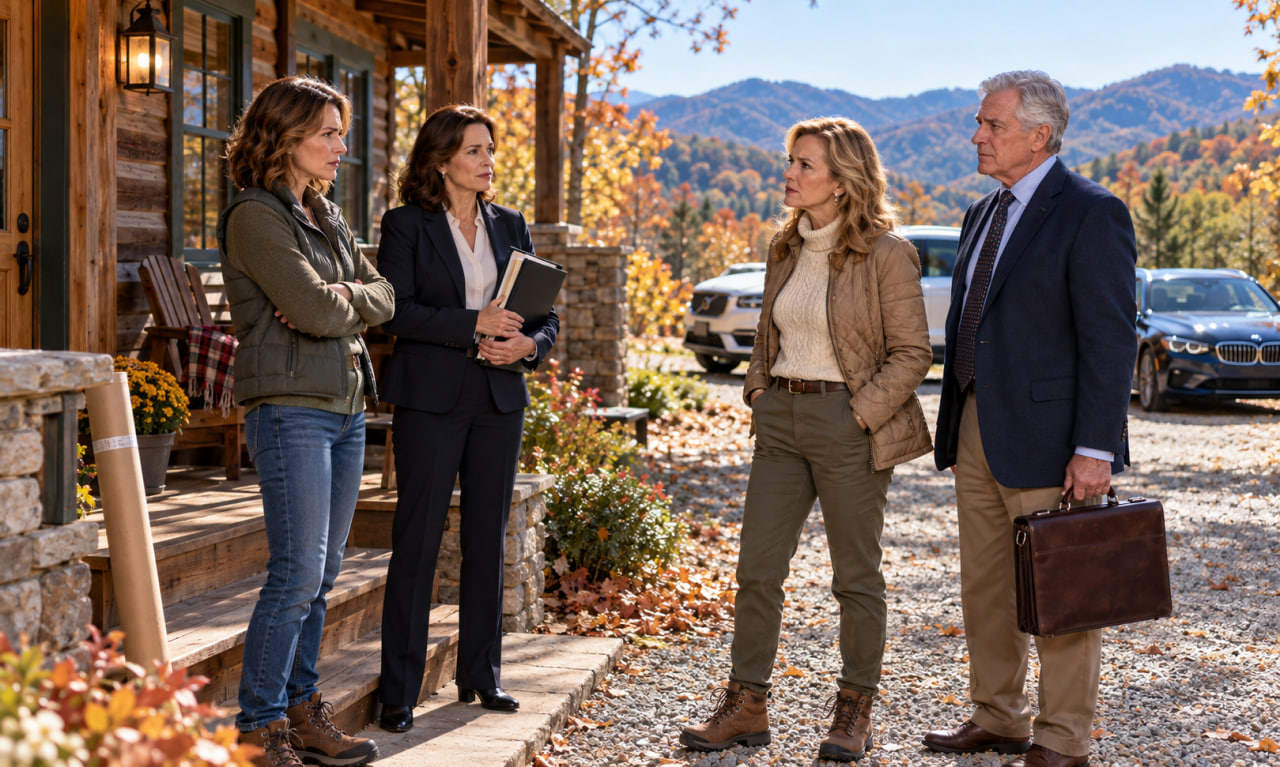
“No… why?”
Patricia lowered the phone.
“The county recorder just called.”
She took a slow breath.
“Someone filed a document against your property yesterday morning.”
PART 4
For a second, I honestly thought I had misheard her.
“A document?” I repeated. “What kind of document?”
Patricia’s expression had lost every trace of calm.
She put the call on speaker.
A woman introduced herself as Helen Morris, deputy recorder for the county clerk’s office.
“Ms. Bennett,” she said, “I’m calling because an affidavit affecting Parcel 18-4721 was presented for recording yesterday. During routine review, one of our clerks noticed irregularities involving the notarization.”
Patricia spoke first.
“Was it recorded?”
“It was accepted provisionally,” Helen replied. “But we immediately flagged it for investigation before it could be relied upon for any transfer.”
My hands tightened around the coffee mug.
“What does the affidavit say?”
There was a pause.
“It alleges that the current parcel is subject to an unresolved beneficial interest belonging to descendants of Elias Whitmore.”
Dara.
The name didn’t need to be spoken.
Patricia’s voice became precise.
“Who submitted it?”
“I’m afraid I can’t disclose that over an unsecured call, but I recommend your client come to the courthouse Monday morning.”
The line disconnected.
Neither of us spoke for several seconds.
Finally, Patricia looked at me.
“Did you authorize anyone to file anything?”
“No.”
“Did you sign anything recently besides work documents?”
“No.”
She nodded once.
“Then someone has just made a very serious mistake.”
I barely slept that night.
The mountains, usually peaceful, felt strangely watchful.
Every creak of the cabin sounded louder.
Around midnight, rain began tapping against the roof I had spent months repairing.
I walked through the house checking every window, not because I expected danger, but because anxiety needed somewhere to go.
At 6:15 Monday morning, Patricia and I left for the county courthouse.
The building sat on the town square between a brick post office and an antique bookstore.
Inside, Helen Morris was waiting with a sealed folder.
She led us into a private records room.
“I shouldn’t have to tell you,” she said quietly, “that filing a false property instrument can carry both civil and criminal consequences.”
She opened the folder.
The affidavit looked official.
County formatting.
Legal descriptions.
Parcel number.
Even my property address.
But the deeper we read, the stranger it became.
According to the document, the Whitmore heirs had unknowingly retained an equitable ownership interest that survived every subsequent sale.
It sounded impressive.
It was also legally absurd.
Patricia pointed to the final page.
“There.”
The notary seal.
Helen nodded.
“That’s what our clerk noticed.”
The seal belonged to a notary whose commission had expired almost eighteen months earlier.
Even worse, the signature of the supposed notary did not match the one on file.
Patricia looked up.
“This is forged.”
Helen answered carefully.
“We believe the notarization is invalid. Whether the entire document is fraudulent will be determined by investigators.”
Then she slid over the submission sheet.
Submitted by: Dara Whitmore.
I stopped breathing.
Not because I was surprised.
Because seeing my sister’s handwriting made it real.
Patricia immediately filed an objection requesting the affidavit be rejected and removed from the recording process.
By noon, the clerk issued a temporary suspension preventing the document from clouding my title while the investigation proceeded.
“It won’t affect your ownership,” Patricia assured me.
“But someone tried.”
I nodded slowly.
“Yes.”
She closed the folder.
“And now we need to find out why.”
That evening my phone rang.
Dara.
I answered.
“You went to the courthouse.”
“Yes.”
“You’re trying to make me look like a criminal.”
I laughed once, quietly.
“You filed a forged document against my property.”
“It wasn’t forged.”
“The notary expired eighteen months ago.”
Silence.
Then she said something I never expected.
“Martin handled that.”
“Who’s Martin?”
“My researcher.”
“You mean your attorney?”
“No.”
Another silence.
Finally, the truth emerged in pieces.
Richard Holloway had refused to file any lawsuit after visiting the cabin.
So Dara had hired someone else.
A man named Martin Kessler who called himself a historical property consultant.
He had promised to uncover forgotten ownership rights.
He charged her nearly twelve thousand dollars.
And when he couldn’t find evidence, he created paperwork that looked convincing enough to pressure me into negotiating.
I closed my eyes.
“Dara… he scammed you.”
“No.”
“He used you.”
“He said these claims happen all the time.”
“Did Richard ever agree with him?”
She didn’t answer.
Because she already knew.
Two days later, county investigators interviewed everyone involved.
Richard voluntarily provided his emails showing he had repeatedly advised Dara not to pursue litigation without evidence.
Helen produced the defective notarization.
Patricia submitted my complete title history.
The investigator asked me only one question that mattered.
“Did your sister ever ask you for money before filing this?”
I thought carefully.
“No.”
“So this wasn’t extortion?”
“I think,” I said slowly, “it was desperation disguised as certainty.”
The investigator wrote that down.
A week later, the county formally rejected the affidavit.
It never became part of my chain of title.
Martin Kessler disappeared before investigators could interview him.
His office had already been emptied.
Several other counties were reportedly reviewing similar complaints involving historical land claims.
Patricia sighed after reading the notice.
“He’s probably been doing this to multiple families.”
“So Dara wasn’t his first client.”
“I doubt it.”
I assumed that would be the end of my relationship with my sister.
I was wrong.
Three weeks before Christmas, Mom called crying.
“Please come.”
“What happened?”
“It’s Dara.”
Those three words carried thirty years of history.
I drove to our parents’ house.
For the first time in my life, Dara was sitting silently at the dining table before everyone else arrived.
No clipboard.
No schedule.
No opinions.
Just a woman staring into a cold cup of coffee.
When she saw me, she stood.
“I owe you an apology.”
I waited.
Not because I wanted to punish her.
Because apologies deserve enough room to become honest.
She took a folded cashier’s check from her purse.
“Twelve thousand dollars.”
I frowned.
“What’s this?”
“I sold my boat.”
“You had a boat?”
She almost smiled.
“Apparently I had a boat I never used.”
She pushed the check toward me.
“It won’t erase what I did. But it covers every legal bill you shouldn’t have had to pay because of me.”
I looked at Patricia’s invoices in my mind.
The amount was almost exact.
“You calculated it.”
“I asked Richard what these cases usually cost.”
Mom quietly wiped tears from across the kitchen.
Dad remained unusually still.
Then Dara said the sentence I had waited my entire childhood to hear.
“I spent so many years believing that taking care of the family meant controlling it.”
Her voice broke.
“I didn’t realize those were different things.”
I didn’t hug her immediately.
Healing isn’t that fast.
Instead, I sat across from her.
The same dining table where she had once criticized my decision to move away.
The same table where nobody defended me.
This time Dad finally spoke.