
“Did he ever deliver them?”
“We haven’t established that.”
“What about his death?”
“The medical examiner’s original report lists natural causes. We have no evidence at this stage that it was anything else.”
I took a slow breath.
“Then we need to leave that conclusion alone until the evidence supports changing it.”
“Agreed,” Rebecca said.
When I hung up, Chloe was staring at me.
“Dad found the same fraud?”
“It appears he found evidence of a related scheme.”
“And he died.”
“Yes.”
She covered her mouth.
I sat beside her.
“Chloe, we don’t know that the two events are connected. We are not going to turn a suspicion into a fact just because it frightens us.”
“But someone had his records.”
“Yes.”
“And Marcus was hiding them.”
“Yes.”
She looked at me with wet eyes.
“Why would he care about Dad?”
I thought about the photograph, the encrypted archive, and the email.
“Because your father may have left evidence that someone has spent years trying to keep hidden.”
Outside, the sky darkened.
Thanksgiving dinner was underway at Marcus’s house, but the guests were no longer laughing.
At 7:23 PM, Detective Ruiz sent me a brief update. The guests had been interviewed. Several had confirmed that Marcus had planned to announce a major personal change at dinner. One had seen a document folder on the dining-room table. Another had heard Sylvia tell a caterer that Chloe had left the family voluntarily.
The rug had been examined for blood and other trace evidence. Investigators had also recovered a brass candlestick with a damaged base. Testing would determine whether it was connected to Chloe’s injuries.
But the most important discovery was still the grandfather clock.
Inside its lower compartment, beneath a removable wooden panel, investigators had found a second envelope.
It contained a handwritten letter from Daniel.
Rebecca arranged for me to read it under supervision the following morning.
I arrived at the station shortly after nine.
The letter was dated twelve years earlier, three weeks before my husband’s death.
I recognized his handwriting immediately. The slight tilt of the letters. The way he crossed his sevens. The small ink blot where his pen had caught the paper.
My hands began to shake.
I read.
Eleanor,
If you’re reading this, I have either failed to deliver the evidence or decided that doing so would put you in danger. I am sorry for keeping this from you.
I found discrepancies in several construction contracts. The discrepancies were not clerical errors. Payments were being approved for equipment that was never delivered, and money was being moved through companies that existed only on paper.
Robert Voss appears to be the central figure, but I believe his brother Daniel is the one managing the financial records. Diane Mercer has been involved in approving certain transactions.
I copied the records because I could not prove what I had found from the company’s books alone.
I have been followed twice. Someone entered my office after hours and removed files from a locked cabinet. I don’t know how much they know about the copies.
There is one person who may be able to help. Her name is Margaret Shaw. She works in federal oversight and knows how to get evidence to the right people without exposing the source.
If I cannot deliver the records myself, find Margaret.
Please don’t blame yourself for any of this. You have always believed that truth is worth pursuing. I hope you still believe it when you read this.
I love you.
Daniel.
I lowered the letter.
For twelve years, I had carried the grief of losing my husband. I had mourned the life we might have shared, the retirement we had planned, the ordinary mornings we would never have again.
Now I had a different kind of grief: the knowledge that he might have spent his final weeks frightened and alone because he believed he was protecting me.
Rebecca waited quietly.
“Do you know Margaret Shaw?” she asked.
I shook my head.
“Not by that name.”
“Could it be someone from your old office?”
“Possibly.”
“Would you be willing to help us identify her?”
“Yes.”
I looked at the letter again.
Then I noticed something I had missed the first time.
A line written in the margin, almost hidden beneath the fold.
The second key is where we first promised forever.
I read it aloud.
Rebecca frowned.
“What does that mean?”
I closed my eyes.
Our wedding.
Daniel had proposed to me in a small botanical garden outside Philadelphia. We had returned there for our anniversary every year until work and family obligations made the trip difficult.
But that was not where we had first promised forever.
We had married at the old courthouse.
Afterward, we had gone to a tiny diner where Daniel had slid a brass key across the table.
“For the house,” he had said. “So you never have to ask permission to come home.”
The key had opened our first house, a narrow brick place with a red door.
We had sold it when Chloe was six.
I looked at Rebecca.
“The old house.”
“Is it still standing?”
“I don’t know.”
We found the address in an old folder. The property had changed hands twice, but the current owner agreed to let investigators examine the storage shed after Rebecca explained that the search concerned a criminal investigation and obtained the necessary authorization.
Inside the shed, behind a loose board, investigators found a small metal box.
It contained an old brass key, a handwritten ledger, and a sealed envelope bearing my name.
The ledger listed payments to shell companies, dates, and initials. Some matched the transactions found in Marcus’s company records.
Others went back nearly twenty years.
The envelope contained a second letter.
Eleanor,
The first ledger is incomplete. I could not risk keeping everything in one place.
The second set of records is not a list of payments. It is a list of people who knew what was happening and when they knew it.
I have hidden it somewhere I believe no one will think to look.
If Margaret has already received the first set, she will know what this means.
If she hasn’t, find her before Daniel Voss does.
I looked up.
“Who is Margaret Shaw?”
Rebecca was already checking her notes.
“We found a reference to a Margaret Shaw in an old federal oversight file. She later became an investigator with a government accountability office. She retired six years ago.”
“Can we contact her?”
“We’re working on it.”
The following afternoon, Margaret called.
Her voice was older, but I recognized the clipped precision of someone who had spent a career asking questions other people wanted to avoid.
“Eleanor Reed?”
“Yes.”
“I knew your husband.”
My throat tightened.
“Why didn’t you ever contact me?”
“Because Daniel asked me not to. He believed your work made you vulnerable to retaliation, and he thought keeping you away from the case was the only way to protect you.”
“Did you receive his evidence?”
“I received part of it. He brought me a set of records shortly before he died. I passed them to the appropriate investigators, but the case was already compromised. Witnesses changed their statements. Documents disappeared. Robert Voss was eventually convicted on other evidence, but the financial network was never fully dismantled.”
“And Daniel?”
“I never believed he was murdered. I did believe he was frightened. He told me that someone had threatened to expose your identity as a federal prosecutor if he continued cooperating.”
I felt cold.
“My identity?”
“He said they knew you were working on a related case. They believed you might recognize the financial patterns.”
“I never saw the records.”
“I know. Daniel wanted it that way.”
I looked at the ledger on the table.
“Do you know what the second set of records contains?”
“Yes. A list of the people who approved the payments, altered the invoices, or knowingly concealed the missing equipment.”
“Who has it?”
Margaret was silent for a moment.
“Daniel told me he had placed it in a location that was important to your family. He said it would be safe there because no one would associate it with the case.”
I looked toward the window.
Our old house was gone. The garden where Daniel had proposed had been redesigned. The courthouse had been renovated.
Then I remembered something.
Our wedding photograph.
It had hung in the hallway of every home we had ever lived in. After Daniel died, I had packed it in a box of keepsakes and placed it in the attic.
Behind the frame was a narrow wooden backing Daniel had built himself. He used to joke that it was a place for secrets too small to matter.
I called Chloe.
“Do you remember the wedding photograph in the attic?”
“Yes.”
“Do you remember your father repairing the frame?”
“Yes. He said the backing was loose.”
I closed my eyes.
“I’m going to need your help.”
That evening, with investigators present and the proper authorization in place, we opened the frame.
Behind the backing was a thin envelope containing a small memory card and a handwritten list.
The list contained fourteen names.
Diane Mercer was the fourth.
Daniel Voss was the first.
Marcus Hale was the twelfth.
I stared at the name.
Marcus had been a child when Daniel first investigated the fraud. He could not have been part of the original scheme.
But the list was dated two years before my husband’s death.
“How is that possible?” I whispered.
Rebecca examined the document.
“We need to establish the date and origin of this list. It may have been updated later, or someone may have added names.”
“Could Marcus have been connected to the network before he joined the company?”
“Possibly. We don’t know yet.”
I looked at the memory card.
“What’s on it?”
The digital evidence team recovered several files.
The first was a scanned copy of the original ledger.
The second was an audio recording.
The third was a video.
When it played, the image was dark and grainy. A man sat at a desk, his face turned partly away from the camera.
Daniel.
My husband.
Alive, tired, and speaking quietly into the lens.
“If you’re seeing this, I couldn’t get the records to Margaret.”
He paused and rubbed his eyes.
“I don’t know who has access to these files. I don’t know whether the people involved realize how much I have copied. But I need to say this clearly: the records show that the false invoices were approved by people inside the company and outside it. The money did not disappear by accident.”
He leaned toward the camera.
“Robert Voss is not the only person responsible. Daniel Voss controls the shell companies. Diane Mercer approved the transactions. There are others who used their positions to protect the scheme.”
He glanced toward the door.
“And one of them has been using my name.”
My breath caught.
Daniel continued.
“I found payments routed through an account connected to my old consulting work. I did not authorize them. Someone is trying to make it appear that I helped move the money.”
He swallowed.
“If anything happens to me, I want Eleanor to know that I did not betray her. I did not betray the law. I made mistakes, but I did not knowingly participate in this fraud.”
The video ended.
For several seconds, I couldn’t move.
Then I heard Chloe’s voice behind me.
“Mom?”
She had insisted on coming to the station with her doctor’s approval and a wheelchair. Her face was still bruised, but she was determined to hear the recording herself.
I turned toward her.
She was crying.
“He knew,” she whispered. “He knew someone was going to blame him.”
I knelt beside her chair.
“He wanted us to know the truth.”
“But he couldn’t tell you.”
“No.”
“Because he thought he was protecting you.”
I nodded.
Chloe reached for my hand.
“I hate that he was alone.”
“So do I.”
We stayed like that until Rebecca gently asked us to step out while the team secured the files.
The next morning, the case changed again.
The memory card’s metadata showed that the video had been created years after Daniel’s death.
I stared at the report.
“That can’t be right.”
Patel pointed to the file details.
“The file was copied onto the card recently. The recording itself could be older, but we need to establish the original creation date.”
“Can you verify the footage?”
“We’re examining it.”
Then the team found the detail that made the room go still.
The video had been recorded in a room with a window overlooking the blue house where I lived now.
Not the house Daniel and I had sold.
My current home.
The camera angle showed the porch, the small American flag, and the kitchen window where I had stood when Marcus called me at 5:02 AM on Thanksgiving morning.
I looked at Rebecca.
“Someone has been inside my house.”
Patel was already moving.
They searched the house and found no sign of forced entry. But a small wireless camera had been hidden inside the smoke detector in the hallway.
The device had been installed recently.
Someone had been watching me.
And someone had copied Daniel’s old recording onto a memory card and placed it inside the wedding photograph.
The question was no longer whether Marcus had access to my husband’s records.
The question was who had placed the camera in my home—and why.
At 11:32 AM, the answer began to emerge.
A technician traced the camera’s transmission to a device registered to a private security company. The company had been hired by Diane Mercer to monitor several executives suspected of leaking procurement records.
But the account had been accessed from a terminal inside Marcus’s office.
When investigators examined the company’s internal correspondence, they found an email from Diane to Marcus dated three weeks earlier.
Your mother-in-law’s old case files may be relevant. Find out what she kept. Do not approach her directly.
Marcus had not been acting alone.
He had been searching for the records because someone above him feared that my husband’s old evidence could expose the entire network.
But the email did not explain why Daniel’s recording had been copied recently, or why the camera had been installed in my home.
Then Vanessa came forward with a final piece of evidence.
She had recovered a deleted message from Diane’s phone backup. It contained a photograph of the wedding frame and a short instruction:
The list must be found before Eleanor understands what it means.
The message had been sent two days before Thanksgiving.
Diane had known about the hidden records.
And she had known I was close to finding them.
At 1:18 PM, federal agents executed a search warrant at Diane’s office.
They recovered accounting records, correspondence, and a set of handwritten notes describing payments to shell companies. Several notes matched Daniel’s ledger.
Diane was arrested on charges related to the procurement fraud, with additional charges under investigation.
Marcus was charged separately for the assault on Chloe and faced further scrutiny for his alleged role in the fraudulent invoices. The evidence suggested that he had helped conceal missing equipment and had knowingly submitted false records. Those allegations would have to be proved in court.
Sylvia was charged in connection with her alleged participation in the assault and the effort to conceal what had happened. Her lawyers denied the allegations.
The cases would take months to resolve.
But the immediate danger had passed.
For the first time since Thanksgiving morning, I slept through the night.
Six months later, Chloe stood on the porch of my blue house with a cup of coffee in her hand.
The bruises had faded. Her finger had healed, though it ached in cold weather. She had returned to engineering work on a reduced schedule and was seeing a therapist who specialized in domestic abuse.
She had also filed for divorce.
The process was difficult. Marcus’s lawyers challenged the evidence, disputed the timeline, and argued that the injuries were accidental. But the terminal footage, medical findings, messages, and testimony from witnesses built a strong case.
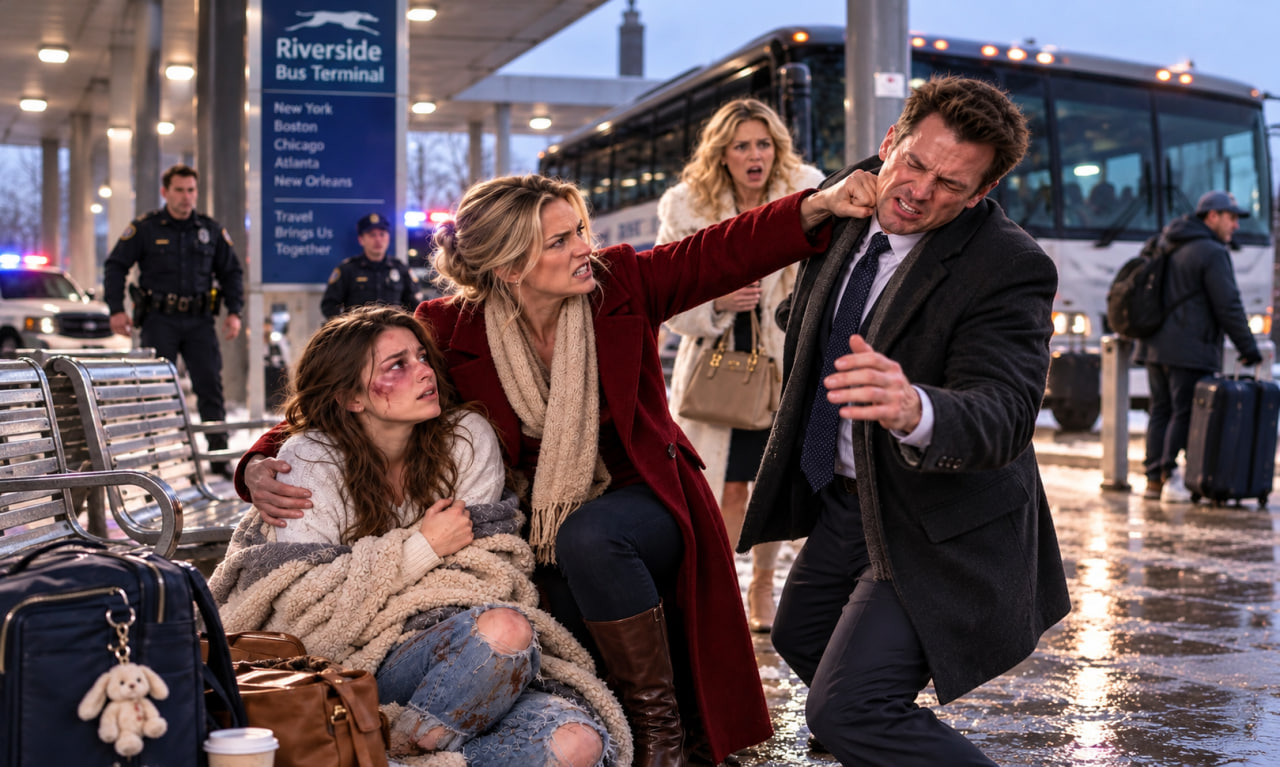
Marcus eventually pleaded guilty to the assault charges and admitted that he had abandoned Chloe at the terminal after an argument. He was sentenced to prison and ordered to pay restitution for her medical expenses.
The federal fraud investigation continued. Vanessa cooperated, providing the recording and financial records. She admitted her own failures to verify invoices and accepted responsibility for the approvals she had made. Her cooperation helped investigators establish which transactions she had knowingly approved and which had been entered using her credentials without her knowledge.
Diane Mercer was convicted of conspiracy and fraud. Several other people were charged as the investigation uncovered the full network.
The old evidence Daniel had gathered did not solve every question, but it helped investigators connect the past to the present. The case established that he had been a whistleblower, not a participant in the fraud.
His death was reviewed by the appropriate authorities. They found no reliable evidence that it had been caused by a criminal act. The conclusion remained that he had died of natural causes.
That answer hurt in its own way.
There was no hidden killer to confront, no final confession that could restore the years we had lost. Only a man who had been afraid, who had tried to do the right thing, and who had carried too much of that burden alone.
One afternoon, Chloe found me sorting through the boxes of documents that had been returned after the investigation.
She held up an old photograph of her father and me standing outside the courthouse on our wedding day.
“Do you ever wish you’d known?” she asked.
I looked at Daniel’s face.
“Yes.”
“Do you wish he’d told you everything?”
“Yes.”
She sat beside me.
“But if he had, you might have been in danger too.”
“Perhaps.”
She rested her head on my shoulder.
“I think he wanted you to have a life outside his fear.”
I kissed the top of her head.
“I think so too.”
A week later, Vanessa visited us.
She came without flowers or excuses. She sat at the kitchen table and apologized to Chloe directly.
“I knew you were a real person,” she said. “I chose to act as though you were an obstacle instead. I can’t undo that.”
Chloe listened quietly.
“I don’t forgive you yet,” she said.
Vanessa nodded.
“I understand.”
“But I don’t want to spend the rest of my life hating you either.”
Vanessa’s eyes filled.
“Thank you for saying that.”
It wasn’t forgiveness. Not yet.
It was a beginning.
Vanessa had lost her job and faced professional consequences for her role in the false approvals. She found work later in compliance at a small company, where she began rebuilding her career under closer supervision. She kept in contact with investigators when needed and did not ask Chloe to make her feel better about the choices she had made.
That mattered.
One evening, Chloe and I sat on the porch while the sun slipped behind the trees.
The little American flag stirred in the breeze.
“I used to think you were invincible,” Chloe said.
I laughed softly.
“Me?”
“You always knew what to do. You never seemed frightened.”
“I was frightened plenty of times.”
“You never showed it.”
“Because I thought I had to be strong for everyone else.”
She looked at me.
“Did it work?”
I considered the question.
“Sometimes. Other times, it just made people think I didn’t need help.”
She nodded slowly.
“I think I did that too.”
We sat quietly for a while.
Then she asked, “Do you ever miss being a prosecutor?”
“Every now and then.”
“Would you go back?”
“No. But I might teach young lawyers how to recognize a case built on fear rather than facts.”
She smiled.
“You’d be good at that.”
“I’d be unbearable.”
“You already are.”
We laughed, and the sound surprised us both.
It was the first time in months that laughter had come without effort.
Later that night, I took the old lockbox from the closet.
Inside were my retired badge, my federal credentials, and a photograph of Daniel holding a newborn Chloe in the hospital. His smile was so wide that his eyes had nearly disappeared.
I placed the photograph beside the badge.
For years, I had kept those two parts of my life separate. My career belonged to the past, and my family belonged to the present. I had believed that leaving the courtroom meant leaving behind the part of myself that knew how to confront danger.
But the truth was simpler.
The badge had never made me brave.
The work had taught me to be patient, to ask questions, to preserve evidence, and to keep going when the answers were painful.
The people I loved had taught me why those things mattered.
I closed the lockbox.
Then I turned off the kitchen light and looked through the window at the quiet street.
Marcus had believed my age made me harmless.
Sylvia had mistaken my silence for weakness.
Diane had assumed the past could be buried.
And I had believed that protecting my daughter meant waiting for her to ask for help.
We had all been wrong.
But Chloe was alive. She was rebuilding her life. The truth about Daniel had been established, and the people who had tried to conceal the fraud were facing the consequences of their choices.
It was not a perfect ending.
It was something better.
It was an honest one.
On the first Thanksgiving after the trial, Chloe and I made dinner together in the blue house. She insisted on preparing the turkey, though she checked the temperature so many times that I threatened to confiscate the thermometer.
We baked pumpkin pie. We spilled cinnamon beside the stove. We placed Daniel’s photograph on the mantel.
At five in the afternoon, Chloe brought two plates to the table.
She paused beside the empty chair where her father used to sit.
“Do you think he’d be proud of us?” she asked.
I looked at her.
“Yes,” I said. “Not because we won. Because we kept telling the truth when it would have been easier to hide.”
She smiled through her tears.
Then she reached for my hand.
Outside, the flag moved gently in the evening wind.
For the first time in a long time, the house felt like a place where nothing had to be hidden.
And when Chloe raised her glass, I raised mine with her.
“To the people who stay,” she said.
I squeezed her hand.
“To the truth,” I answered.
And for once, neither of us had to be afraid of what came next.
THE END