
I followed his recommendations.
For the first time, I understood that independence did not mean refusing every restriction.
It meant making informed choices instead of allowing someone else to make them for me.
I also started taking a weekly exercise class at the community center. Wilma came with me, mostly because she claimed the instructor was handsome.
He was seventy-two, married, and had a hearing aid.
Wilma said those were minor details.
I began walking to the library, visiting the farmers’ market, and riding Ruby along quieter streets during daylight hours.
Sometimes Brian drove me to appointments.
Sometimes I took the bus.
Sometimes I stayed home because I wanted to.
That last part mattered more than I expected.
For months, I had felt that every choice I made was being measured against my age. If I went out, I was risking something. If I stayed home, I was becoming frail. If I asked for help, I was dependent. If I refused it, I was stubborn.
I was tired of being treated like a problem that needed solving.
I was still Evelyn Bennett.
I liked crossword puzzles, cinnamon toast, old movies, and the sound of rain against the kitchen window.
I liked gardening before breakfast and having coffee with Wilma on Fridays.
I liked my son, even when he frustrated me.
And I liked the fact that I could still learn new things.
One afternoon, I rode Ruby to the grocery store. I parked her near the entrance and went inside.
A young woman in her twenties held the door open for me.
“That’s a beautiful bicycle,” she said.
“Thank you. She’s a good girl.”
The woman smiled.
“I’m thinking of buying one for my grandmother. She says she’s too old to learn.”
“Tell her that I learned at seventy-six.”
“Really?”
“Really.”
The woman thanked me and went on her way.
I stood for a moment beside the shopping carts, smiling at nothing in particular.
Perhaps my bicycle would never take me as far as my Buick had.
Perhaps there would come a day when I could no longer ride it, either.
But that day had not arrived.
And I was done mourning things I had not yet lost.
By early spring, Brian had changed in small but meaningful ways.
He called before visiting.
He asked whether I wanted him to handle certain errands instead of simply doing them.
When he disagreed with me, he explained his concerns and listened to my response.
Sometimes we still argued.
One Saturday, he arrived at my house and found me carrying a bag of garden soil from the shed.
“Mom, let me take that.”
“I can carry it.”
“It’s heavy.”
“So am I, and I manage that every day.”
He laughed despite himself.
“Please let me help.”
I handed him the bag.
Not because he had ordered me to.
Because I had decided to.
That distinction became the foundation of our new relationship.
We also reviewed my financial arrangements with Mr. Collins. I updated my will, confirmed that my accounts were properly documented, and made sure any future authority to act on my behalf would be clearly defined and based on my wishes.
Brian was not excluded from my life.
He was simply no longer allowed to confuse being included with being in charge.
One evening, as we sat on the porch, he asked me something unexpected.
“Mom, do you think Dad would be disappointed in me?”
I looked at him.
“Why would he be?”
“Because I treated you that way.”
I considered the question.
“Your father could be stubborn,” I said. “He once spent three hours trying to repair a toaster that cost less than the replacement parts.”
Brian laughed.
“And when I told him he was wasting his time, he said that wasn’t the point. The point was that he wanted to finish what he’d started.”
I looked toward the garden.
“Your father loved you. He would want you to learn from your mistakes, not spend the rest of your life punishing yourself for them.”
Brian nodded.
“I wish I could ask him what to do.”
“So do I, sweetheart.”
We sat in silence for a while.
Then he said, “I miss him.”
I reached over and rested my hand on his.
“Me too.”
It was a small moment, but something shifted between us.
For the first time, we were not a frightened son trying to control his mother or an angry mother trying to prove her independence.
We were two people who had lost someone we loved and were learning how to live with that loss together.
Almost a year after my birthday, Brian invited me to lunch.
He chose the same supper club where he’d taken my keys.
When I arrived, he was waiting at a table near the window.
He stood when he saw me.
“Happy birthday, Mom.”
“My birthday is tomorrow.”
“I know. I wanted to beat everyone else to it.”
There was a small gift beside his plate.
I sat down.
“What’s that?”
“Open it.”
Inside was a framed photograph.
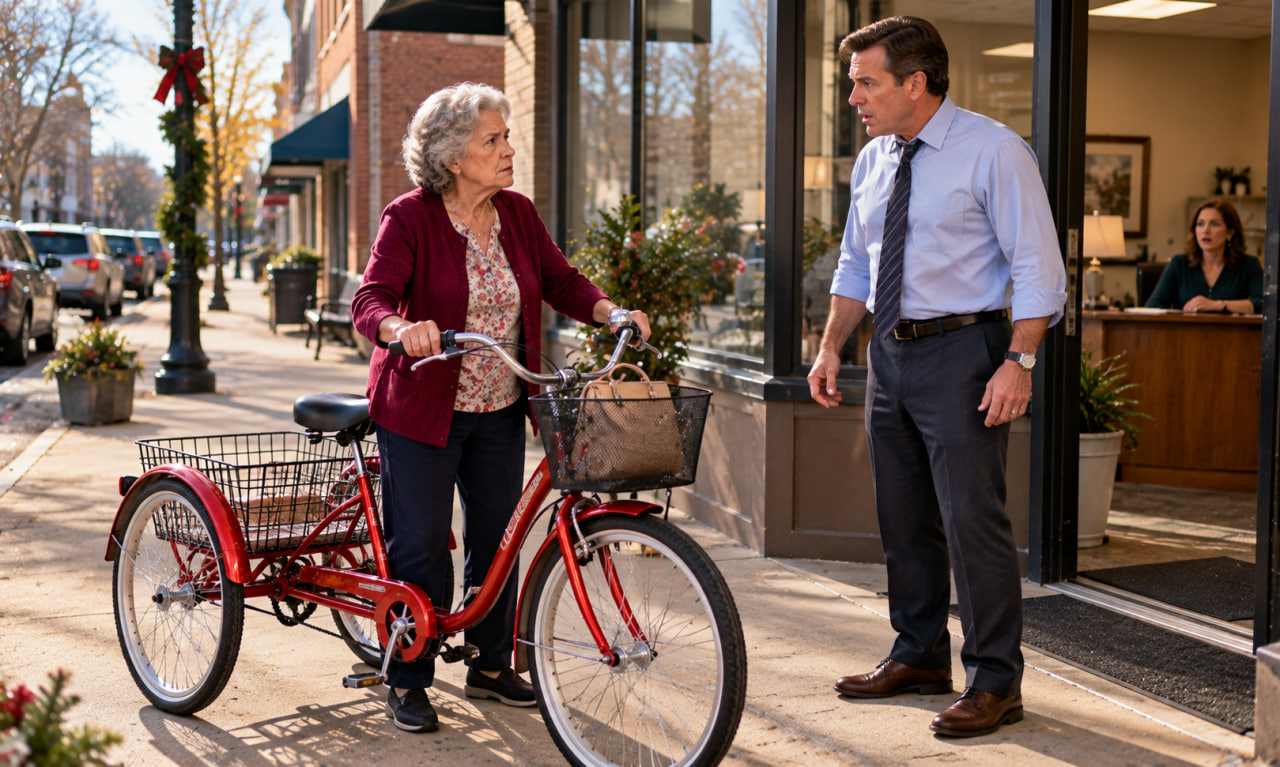
It showed me on Ruby, riding down Main Street with my cardigan buttoned to the neck and my purse in the basket. My hair was blowing in the wind, and my face was turned toward the camera.
I looked ridiculous.
I also looked happy.
“Where did you get this?”
“Linda took it from the office window that morning. She sent it to me a few weeks ago.”
I studied the photograph.
In the background, Brian stood outside his office, staring at me with an expression that seemed to contain fear, embarrassment, and something else I couldn’t quite identify.
“What were you thinking that day?” I asked.
He looked at the picture.
“That I had no idea what to do.”
“And now?”
He smiled faintly.
“Now I know I should have asked you.”
I put the photograph back in its frame.
“That’s a good start.”
He took a deep breath.
“There’s something else I want to tell you.”
I waited.
“I’ve been thinking about Dad’s title paperwork. I helped you put my name on the Buick because I thought it would make things easier after he died. I never imagined I’d use it to make a decision you didn’t agree with.”
“I know.”
“I should have checked with you first.”
“Yes.”
He nodded.
“I can’t change what happened. But I want you to know that I understand why you were hurt.”
I looked at him for a long moment.
Then I reached across the table and took his hand.
“Brian, I don’t need you to spend the rest of your life feeling guilty. I need you to remember this the next time you’re tempted to make a decision for someone because you’re afraid.”
He squeezed my hand.
“I will.”
Our food arrived, and we talked about ordinary things: the grandchildren’s school projects, Megan’s new job, Wilma’s latest argument with the community center instructor.
We laughed.
We ate.
And for the first time in a long time, lunch felt like lunch rather than a family meeting.
When we finished, Brian walked me outside.
Ruby was parked near the entrance.
He looked at the bicycle, then at me.
“Do you need a ride home?”
I considered the question.
“No, thank you. It’s a nice day.”
“All right.”
He paused.
“Would you mind if I rode with you for a little while?”
I stared at him.
“You want to ride a bicycle?”
“Not that one. I’m not sitting in the little back seat.”
“Coward.”
He laughed.
“I was thinking I’d walk beside you.”
I smiled.
“That’s what you used to do when you were little.”
“I remember.”
For a moment, I saw him at six years old, walking beside me along the sidewalk, his small hand reaching for mine whenever he felt uncertain.
We began moving down the street, Ruby’s red wheels turning steadily beneath me while Brian walked at my side.
He didn’t hold the handlebars.
He didn’t tell me which way to turn.
He simply walked beside me.
And that was exactly what I had wanted from him all along.
On my seventy-seventh birthday, I received three gifts.
Wilma gave me a bright yellow raincoat.
Megan gave me a book of crossword puzzles.
Brian gave me a small envelope containing a handwritten letter.
I read it alone that evening.
Dear Mom,
Last year, I thought loving you meant preventing anything bad from happening to you. I thought if I could remove every risk, I could keep you safe forever.
I was wrong.
I can’t promise that you’ll never fall, never get sick, or never need help. I can’t promise that life will always be easy.
But I can promise that I’ll ask before I act. I’ll listen before I decide. And I’ll remember that being your son means standing beside you, not standing in front of you.
I’m sorry I took your keys.
I’m even sorrier that I made you feel you had to prove you were still capable of living your own life.
I love you, Mom.
Brian
I folded the letter carefully and placed it in the drawer beside my husband’s old watch.
Then I went outside.
Ruby stood beneath the porch light, her red frame shining in the darkness.
I rang the bell.
Its bright little sound carried across the quiet street.
The following morning, I rode to the grocery store, bought fresh flowers, and stopped by the cemetery to visit Thomas.
I placed the flowers beside his headstone and told him about Brian, the bicycle, and everything that had happened during the past year.
“I think our boy is finally growing up,” I said.
The wind moved softly through the trees.
I smiled.
“I wish you could have seen him walking beside me.”
Then I climbed back onto Ruby and rode home.
I was seventy-seven years old. My knees ached when the weather changed, and I sometimes forgot why I’d walked into a room. I had good days and difficult ones, just like everyone else.
I knew there would come a time when I would need more help.
When that day arrived, I hoped I would have the wisdom to accept it.
But I also hoped my family would have the wisdom to ask what I needed before deciding what was best for me.
Because growing older does not mean a person stops being a person.
It does not erase a lifetime of choices, memories, mistakes, courage, or dreams.
And love should never become a cage simply because someone is afraid of what might happen outside it.
Brian had sold my Buick for $4,200.
He could never buy back the exact morning he took my keys, or undo the humiliation I felt sitting beside my birthday cake while my own son decided that my life belonged in his hands.
But he could learn.
And I could forgive him without pretending what he’d done was right.
That was our second chance.
Not a perfect family, not a perfect son, and not a perfect mother.
Just a family learning to love one another better.
As for Ruby, she carried me through another summer, another autumn, and another winter.
And whenever someone asked why a woman my age rode a three-wheeled bicycle through town, I gave them the same answer.
“Because I can.”
Then I rang the bell and kept going.
The End.