
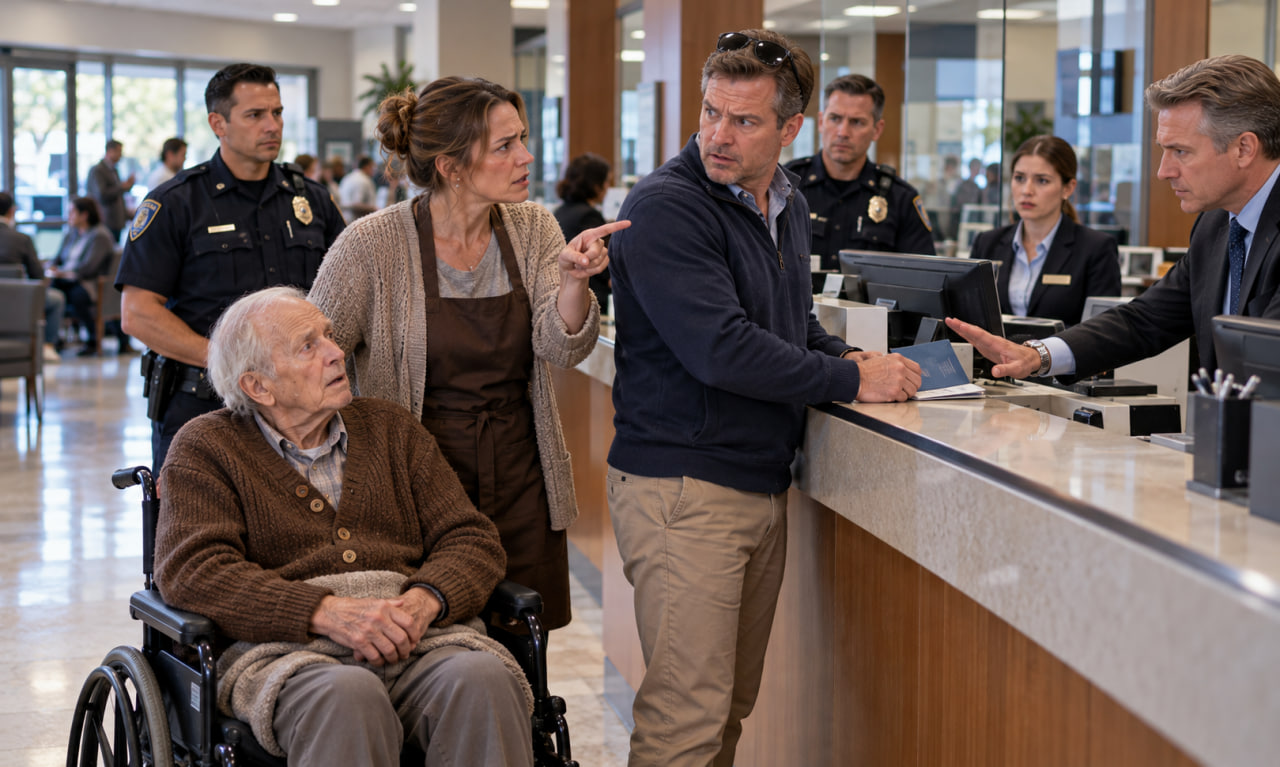
He told me to send him everything and said he would advise me on the appropriate steps to protect Dad’s interests.
Then I stepped outside the records office and leaned against the wall.
For several minutes, I couldn’t move.
The pension withdrawals were bad enough.
But this was different.
Hugh hadn’t merely taken money that should have paid for Dad’s care.
He had approached the one thing Dad had spent his entire working life trying to secure.
The house.
The place Dad had always called ours.
I called Hugh.
He answered on the fourth ring.
“What now, Claudia?”
I could hear traffic in the background.
“Why did you file an application concerning Dad’s house?”
Silence.
Then a sharp laugh.
“I don’t know what you’re talking about.”
“I have the documents.”
Another pause.
“You went digging through private records?”
“They belong to Dad.”
“Exactly,” Hugh snapped. “Dad’s property. Dad’s decisions. You don’t own him just because you got some court paperwork.”
“Then why did you tell the authorities you had permission to handle his property?”
“Because somebody has to take responsibility!”
“Responsibility?” I repeated. “You emptied his pension account.”
“I told you, I borrowed the money!”
“And you tried to obtain authority over his house.”
“I was trying to help him!”
“Help him do what?”
He hung up.
I stood outside the records office, staring at my phone.
Then a message arrived.
It was from Hugh.
You don’t know the whole story. Ask what Mom did before you accuse me of everything.
I read it once.
Then again.
My first instinct was to call him back.
Instead, I looked at the photograph of Mom’s letter saved on my phone.
I have made arrangements to protect the house and what little savings we have left.
I hope I will never need to explain why.
I had always believed Mom’s estate was simple.
She had left the house to Dad, and he had continued living there.
There had been no dramatic family meeting, no hidden fortune, no complicated inheritance battle.
At least, that was what I remembered.
But Mom’s letter suggested something else.
Something she had never told us.
I called the lawyer again and explained the message.
He listened carefully.
“Don’t assume your brother is telling the truth,” he said. “But don’t dismiss the possibility that there are documents you haven’t seen. We need to find out what your mother actually arranged.”
I agreed.
Then I remembered the storage receipt.
The blue folder.
The brass key.
And the words Mom had written before she died.
Love should never require you to surrender everything you have.
I looked up at the pale morning sky.
For the first time, I wondered whether the secret Mom had hidden wasn’t simply about protecting Dad from Hugh.
Perhaps it was about protecting Hugh from something he had done long before the pension withdrawals began.
And if that was true, the next thing I discovered could change everything I believed about my family.
PART 4
The next morning, I drove to the storage facility with the brass key and my mother’s old receipt.
The manager verified my identity and led me to a small unit at the end of a quiet corridor. Inside were several cardboard boxes, an old suitcase, and a blue folder resting on a metal shelf.
My hands trembled as I opened it.
There were bank statements, legal documents, and a letter addressed to both Hugh and me.
I read it slowly.
Eight years earlier, Mom had discovered that Hugh was struggling with serious debts. He had borrowed money from several people and hidden the truth from Dad. Mom had quietly paid some of those debts, but she had refused to let him sell the family house to solve his financial problems.
She had arranged for the house to be protected through a legal agreement, ensuring that Dad could continue living there and that its value would be preserved for his care.
But the most painful discovery was in the final pages.
Mom had left a portion of her own savings in a separate account specifically for Dad’s medical expenses.
The account was not a fortune, but it was enough to help provide for him in his final years.
And according to the latest statements, money had recently been withdrawn from it.
The records showed that Hugh had obtained access using documents he claimed Dad had authorized.
I sat down on an old wooden chair, tears filling my eyes.
Hugh hadn’t simply taken the pension.
He had been reaching into the money Mom had carefully protected for Dad, too.
I called the lawyer immediately.
Within days, he helped me submit the documents to the appropriate authorities. The bank preserved the relevant records, and the property office placed the disputed application under review.
When the police questioned Hugh again, his explanations began to fall apart.
Eventually, he admitted that he had used much of Dad’s pension to pay his personal debts. He also admitted that he had hoped to use the house as security for another loan.
He insisted he had intended to repay everything.
But good intentions could not undo the harm he had caused.
The investigation continued, and Hugh was required to answer for his actions. The disputed property application was stopped, and steps were taken to protect Dad’s remaining assets.
For the first time in months, I could concentrate on caring for my father without wondering whether his next prescription would be paid for.
Still, one thing remained unresolved.
My brother.
Two weeks later, Hugh appeared at our front door.
He looked different. His expensive watch was gone, his clothes were wrinkled, and the confidence he had always carried seemed to have disappeared.
“Can I see Dad?” he asked.
I hesitated.
Then I stepped aside.
Dad was sitting by the window, holding an old photograph of Mom. When Hugh approached, Dad looked up with a gentle smile.
“Hello, son,” he said. “Have you come home from work?”
Hugh’s face crumpled.
He knelt beside the wheelchair and began to cry.
“I’m sorry, Dad.”
Dad reached out and touched his cheek.
“Don’t cry. Everything will be all right.”
Those words broke something inside Hugh.
He bowed his head and wept like the little boy Dad used to carry on his shoulders.
I stood in the doorway, remembering all the years Dad had worked to give us a better life. I wanted to hate Hugh. Part of me still did.
But I also understood that forgiveness and trust were not the same thing.
When Hugh finally stood, he turned to me.
“I know saying sorry doesn’t fix anything,” he whispered. “I’ll cooperate with the investigation. I’ll repay what I can. I don’t expect you to forgive me.”
For once, I believed he understood the seriousness of what he had done.
“I hope you keep your word,” I said. “But Dad’s care will always come first. If you want to be part of his life, you have to prove that he can be safe with you.”
He nodded.
I didn’t embrace him. I didn’t tell him everything was forgiven.
That would take time, and perhaps some things would never be the same.
But I let him sit with Dad for a while.
Sometimes, that was enough for one day.
THE BEST ENDING: WHAT DAD REMEMBERED
Several months later, Dad’s condition worsened. His memory faded further, and he needed more help with even the simplest tasks.
But his pension was protected, his medical expenses were covered, and the house remained his home.
I continued working at the bakery every morning. Lupita stayed with Dad during my shifts, and I arranged my life around the little moments that still brought him happiness.
One Sunday afternoon, I found Hugh sitting beside Dad in the garden.
He was helping him water the flowers Mom had planted years ago.
Neither of them noticed me watching.
Hugh gently adjusted Dad’s sweater, which had been buttoned incorrectly.
Dad laughed.
“You always were a messy boy.”
Hugh smiled through tears.
“Yes, Dad. I suppose I was.”
Then Dad reached for his hand.
“Take care of your sister,” he murmured. “She’s always looking after everyone.”
Hugh looked toward me.
For a moment, neither of us spoke.
Our father might not remember our birthdays anymore. He might forget our names, confuse yesterday with thirty years ago, or ask when he could return to a job he had retired from long before.
But somehow, the love he had spent a lifetime giving us was still there.
That evening, I sat beside his bed and held his hand.
“Dad, do you know who I am?”
He studied my face for a long time.
Then he smiled.
“Of course,” he whispered. “You’re my little girl.”
I pressed his hand against my cheek and cried.
Not because he had forgotten so much.
But because, for one beautiful moment, he had remembered enough.
My brother had taken money, broken trust, and nearly endangered the home our parents had worked their whole lives to protect.
He couldn’t erase those choices with an apology. He still had to face the consequences and rebuild what he had destroyed.
But Dad’s final years would not be spent abandoned, without medicine, or wondering whether he had somewhere safe to sleep.
I had made sure of that.
And as I watched Dad drift peacefully to sleep, I finally understood the greatest lesson my mother had left behind.
A family is not protected by sharing the same blood. It is protected by the people who refuse to let love become an excuse for cruelty.
Hugh had been given another chance to become the son our father deserved.
Whether he truly changed would be his responsibility.
Mine was simpler.
I would keep showing up.
Just as Dad had always shown up for us.
And that was how I chose to honor him—not by letting his money define his final years, but by making sure he never had to question whether he was loved.
Because Dad might eventually forget almost everything about his life.
But I would never let him forget that he mattered.
THE END