
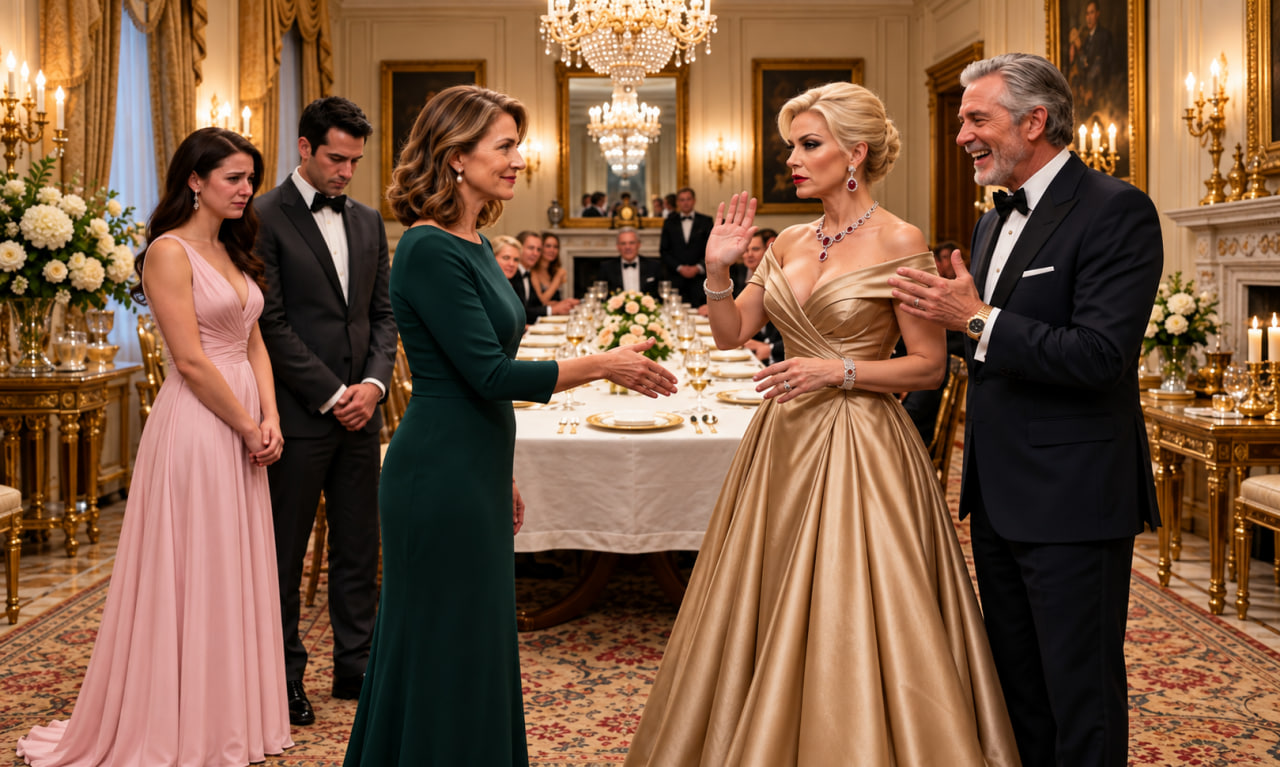
“YOU’RE NOT IMPORTANT ENOUGH TO SPEAK TO ME!” my daughter’s future mother-in-law snapped before thirty wealthy guests. Her husband laughed, “Perhaps you’d be more comfortable with the staff.” My daughter nearly cried. I smiled, took out my phone, and said, “Michael, cancel the $420 million acquisition. Immediately.” Seconds later, her husband’s phone rang, and his face went deathly pale. “WAIT… YOU’RE CATHERINE BENNETT?!” he gasped. But the worst news was still to come…
“You’re not important enough to speak to me,” my daughter’s future mother-in-law declared, interrupting my introduction.
Thirty wealthy guests fell silent.
The woman insulting me clearly had no idea who was funding her husband’s billion-dollar ambitions.
I’m Catherine Bennett, fifty-eight, widowed, and founder of a Boston-based private investment firm.
But that night, I was simply Emma’s mother.
My daughter was engaged to Andrew Whitmore, the charming thirty-two-year-old son of two prominent business executives.
His father, Richard Whitmore, headed a manufacturing conglomerate, while his mother, Victoria, ran a luxury retail company as CEO.
They owned mansions, collected valuable artwork, and treated ordinary people like furniture.
I’d accepted an invitation to their engagement dinner at their estate near Greenwich, Connecticut.
Emma had warned me about their difficult personalities.
I hadn’t anticipated such cruelty.
When Victoria asked about my profession, I smiled.
“I work in investments, primarily helping businesses grow.”
She studied my plain navy dress.
“How quaint.”
I offered my hand.
“Catherine Bennett. It’s lovely to finally meet you.”
She ignored it.
Instead, she turned to another guest.
“You’re not important enough to speak to me.”
Someone laughed awkwardly.
Emma flushed bright red.
“Victoria, that’s my mother!”
“Precisely,” Victoria answered. “And she should understand that certain conversations are above her station.”
Andrew stared into his champagne glass.
He remained silent.
Richard approached with a smile.
“Come now, Victoria. We shouldn’t embarrass our guests.”
Then he faced me.
“Perhaps you’d be more comfortable speaking with the household staff.”
Tears filled my daughter’s eyes.
I felt a sudden chill.
For twenty-seven years, I’d developed my investment firm after my husband’s sudden death.
I’d raised Emma alone, worked eighteen-hour days, and quietly acquired controlling interests in several successful companies.
I never flaunted my fortune.
Wealth didn’t impress me.
Character mattered.
And the Whitmores had shown me exactly who they were.
I retrieved my phone.
Richard chuckled.
“Calling your driver?”
“No,” I answered.
I dialed my chief investment officer.
“Michael, cancel the Whitmore acquisition.
Withdraw our preliminary offer and suspend further negotiations.”
Richard’s smile disappeared.
Victoria turned.
“What did you just say?”
I returned my phone to my purse.
“Exactly what you heard.”
Then Richard’s phone rang.
The moment he recognized the caller, his expression was priceless.
Richard answered with trembling hands.
“Michael? What’s happening?”
His expression shifted as he listened.
“Withdrawn? That’s impossible!”
Victoria approached him.
“Richard, what’s going on?”
He stared at me.
“Who are you?”
I held his gaze.
“The woman you suggested should speak with your household staff.”
Emma looked bewildered.
“Mom?”
I squeezed her hand.
“It’s all right, sweetheart.”
Richard lowered his phone.