
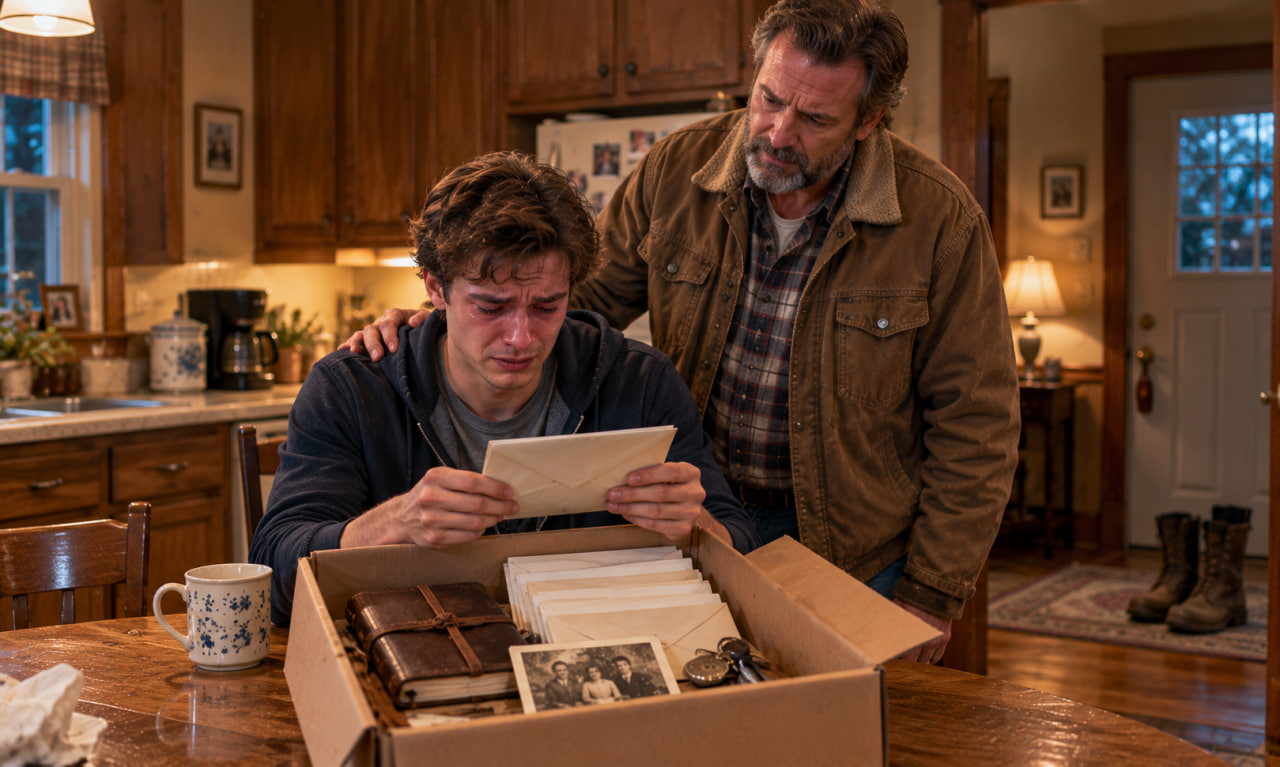
My heart began to pound.
“What did he buy?”
“A small property on the other side of town. Nothing fancy. It used to be an old repair shop with a little apartment upstairs.”
I stared at him.
“Why would Dad buy a repair shop?”
“Because he thought you might want to work for yourself someday.”
I almost laughed.
My father had never once asked me what I wanted to do with my life.
He’d never encouraged my dreams or helped me make a plan.
And now Marcus was telling me he’d bought a property for a future I hadn’t even known he was imagining.
“Did he expect me to run it?”
“I don’t know. He left the keys and the paperwork with his attorney. The attorney has instructions to contact you after the funeral.”
I looked at the clock.
It was nearly midnight.
My father’s funeral had ended only hours earlier, and I was sitting in the kitchen surrounded by five years of secrets.
I was exhausted.
Angry.
Heartbroken.
And more confused than I’d ever been.
Marcus rose from his chair.
“You don’t have to figure everything out tonight.”
I nodded, though I knew sleep would be impossible.
At the door, he turned around.
“There’s one more thing.”
I looked up.
“Your father asked me to tell you something if you ever started blaming yourself for the way things were between you.”
My throat tightened.
“What?”
Marcus’s eyes were wet.
“He said, ‘Tell my son that being a difficult father was my failure, not his.’”
The words settled over me like a weight.
Marcus opened the door.
“He loved you,” he said quietly. “He just waited too long to show you the way you needed.”
Then he left.
I remained at the kitchen table until dawn, surrounded by letters from a man who had been sitting only a few feet away from me for five years without ever finding the courage to say what he had written on paper.
When the sun finally rose, I gathered everything back into the box.
I almost closed the lid.
Then I noticed a white envelope tucked beneath the notebook.
It hadn’t been labeled with a year.
It had only four words written across the front.
FOR MY SON. OPEN LAST.
My fingers went cold.
I had thought the fifth envelope was the final letter.
Apparently, my father had saved one more secret for the very end.
And whatever was inside it had been important enough that he wanted me to discover everything else first.
I sat back down.
Outside, a delivery truck rumbled past the house. Somewhere down the street, a dog barked.
The world was continuing as if nothing had happened.
But my world had changed.
I opened the envelope.
Inside was a single sheet of paper and a business card for an attorney.
The paper began with a sentence that made my stomach drop.
Son, if you have reached this letter, then you know about the money. You know about the property. And you probably have more questions about me than you had before I died.
There is one final thing you need to know.
The money you paid me was never the only thing I saved.
I stopped breathing for a moment.
Then I continued.
When your mother died, I promised her I would make sure you always had a home. I meant it.
But there was a problem I never told you about.
The house we lived in was not entirely paid off.
I stared at the page.
I had always assumed the house belonged to my father. He had lived there for decades, repaired the roof, replaced the windows, and complained about property taxes.
I’d never questioned whether he still owed money on it.
The letter continued.
After your mother died, I fell behind on several payments. I worked extra shifts and eventually caught up, but years later, when I lost my job for a short period, I borrowed money to keep the house.
I spent years paying that debt back.
By the time you turned eighteen, I was finally close to having everything settled.
I wanted you to have a home that was yours without owing anyone anything.
I read the next paragraph twice.
The house is now paid off.
My hands trembled.
I have left instructions with my attorney to transfer the property to you, along with the savings account and the repair shop.
I lowered the paper.
The house.
The savings.
The repair shop.
For years, I had believed my father was taking from me.
He had been trying to leave me something.
But then I reached the final paragraph.
There is one condition I want you to understand. You are not required to keep the house, the shop, or anything else I leave you. If you want to sell everything and begin again, do it without guilt.
I spent too much of my life believing that providing for you was the same as being there for you.
Don’t make the same mistake with the people you love.
If you become a father someday, sit with your child when they are sad. Ask about their day. Tell them you’re proud of them, even when they fail.
And if you have to choose between buying something you want and spending an hour with someone who needs you, remember that time is the one thing you can never save for later.
I wish I’d learned that sooner.
Love,
Dad.
I laid the letter on the table.
For the first time since his death, I stopped trying to decide whether my father had been a good man or a bad one.
He had been both kind and cruel, generous and emotionally distant, a man who had tried to secure my future while neglecting my present.
He had made mistakes that money couldn’t repair.
And he had left behind a truth I would have to carry for the rest of my life.
I could forgive him.
I could love him.
I could even be grateful for what he had done.
But I didn’t have to pretend that the hurt had never happened.
That morning, I made myself a promise.
I would visit the attorney.
I would see the property.
I would find out what my father had left me.
But I would not spend the rest of my life trying to prove that I deserved the love he had struggled to give.
I had already spent five years doing that.
And I was done.
PART 4
Three days after my father’s funeral, I walked into a small law office on the other side of town carrying the box he’d left behind.
I hadn’t slept well since opening it.
Every time I closed my eyes, I saw those letters. I heard the things my father had never said to my face. And I kept returning to the same question.
If he had loved me all those years, why had he made it so difficult for me to feel loved?
The attorney, a gray-haired man named Mr. Bennett, greeted me and invited me into his office.
“I knew your father for nearly twenty years,” he said. “He spoke about you often.”
I almost laughed.
“That’s interesting. He barely spoke to me.”
Mr. Bennett didn’t try to defend him.
Instead, he opened a folder.
“Your father asked me to explain everything carefully. He was particularly concerned that you might believe he expected something from you in return.”
He slid three documents across the desk.
The first confirmed that the house had been paid off and would be transferred to me.
The second showed the savings account containing the money I’d paid him in rent.
The third concerned the property with the small repair shop and apartment.
I looked at the estimated value.
It was worth considerably more than I’d expected.
My father hadn’t been wealthy. He had worked long hours, driven an old truck, and worn the same work jacket until the sleeves began to fray.
Yet somehow, he had managed to build something that would give me a chance at a different life.
“Why didn’t he tell me any of this?” I asked.
Mr. Bennett folded his hands.
“Your father believed that if you knew about the money, you might stop paying him rent. He wanted you to develop financial discipline, but he also wanted to save for your future.”
“That sounds like an excuse.”
“It may be,” he admitted. “Your father was not always good at distinguishing a good intention from a good decision.”
I looked at him.
“Did he know how much I resented him?”
“Yes.”
“Did he know I thought he didn’t love me?”
Mr. Bennett paused.
“That was one of his greatest regrets.”
I looked down at the documents.
“I don’t understand. If he knew, why didn’t he do something?”
“Because he kept believing there would be another opportunity. Another weekend. Another birthday. Another time to sit down and explain himself.”
Mr. Bennett removed a final envelope from the folder.
“He asked me to give you this only after we’d discussed the estate.”
I recognized my father’s handwriting immediately.
Inside was a single photograph.
It showed me at about seven years old, sitting on my father’s shoulders at a county fair. My mother stood beside us, laughing at something outside the frame.
I barely remembered that day.
On the back, Dad had written:
This was the last summer before everything changed. Your mother said you were the happiest boy she’d ever seen.
I wish I had remembered how to make you feel that way again.
I held the photograph for a long time.
Then I asked the attorney a question I’d been afraid to ask.
“Was he happy?”
Mr. Bennett looked surprised.
“Your father?”
I nodded.
“Near the end, I mean. Was he lonely?”
The attorney took off his glasses.
“I think he was. He mentioned several times that you hardly spoke anymore. He wanted to invite you fishing, but he was afraid you’d refuse.”
I looked away.
I remembered those invitations.
Every few months, Dad would stand in the kitchen and say something like, “I’m going to the lake Saturday. You can come if you want.”
He never asked directly.
He never said he wanted to spend time with me.
And I always answered the same way.
“I’m working.”
Sometimes I really was.
Other times, I simply didn’t want to sit beside a man who could spend three hours fishing without asking me a single question about my life.
“I thought he didn’t want me there,” I whispered.
Mr. Bennett nodded slowly.
“Sometimes two people can love each other and still spend years misunderstanding one another.”
I put the photograph back in its envelope.
Before leaving, I signed the necessary paperwork and accepted the responsibility for the estate.
But I made one decision immediately.
I wasn’t going to sell the house.
Not yet.
I needed time to decide what it meant to me.
For years, I’d thought of that place as somewhere I needed to escape.
Now, for the first time, I wondered whether I could turn it into something different.
A home that didn’t feel like a place where love had to be earned.
A home where people could sit at the kitchen table and talk without worrying about what they owed each other.
I didn’t know how to build that kind of home.
But I knew what it felt like to live without one.
And that was a place to start.
Two weeks later, I visited the repair shop.
It stood on a quiet street lined with small businesses, between a bakery and a hardware store. The sign above the entrance was faded, and the front windows were dusty.
I unlocked the door.
Inside, I found a workbench, several old tools, shelves of spare parts, and a small office that overlooked the street.
Upstairs was a modest apartment with a bedroom, a kitchen, and a living room barely large enough for a sofa.
It wasn’t impressive.
But it was clean, solid, and full of possibilities.
On the workbench, I found a photograph of my father standing outside the building.
He was wearing his old work jacket.
Beside him stood Marcus.
They were both smiling.
I had seen my father smile before, of course. But usually, it was a brief, tired expression when something on television amused him.
In this photograph, he looked genuinely happy.
Behind the picture was a folded note.
If you’re standing here, it means you found the place.
I bought this because I wanted you to have somewhere you could build something of your own.
I don’t expect you to become a mechanic. I don’t expect you to keep this business.
I only wanted you to have a choice.
When I was young, I spent most of my life doing whatever I had to do to survive. I wanted your life to be different.
Maybe I went about it the wrong way.
But if this place gives you even one opportunity you wouldn’t otherwise have had, then it was worth it.
I sat on the old office chair.
For a long time, I listened to the silence.
Then I began to cry.
Not because I suddenly believed my father had done everything right.
Not because his letters had erased five years of resentment.
I cried because I finally understood what he had been trying to give me.
A choice.
And I cried because he had never understood that I needed something else from him, too.
I needed him.
Not his money.
Not his property.
Not the account statements.
I needed the father who might have sat beside me after a difficult day and said, “Tell me what happened.”
I needed the father who could have looked at my worn shoes and bought me another pair without making me feel ashamed.
I needed the father who might have attended one of my school events simply because I wanted him there.
Those things were gone.
No inheritance could bring them back.
But perhaps I could still do something meaningful with what remained.
I stood up, opened the windows, and began cleaning.
I swept the floors, wiped the shelves, and sorted the tools.
By the time Marcus arrived that afternoon, I had filled three garbage bags and uncovered a workbench I could barely see beneath the dust.
He stood in the doorway, looking around.
“You’re keeping it?”
“For now.”
“What are you going to do with it?”
I looked at the workbench.
“I haven’t figured that out yet.”
Marcus smiled faintly.
“Your father would have liked that answer.”
I shook my head.
“Please don’t tell me what my father would have liked.”
His smile disappeared.
I regretted the sharpness of my words, but I continued.
“I know you loved him. I know he was your best friend. But I need to be allowed to be angry with him without everyone telling me how much he loved me.”
Marcus lowered his head.
“You’re right.”
“I can appreciate what he did and still be hurt by what he didn’t do.”
“You’re right,” he repeated.
For a moment, neither of us spoke.
Then Marcus walked to the workbench and picked up a wrench.
“Well,” he said, “if you’re going to clean this place, you might as well have some help.”
I smiled despite myself.
“You’re not getting paid.”
“Neither did I get paid when I helped your father fix his truck for twenty years.”
That was the first time I laughed since the funeral.
It wasn’t a big laugh.
But it was real.
And for that afternoon, it was enough.
Over the next few months, I made the repair shop my project.
I kept my job and spent evenings renovating the building. I repaired the shelves, painted the walls, replaced broken lights, and cleaned the upstairs apartment.