
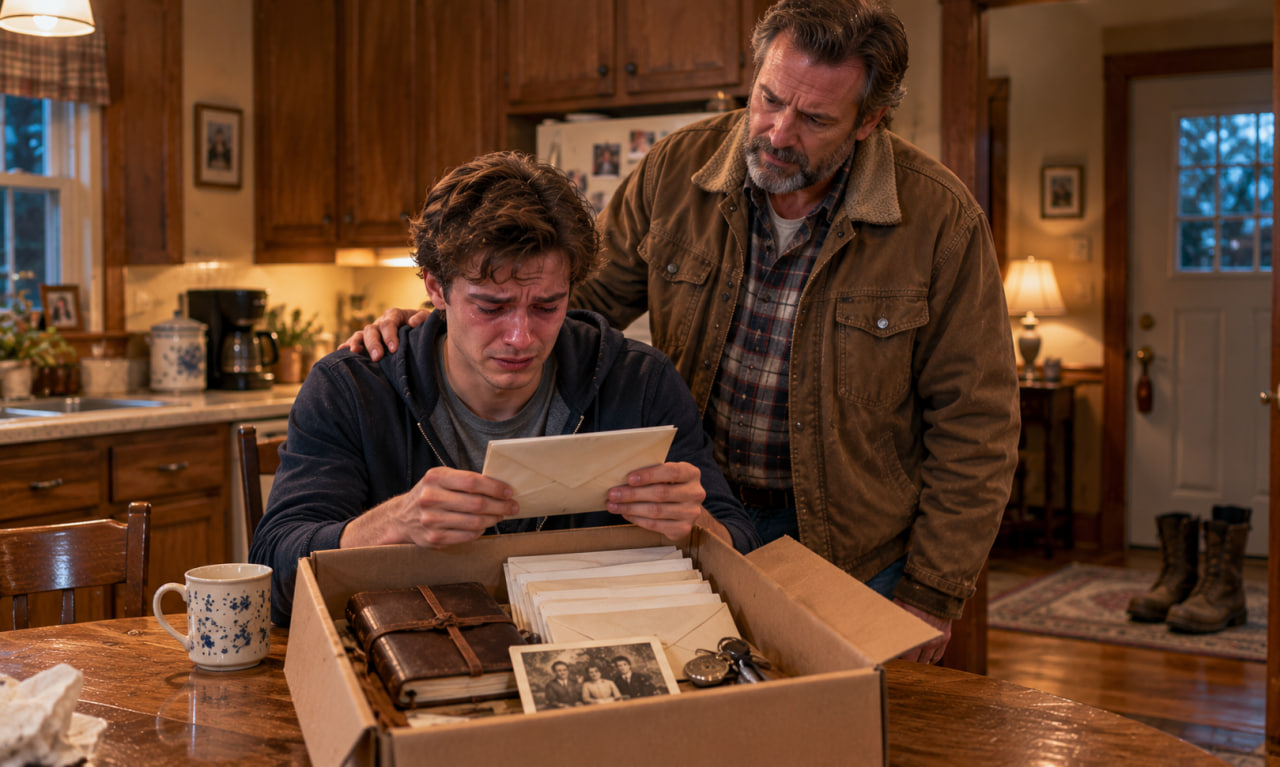
I used part of the savings my father had left me to enroll in a technical business course.
I didn’t know whether I wanted to become a mechanic or run a business, but I wanted to understand how to build something that could support me.
The first time I bought a new pair of work boots, I stood in the store for nearly twenty minutes before choosing them.
They weren’t expensive.
They were simply good, sturdy boots that fit properly.
I sat on a bench and put them on.
Then I stared at my feet, remembering the shoes I’d worn when I was eighteen.
The ones with the soles I’d glued back together.
I thought about how angry I’d been with my father that day.
And I thought about how easily he could have made that particular pain disappear.
A single trip to the store.
A simple conversation.
A small act of kindness.
I couldn’t understand why he’d made so many things harder than they needed to be.
Maybe I never would.
But I promised myself that I wouldn’t make the same mistake with someone else.
By the end of the year, I had turned the repair shop into a small workshop where people could bring bicycles, lawn equipment, and household appliances for basic repairs.
I hired an experienced technician named Daniel, who had been looking for a place to work after the business where he’d spent fifteen years closed.
The business wasn’t an overnight success.
Some weeks, we barely covered expenses.
Other weeks, customers arrived with more work than we could handle.
But slowly, we built a reputation for honest prices and reliable service.
I kept the upstairs apartment for myself.
For the first time in my life, I had a place that belonged to me.
And I didn’t charge myself rent.
That thought made me smile more often than it probably should have.
Almost a year after my father’s death, I received a phone call from Marcus.
“Are you busy Saturday?” he asked.
“Why?”
“I need a favor.”
“What kind?”
He hesitated.
“Your father used to take me fishing every autumn. We stopped going after he got sick, but I thought I’d go one more time.”
I was quiet.
Then he asked, “Would you like to come with me?”
My first instinct was to refuse.
I didn’t like fishing.
I didn’t particularly enjoy sitting beside a lake for hours, waiting for something to happen.
And the idea of doing something my father had loved without him there felt strange.
But I remembered the photographs in the box.
My father had spent years inviting me to the lake.
I had spent years saying no.
“I’ll come,” I said.
Marcus was silent for a moment.
“Are you sure?”
“Yes.”
“All right. I’ll pick you up at six.”
We arrived at the lake just after sunrise.
The air was cold, and a thin layer of mist hovered over the water. Marcus unloaded two fishing rods from his truck and handed me one.
I looked at it.
“I have no idea what I’m doing.”
“Neither did your father when he started.”
I smiled.
We sat on the bank.
For the first hour, we barely spoke.
Then Marcus began telling me stories about my father.
Not the heroic stories I had expected.
The embarrassing ones.
He told me about the time Dad backed his truck into a fence because he was too busy arguing about a football game to look behind him.
He told me about the fishing trip when Dad forgot the bait and tried to convince everyone that fish would be attracted to his sandwiches.
He told me about the time my father won a small prize at a fair and spent the entire drive home insisting it was the best day of his life.
I laughed.
For the first time, I heard about my father as a young man, before my mother’s death, before the bills and the long shifts, before his silence became the defining feature of our relationship.
He had been funny.
He had been foolish.
He had been someone who made mistakes and embarrassed himself and sometimes did things simply because they made him happy.
I had spent so long thinking of him as the man who charged me rent that I had forgotten he had lived an entire life before I was old enough to remember.
“Was he always so quiet?” I asked.
Marcus shook his head.
“No. Your mother could barely get him to stop talking when they first met.”
I looked at him in surprise.
“You’re joking.”
“I wish I were. He told the same three stories at every dinner party, and he laughed at his own jokes before he reached the punchline.”
I laughed again.
Then my expression changed.
“What happened to him?”
Marcus watched the water.
“Grief changes people. Sometimes it makes them reach for others. Sometimes it makes them shut every door they can find.”
“Why didn’t he let me help him?”
“Maybe he thought he was supposed to be the one helping you.”
I stared at the lake.
“That’s the problem, isn’t it? He spent so much time trying to be responsible that he forgot how to be close to me.”
Marcus nodded.
“I think so.”
We sat quietly for a while.
Then I asked the question that had been sitting in my chest for almost a year.
“Do you think he knew I loved him?”
Marcus turned toward me.
“Yes.”
“How can you be sure?”
“Because he knew you were angry, and he knew you were hurt. But whenever he talked about you, he never once questioned whether you were a good son.”
I looked down at my hands.
Marcus continued.
“He was proud of you. He just didn’t know how to say it without making it sound like advice.”
I swallowed.
“I wish he’d told me.”
“So do I.”
That answer meant more to me than any comforting speech could have.
We stayed until late morning.
I never caught a fish.
Marcus caught two.
On the drive home, I watched the trees pass outside the window and thought about how many ordinary moments I had spent wishing my father would become someone different.
I couldn’t change the past.
But I could stop letting it determine every decision I made in the future.
That evening, I returned to the repair shop and hung my father’s photograph above the workbench.
Not because I wanted to pretend he had been perfect.
Because I wanted to remember the whole man.
The one who failed me.
The one who tried to provide for me.
The one who loved me in ways I couldn’t always recognize.
And the one who had finally taught me, too late for us to share it, what mattered most.
Two years later, something happened that brought me back to the kitchen table where everything had begun.
I had been working at the repair shop when a young man walked through the door carrying a broken bicycle wheel.
He looked about eighteen.
His jacket was thin, his shoes were worn, and he kept apologizing for the condition of his bicycle.
“I’m sorry it’s such a mess,” he said. “I know it might cost too much to fix.”
I examined the wheel.
“It won’t cost much.”
He looked relieved.
“Could you tell me how much before you start? I only have a little money.”
“Of course.”
He reached into his pocket and counted a handful of crumpled bills.
“I started working at a grocery store last month,” he explained. “I’m trying to save for a car, but I need this bicycle to get to work.”
I looked at his shoes.
The soles were separating near the toes.
For a moment, I was eighteen again, standing in our kitchen while my father told me to put on another pair of socks.
I felt an ache in my chest.
I repaired the wheel and adjusted the brakes. When I finished, I told the young man the price.
He counted his money again.
“I’m a little short,” he admitted. “Could I bring the rest next week?”
I looked at the small pile of bills in his hand.
Then I shook my head.
“You’re all right. Pay what you can.”
He stared at me.
“Really?”
“Really.”
His shoulders relaxed.
“Thank you. I’ll come back next week and pay the rest.”
“You don’t have to.”
“But I want to.”
I smiled.
“Then come back next week.”
He left with his bicycle, thanking me several times before disappearing down the street.
I watched him go.
Then I returned to the office and sat at my desk.
For years, I had believed that my father had taught me to be responsible by charging me rent.
But the most important lesson I learned from him came after he died.
It wasn’t about saving money.
It wasn’t about buying property or building a business.
It was about understanding that people can remember a small act of kindness for the rest of their lives.
And they can remember a small act of cruelty just as long.
I couldn’t undo the pain my father had caused me.
But I could decide what I would do with it.
I could let it turn me into someone who measured love in obligations.
Or I could use it to become someone who understood that love should never leave a person wondering whether they mattered.
I chose the second.
On the fifth anniversary of my father’s death, I returned to the house where I grew up.
I had kept it for a while, then eventually sold it to a young couple who were expecting their first child. Before handing over the keys, I had walked through every room one last time.
The kitchen was smaller than I remembered.
The hallway seemed shorter.
My childhood bedroom had barely enough space for the bed and desk that once filled it.
Standing there, I finally understood something I hadn’t been able to understand when I was younger.
The house had never been the reason I felt alone.
It was the silence inside it.
I had spent years hoping the house would somehow become warmer, that my father would suddenly start asking about my life, that one day we would sit at the kitchen table and talk like other fathers and sons.
That day never came.
But I no longer blamed myself for it.
I drove to the cemetery with a small bouquet of flowers and stood beside my father’s grave.
For a while, I said nothing.
Then I placed the flowers on the ground.
“I read every letter,” I told him.
The wind moved gently through the trees.
“I understand more now. I understand why you wanted me to learn how to take care of myself. I understand why you were afraid I wouldn’t have the opportunities you wanted me to have.”
I took a breath.
“But I wish you’d understood that I didn’t need you to make my life easy. I just needed you to be there.”
My voice cracked.
“I needed a father, Dad. Not a landlord.”
I stood quietly, allowing myself to feel the sadness without pushing it away.
Then I continued.
“I’m not going to spend the rest of my life angry with you. But I’m not going to pretend everything was okay, either.”
I wiped my eyes.
“You left me money, a house, and a business. Those things helped me build a future. But the best thing you left me was a lesson I wish we’d both learned sooner.”
I looked down at the flowers.
“Love people while they’re still here. Tell them what they mean to you. Don’t wait until a letter is the only way you can say it.”
For the first time, I felt no need to imagine what my father might have said in response.
I didn’t need another apology.
I didn’t need him to explain himself again.
I could love him without pretending he had never hurt me.
And I could finally let go of the belief that I had somehow failed to earn the father I needed.
Before leaving, I placed one hand on the headstone.
“Goodbye, Dad.”
Then I walked back to my car.
I didn’t look back.
Not because I had forgotten him.
Because I was finally ready to carry the memories without letting them hold me in place.
That evening, I returned to my apartment above the repair shop.
The business was doing well. Daniel had become a trusted partner, and we had hired another technician. I had finished my training and was saving to expand the shop.
My life wasn’t perfect.
I still had difficult days.
I still missed my mother.
And sometimes, when something wonderful happened, I caught myself wishing I could call my father and tell him about it.
But I had learned to share those moments with the people who were still here.
I called Marcus every Sunday.
I made time for my friends.
When someone I cared about asked to talk, I tried not to postpone the conversation simply because I was busy.
And when I eventually became a father myself, I made a promise I intended to keep.
My child would never have to wonder whether they were welcome in my home.
They would never have to pay for the privilege of feeling loved.
I would teach them responsibility, certainly.
I would expect them to work hard, respect others, and learn how to stand on their own feet.
But I would also sit beside them when they were hurting.
I would listen when they were angry.
I would tell them I was proud of them, even when they made mistakes.
And I would never assume that providing for them meant I had done everything a father needed to do.
Because I knew what it felt like to grow up with a roof over my head and still feel homeless in my own heart.
Sometimes, I still take out the box my father left me.
I keep the letters in a drawer beside the photograph of my mother holding me as a baby.
I don’t read them every day.
I don’t need to.
I know what they say.
They remind me that people can love us and still fail us. That good intentions don’t erase painful choices. And that forgiveness isn’t the same as pretending the hurt never happened.
Most importantly, they remind me that the future is not a place where we finally receive everything the past denied us.
It’s something we build with the choices we make today.
My father spent five years collecting $250 a month because he wanted to give me a better future.
In the end, he gave me something more complicated than money.
He gave me the opportunity to understand him.
And he gave me the chance to become a different kind of man.
I will always wish he’d told me he loved me while he was alive.
I will always wish we’d had one more conversation, one more fishing trip, one more ordinary afternoon when we could have started over.
But I no longer measure his love by the things he failed to say, nor do I excuse his silence because of the things he left behind.
I remember both.
And I choose to live differently.
Because the greatest inheritance a parent can leave a child isn’t a house, a bank account, or a business.
It’s the wisdom to give the next generation the love they should never have had to earn.
And that is the inheritance my father left me.
The one I intend to pass on.
THE END