
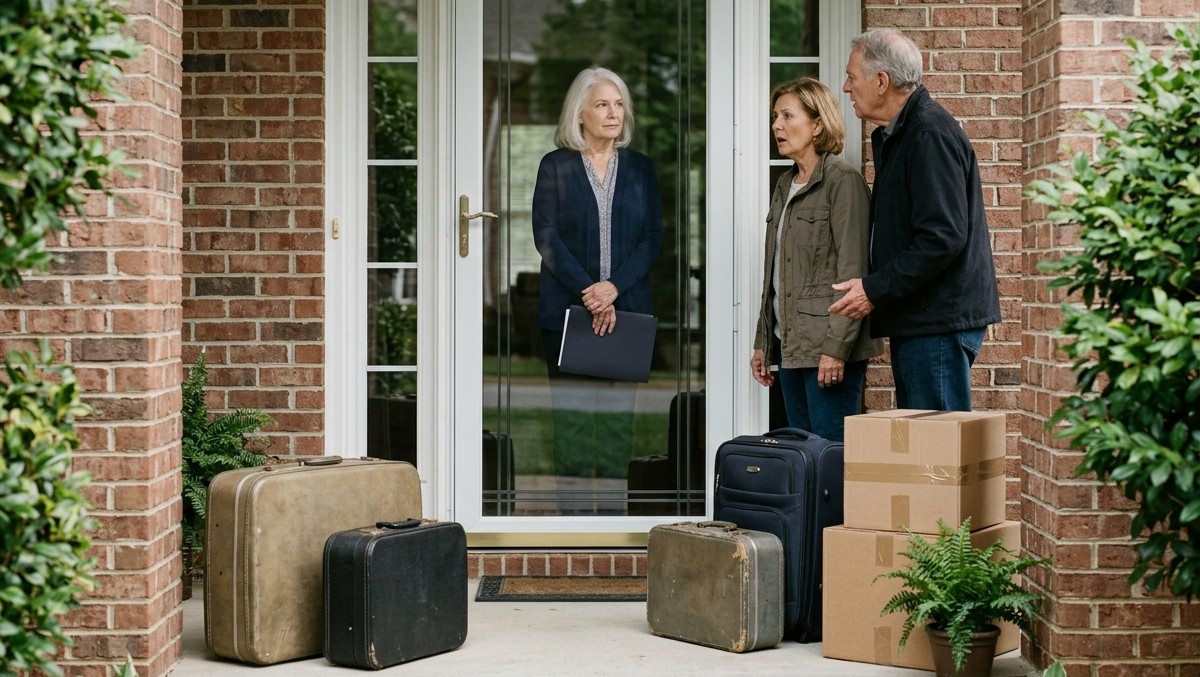
My daughter-in-law didn’t ask if her parents could move into my million-dollar home.
She informed me.
And when I said no, she smiled across my own kitchen island and calmly explained what refusing might cost me.
Sunday dinners.
Family visits.
And time with my grandchildren.
The worst part?
My son stood ten feet away, lowered his eyes, and said nothing.
They walked through my house as though they already owned it. They chose bedrooms, discussed where their furniture would go, and even started talking about renovations.
Three days later, her parents showed up at my front door with suitcases.
They were certain I would eventually surrender.
What none of them knew was that I had already signed a contract to sell the house.
The Home I’d Lived in for 32 Years
My name is Judith. I’m sixty-nine years old, a retired elementary school principal, and that beautiful four-bedroom house outside Charlotte had been my home for thirty-two years.
My late husband, Robert, and I bought it when our son Daniel was nine.
Back then, it cost less than a quarter of what it was worth now.
We painted every room ourselves, planted the oak tree beside the driveway, and spent years paying down the mortgage.
Robert died five years ago.
Afterward, I kept the house because I couldn’t imagine leaving the place where we’d raised our son.
But maintaining it alone had become exhausting.
The staircase hurt my knees. The property taxes kept rising. Half the rooms hadn’t been used in months.
Six weeks earlier, I’d found a little two-bedroom cottage near the public library.
It had a garden, no stairs, and a covered porch where I could drink coffee in the mornings.
More importantly, it was close to Daniel’s family.
I could still attend my grandchildren’s school events without spending my retirement maintaining an enormous house.
I’d accepted an offer on my property twelve days before Vanessa’s announcement.
The sale was scheduled to close in seven weeks.
I had planned to tell Daniel over Sunday dinner.
Instead, Vanessa arrived with a measuring tape.
My Daughter-in-Law Wanted Her Parents to Move In
“Mom, my parents need somewhere comfortable to stay,” Vanessa said. “Your house has all this space. We’ve already figured out the bedrooms.”
Her father, Frank, had recently retired.
Her mother, Carol, was sixty-six and had been struggling to keep up with the rent on their apartment after an increase.
I knew they were worried about money.
I’d even suggested they look for smaller places closer to the grandchildren.
But I hadn’t invited them to live with me.
Vanessa walked upstairs without waiting for permission.
Carol followed, discussing where she’d put her antique dresser.
Frank said the downstairs study would make a good television room.
I stood in the hallway, listening to strangers redesign the home I’d shared with my husband.
When I told them the arrangement wouldn’t work, Vanessa smiled.
“Judith, you’re one person in a house this size. We’re talking about family.”
Then she mentioned the grandchildren.
Sophie was ten, and Oliver was seven.
I picked them up from school on Thursdays, baked cookies with them, and attended almost every soccer game and dance recital.
Vanessa knew exactly how much they meant to me.
“It would be a shame if the kids got confused about why Grandma wouldn’t help their other grandparents,” she said.
Daniel stood by the kitchen doorway, staring at his shoes.
I asked whether he agreed with his wife.
“Mom, they’re in a difficult situation. Can’t we just figure something out?”
I told him we could discuss ways to help, but I wasn’t surrendering my home.
They left angry.
I called Daniel twice over the next two days because I wanted to explain my plans.
He didn’t answer.
Three Days Later, They Arrived With Suitcases
On Wednesday morning, Frank and Carol arrived with three suitcases, two cardboard boxes, and a potted fern.
“Vanessa said you needed a little time to adjust,” Carol announced. “We don’t mind starting in the guest room.”
I didn’t open the storm door.
I explained that they couldn’t move in.
Frank frowned.
“We’ve already given notice on our apartment.”
I felt a flicker of sympathy.
Then he added something that changed everything.
“Daniel said the house would be his eventually anyway.”