
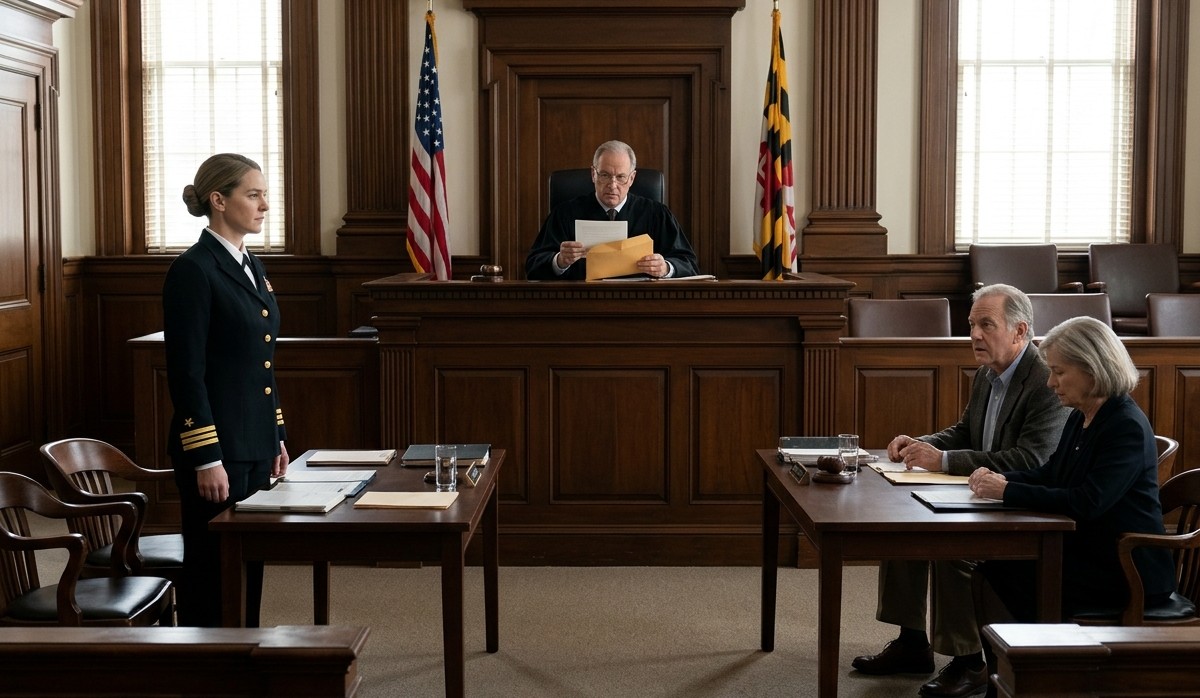
My parents sued me for $480,000.
They never expected me to walk into court wearing a Navy uniform.
The moment I entered the Maryland courtroom, my father laughed.
My mother looked away in embarrassment.
Then Judge Albright examined my uniform, studied my face, and whispered:
“My God… is that really her?”
I was Joanna Holloway.
Twelve years earlier, my parents had called my decision to join the Navy a disgrace to our family.
They hadn’t visited me once since I became an officer.
Now, they were suing me.
My father claimed I had stolen money that belonged to my family.
I said nothing.
Then Judge Albright opened an envelope attached to the case file.
His expression changed instantly.
He looked directly at my parents.
“Mr. and Mrs. Holloway, before we proceed, there’s something you need to know about your daughter.”
My father stopped smiling.
Because the document in the judge’s hands contained a name neither of my parents had expected to see.
Commander Evelyn Holloway.
My father’s older sister.
The woman he’d forbidden me to contact sixteen years earlier.
The Career My Parents Called a Disgrace
My name is Joanna, and I’m thirty-nine.
I grew up in a wealthy Maryland family where appearances mattered more than affection.
Dad owned several rental properties. Mom organized charity dinners and reminded me constantly that Holloways belonged in respectable professions.
When I announced at twenty-seven that I was accepting a Navy commission after completing my degree, Dad called it an embarrassment.
“I didn’t spend money raising you so you could take orders from strangers,” he said.
Mom told relatives I’d gone through a rebellious phase.
But I wasn’t rebelling.
I wanted to serve, lead, and build a life that belonged to me.
The only person who congratulated me was Aunt Evelyn.
She’d spent twenty-six years as a Navy nurse before retiring.
Dad hated her because she’d once refused to give him money without asking questions about his debts.
“That woman thinks she’s better than us,” he’d say.
What he never told me was that Evelyn had saved his business from foreclosure.
The Family Secret My Father Never Told Me
Sixteen years earlier, Evelyn had paid off a loan secured against a waterfront rental property.
In exchange, Dad signed a recorded deed giving her a fifty-percent ownership interest.
I learned this only after Evelyn died two years ago.
Throughout my Navy career, I’d commanded teams during difficult overseas assignments.
I’d also stopped hoping my parents would become proud of me.
Evelyn, however, had remained close.
She attended my commissioning ceremony, sent care packages during deployments, and called whenever she knew I was coming home.
She never had children.
In her final years, I visited whenever my duties allowed and helped arrange care when her health declined.
She left her half-interest in the waterfront property to a trust naming me as beneficiary.
Fourteen months ago, Dad agreed to sell the property.
After the closing costs and remaining obligations were settled, the proceeds were $960,000.
His half was $480,000.
Evelyn’s half, held by her trust, was also $480,000.
The closing attorney distributed each share separately.
I received mine through the trust’s administrator.
Dad received his directly.
I thought the matter was finished.
I was wrong.
Why My Parents Sued Me for $480,000
Six months after the sale, a lawyer’s letter arrived accusing me of taking money that should have belonged to my father.
Dad claimed Evelyn’s payment had been a family loan, not a purchase of ownership.
He argued that I’d pressured her into leaving me an asset that belonged to the Holloway family.
I sent my attorney the deed, trust documents, and closing statement.
I assumed the facts would end the argument.
Instead, my parents filed a lawsuit demanding the entire $480,000.
They even requested that the court restrict my access to the disputed funds while the case proceeded.
Now I stood in court as Judge Albright examined the documents my attorney had submitted, copies of which had also been provided to my parents’ lawyer.
He recognized me from a newspaper article about a Navy evacuation mission I’d helped lead.
But my military record wasn’t why his expression changed.
The name on Evelyn’s deed was.
“The records indicate that your sister owned half this property,” he told my father. “Her trust held that interest after her death.”
Dad leaned forward.
“Your Honor, she was only helping the family. That was never supposed to be permanent.”
Judge Albright pointed to the signed deed.
“Then why did you execute and record a document transferring ownership to her?”
My father opened his mouth, then closed it.
Mom stared at her hands.
I remembered the afternoons she’d spent telling me Aunt Evelyn was selfish and had never done anything worthwhile for our family.