
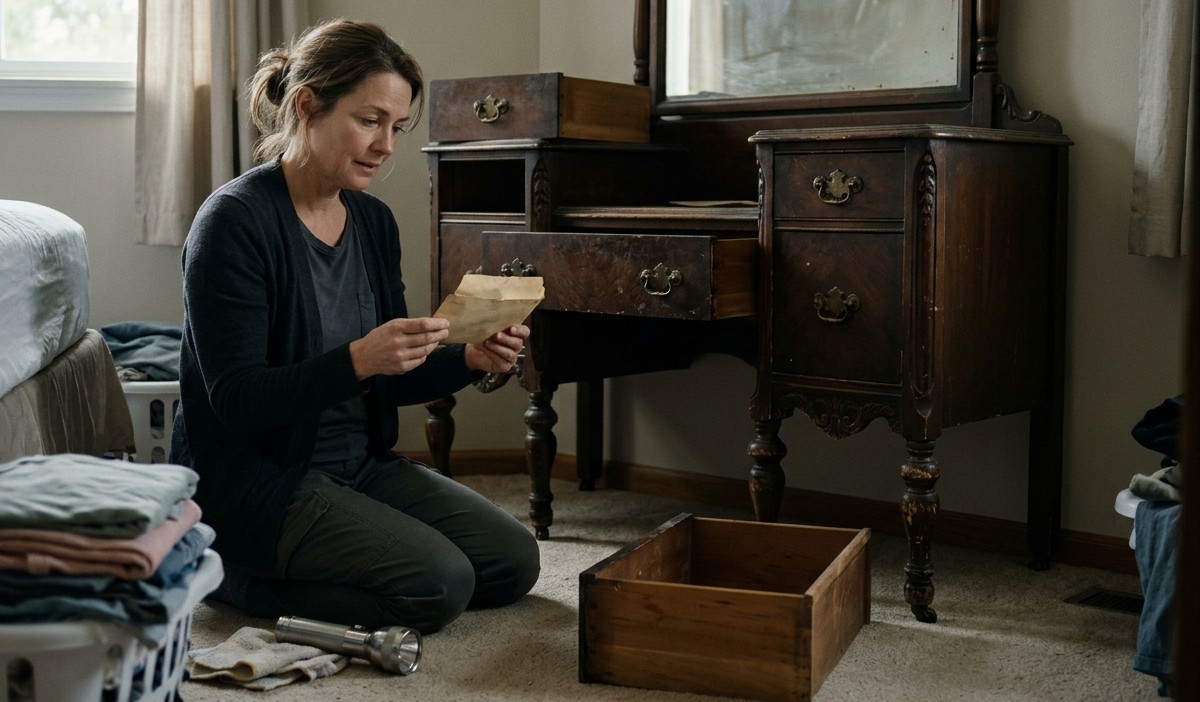
My husband took almost everything in our divorce.
The house. Both cars. The camper we had used exactly twice. Even the dining table he had complained about for years.
By the end, I was so emotionally exhausted that I stopped caring about “winning.”
I wanted the marriage finished more than I wanted furniture, so I let Grant keep almost everything.
The only thing he didn’t bother fighting for was his grandmother Eleanor’s old vanity—a heavy, dark piece of furniture with carved legs, brass handles, and a cloudy mirror that had sat in his family’s hallway for decades.
When the movers carried it toward my truck, Grant actually laughed.
“You can have the ugly thing. Nobody wants it.”
I said nothing.
Nearly a year later, I discovered something hidden behind one of its drawers.
And suddenly, the piece of furniture nobody wanted became the most meaningful thing I had taken from our marriage.
The Only Thing I Wanted From His Grandmother
I wanted the vanity because Eleanor had always treated me like family when Grant’s relatives never quite did.
During the last two years of her life, I drove her to medical appointments, brought groceries, picked up prescriptions, and spent Sunday afternoons listening to stories I had already heard five times.
Grant loved his grandmother, but he was always too busy.
His mother, Diane, lived fifteen minutes away but somehow had even less time.
After Eleanor died, the family divided up her belongings.
Everyone wanted jewelry, china, photographs, and anything that looked valuable.
Nobody wanted the vanity.
Grant only brought it home because I asked him to.
“Why?” he complained. “It weighs a ton.”
“Because she loved it,” I said.
That was enough for me.
The Jammed Drawer That Changed Everything
After the divorce, the vanity sat in the spare room of my little townhouse, collecting folded laundry for nearly a year.
Then one Saturday afternoon, I finally decided to sell it.
I wiped down the mirror, photographed the carved legs, and began emptying the drawers.
The middle drawer had always been difficult, but this time it jammed halfway.
I pulled harder.
Nothing.
I grabbed a flashlight and looked through the gap.
Something pale was taped behind the drawer.
I removed the two drawers above it, reached into the opening, and felt an envelope taped flat against the back panel.
My heart started beating faster.
Across the front, in Eleanor’s handwriting, were four words:
For Laura. Not Grant.
I sat down on the floor.
Eleanor had been dead six years.
Inside the envelope was a small brass key and a folded letter.
Eleanor’s Secret Letter
Dear Laura,
If you found this, then the old vanity finally became yours. I hope Grant learned to appreciate it, but knowing my grandson, I am not betting on miracles.
I actually laughed.
It sounded exactly like her.
Then I kept reading.
She thanked me for helping her during her final years. She reminded me that she had offered to pay me several times and I always refused.
Then came the sentence that made my hands shake.
The key belongs to Box 417 at First County Trust. You are the beneficiary of what is inside. Take this letter and identification to the trust department. Please do not feel guilty. I know exactly who showed up for me.
Love, Eleanor.
On Monday morning, I called the bank.
First County Trust had merged with another institution, but after several transfers, I reached someone in the trust department.
When I gave Eleanor’s full name, the woman became very quiet.
“Ms. Whitmore, could you come in with identification and the original letter?”
I asked if Box 417 still existed.
“The physical box was closed when the branch relocated,” she said, “but the contents were moved into custodial storage because the named beneficiary was never successfully located.”
Named beneficiary.
Me.
The Forgotten Investment Account Worth $318,000
I went with my attorney because, after the divorce, I had learned never to sign financial papers without understanding them.
Inside the stored container were old photographs, Eleanor’s wedding ring, documents, and records connected to an investment account.
The account listed me as its transfer-on-death beneficiary.
It had been worth about $95,000 when Eleanor died.
Because the bank had an outdated address and an incorrect digit in my identification information, the notices had never reached me.