
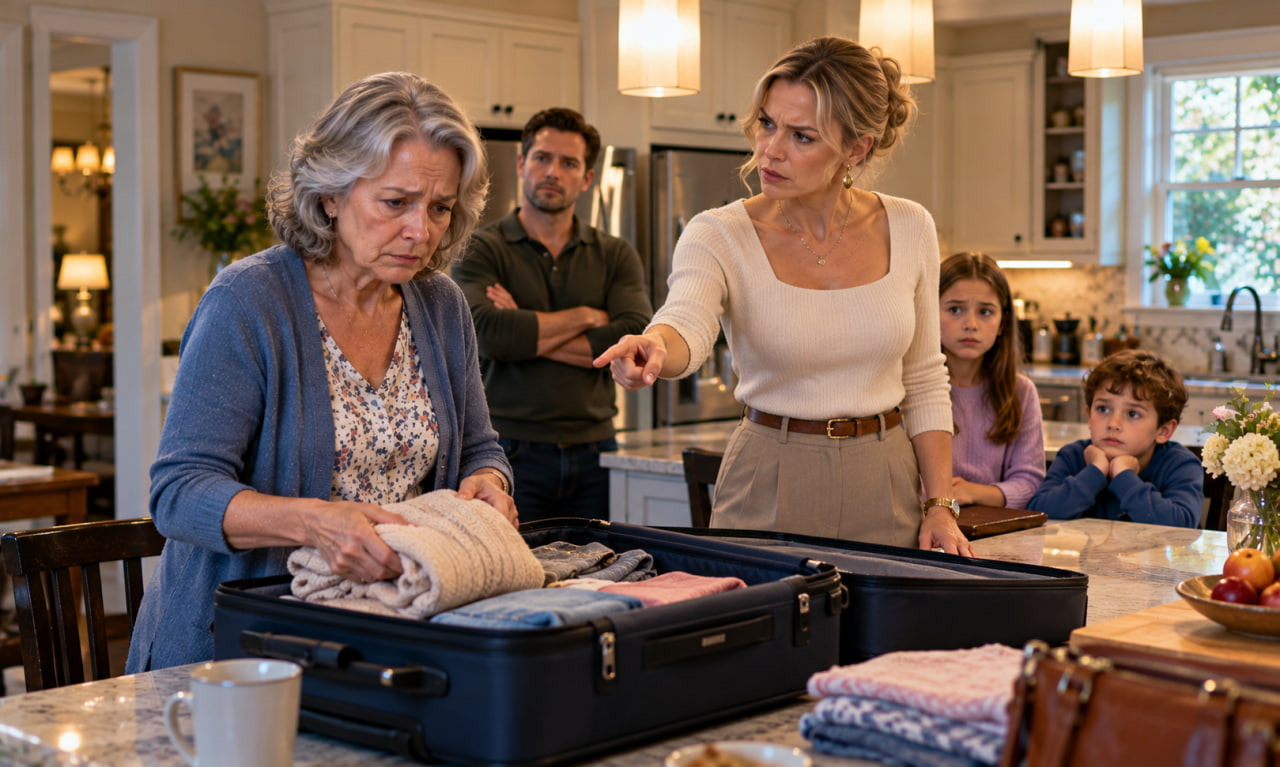
A second message followed.
The emergency babysitter charged $180 for yesterday because we needed someone on short notice.
I read both messages.
Then I put my phone down.
I did not know what response he expected.
Perhaps he wanted sympathy.
Perhaps he wanted me to offer to drive over and take over again.
I couldn’t be sure.
So I answered honestly.
That sounds expensive. I hope you can find a regular arrangement that works for your family.
He did not respond.
That evening, Tessa sent me a longer message.
Lenora, I know things became tense before you left. But we are facing some serious financial pressure now. We have paid for childcare, delivery help, and extra household support. The costs are adding up quickly. I really wish you had given us more notice.
I read it slowly.
More notice.
I had told them I was leaving the previous evening. I had explained that I was returning home. I had removed my name from the pickup list and left the information they needed.
They had simply expected me to change my mind.
I wrote a reply, deleted it, and started again.
I understand the pressure is real, Tessa. I hope you and Callum find a sustainable solution. I agreed to help for six weeks. I did not agree to stay until December, and I did not agree to become the bakery’s unpaid delivery service or your permanent childcare plan. I love the children, and I love my family. But I need my time and my home to be respected, too.
I sent the message.
Tessa read it.
She did not reply.
I thought that might be the end of the conversation.
I was wrong.
The next morning, Callum called again.
“Mom, can we talk about the costs?”
I was standing in the kitchen, preparing to make soup.
“Of course.”
He sounded embarrassed.
“We’ve had to pay for several things we weren’t expecting.”
“What things?”
“Childcare. A delivery driver. Prepared dinners a few nights. And we had to pay someone to stay with the kids while Tessa dealt with a problem at the bakery.”
I stirred the soup.
“How much?”
He hesitated.
“About eighteen hundred and fifty dollars so far.”
I stopped stirring.
Not because I was surprised that childcare and household help cost money.
But because I suddenly understood the number that had been hiding inside all those little favors.
Nearly $1,850 in just two weeks.
And that did not include the cost of all the hours I had given them during the six weeks before I left.
“That’s a lot of money,” I said.
“It is.”
He sounded tired.
“I’m not telling you this to make you feel bad.”
I waited.
He continued.
“It’s just that we never realized how much we were relying on you until you weren’t here.”
I leaned against the counter.
“Callum, I think you knew you were relying on me. I don’t think you understood what that reliance meant.”
He was silent.
“Every time you needed someone to collect the children, I was there. Every time a delivery was late, I went. Every time dinner needed to be made, I made it. Because I loved you, I stopped noticing how much of my own life I was giving away.”
“I’m sorry.”
“I believe you.”
He sighed.
“Can I tell you what happened yesterday?”
“Go ahead.”
“Tessa had to leave the bakery early because the sitter called in sick. I stayed home with the kids. We had a catering order that needed to be delivered, and I couldn’t leave them alone, obviously.”
“Of course.”
“So we paid a courier service to take the order. Then the customer called because one of the boxes was damaged. Tessa had to arrange a replacement.”
I listened.
“Then June needed her school project finished. Micah couldn’t find his library book. The kitchen was a mess, and neither of us had bought groceries.”
He laughed, but there was no humor in it.
“By nine o’clock, we were both exhausted.”
I felt a familiar instinct rise inside me.
I could have offered to come over for a weekend.
I could have suggested preparing several meals in advance.
I could have driven to their house and helped them organize a better system.
The solutions were already lining up in my mind.
For years, that was what motherhood had meant to me: seeing a problem before anyone else did and quietly making it disappear.
But I had learned something during the past few days.
If I rushed to solve every problem, they would never have to learn how to solve their own.
So I asked a different question.
“What are you going to change?”
He was quiet.
“What do you mean?”
“What are you going to do differently so this doesn’t keep happening?”
He took a long breath.
“We’re making a schedule.”
“Good.”
“We’ve also decided that Maris can help with the children on Fridays when she isn’t working.”
I remembered the packaging call that had once been too important for her to interrupt.
“That sounds useful.”
“And we’re going to hire a regular driver for bakery deliveries instead of asking whoever happens to be available.”
“That sounds sensible.”
He paused.
“Mom?”
“Yes?”
“I think I owe you more than an apology.”
I said nothing.
“I don’t mean money. I know you weren’t asking to be paid.”
“That’s true.”
“I mean I owe you an honest acknowledgment of what you did.”
My throat tightened.
For six weeks, I had wanted someone to notice.
Not the money.
Not the recognition.
Just the truth.
“You can start by remembering that helping you was my choice,” I said. “And that choice should have remained mine.”
“I understand.”
“I hope you do.”
We ended the call gently.
I returned to my soup.
Outside, the afternoon sun settled across the garden, and the first few leaves drifted onto the porch.
For the first time since leaving their house, I felt that something important had begun to change.
Not because the bills were expensive.
Not because the household was struggling.
But because my son was finally beginning to see the difference between having help and having someone who had quietly been carrying his responsibilities for him.
And I had a feeling that the real conversation was still ahead.
PART 4
Three days after Callum admitted that the household had spent nearly $1,850 replacing the help I had provided, I received an unexpected invitation.
It was from Tessa.
Lenora, could you come over on Sunday? We’d like to have dinner and talk about everything. I think we all need a fresh start.
I read the message twice.
A fresh start.
Those were promising words, but I had learned that words could be easy when nobody had yet decided what they were willing to change.
I replied:
I’d be happy to have dinner with the family. I’ll come at five, and I’ll be heading home afterward.
Her answer arrived almost immediately.
Of course.
For the first time in weeks, she had accepted my answer without trying to negotiate it.
I took that as a small but meaningful step.
On Sunday afternoon, I baked an apple pie.
Not because anyone expected me to bring dessert. I simply enjoyed baking when I had time to do it properly.
I drove to their house with the pie on the passenger seat, arriving at exactly five.
Callum opened the door.
He looked tired, but he smiled when he saw me.
“Hi, Mom.”
“Hello, sweetheart.”
He hugged me.
It was a little awkward at first, as though neither of us quite knew how to behave after the previous two weeks.
Then he held me a little tighter.
“I’ve missed you.”
“I’ve missed you, too.”
Behind him, June came running down the hallway.
“Grandma!”
She wrapped her arms around my waist, nearly knocking the pie from my hands.
Micah followed, clutching his blue dinosaur.
“Grandma, look! He’s still alive!”
I laughed.
“I’m relieved to hear it.”
For several minutes, I forgot the tension that had brought me there.
I listened to their stories about school. June told me about a science project, and Micah explained why his dinosaur needed a special sleeping place.
Tessa stood in the kitchen doorway, watching us.
When our eyes met, she offered a small smile.
“Dinner is almost ready.”
I followed her into the kitchen.
It looked different.
There were dirty dishes beside the sink, a grocery list on the refrigerator, and a stack of bakery invoices on the counter.
Nothing terrible.
Nothing unusual.
Just the ordinary evidence of a household in which several people were learning that ordinary tasks did not disappear simply because everyone was busy.
Tessa had cooked dinner herself.
Roast chicken, potatoes, and green beans.
The meal was good, although she apologized twice for the potatoes being slightly overcooked.
“You don’t need to apologize,” I told her. “They’re perfectly fine.”
She gave me a tired smile.
“I’m still getting used to everything.”
I knew what she meant.
But I also knew that getting used to responsibility was not the same as being wronged by it.
At dinner, Callum asked June about school and listened patiently while Micah explained the complicated history of his dinosaur family.
Tessa told me the bakery had been busier than expected.
They had hired a part-time delivery driver and arranged regular after-school care.
Maris was still helping with some business matters, but she had agreed to watch the children on Friday afternoons when her schedule allowed.
It wasn’t a perfect system.
But it was a system they had chosen and organized themselves.
After the children finished eating, Callum took them upstairs to get ready for bed.
Tessa began clearing the table.
I stood to carry my plate toward the kitchen.
She immediately reached for it.
“You don’t have to do that.”
I paused.
Then I handed it to her.
“Thank you.”
It was such a small exchange that another person might not have noticed it.
But I did.
For weeks, my standing up from a chair had been treated as the beginning of another task.
Now Tessa had offered to do something herself.
I sat back down.
A few minutes later, she returned with two cups of tea.
“Would you mind talking for a while?”
“Of course.”
She sat opposite me.
For a moment, she studied her cup.
Then she looked up.
“I owe you an apology.”
I waited.
“I’ve been thinking about what happened. At first, I was angry that you left. I kept telling myself that you knew how difficult things were for us and that you should have understood the timing.”
She swallowed.
“But I think I was angry because I suddenly had to do things I had gotten used to someone else doing.”
I didn’t interrupt.
“When the bakery was preparing to open, I was terrified it would fail. I had invested so much money, so much time, and so much of myself in it. Maris kept reminding me about deadlines, suppliers, and what could go wrong. Callum was working long hours, and I felt as though I had to keep everything together.”
She rubbed her forehead.
“You were always there. Whenever I needed something, you helped. And instead of seeing that as a gift, I began to treat it as something I could depend on.”
Her eyes became glossy.
“Then you told me you weren’t available on Thursday, and I acted as though your plans were the problem. I didn’t stop to consider that your plans mattered just as much as mine.”
I felt a tightness in my chest.
It was the apology I had wanted, but hearing it did not erase the hurt immediately.
“Thank you for saying that,” I told her.
She nodded.
“I’m not asking you to forget what I said. I know I hurt you.”
“Yes, you did.”
She looked down.
“I was cruel when I told you that it was my house, my kids, and my business.”
I took a slow breath.
“You were right about one thing, Tessa. It is your house, your children, and your business.”
She looked up, surprised.
“But those words came with a responsibility you weren’t acknowledging. If it’s your house, you have to decide how the house will function. If they’re your children, you and Callum have to arrange their care. And if it’s your business, you have to make sure it has the staff and resources it needs.”
I paused.
“I can help. I can love you. I can be part of your life. But I cannot be the invisible solution to every problem.”
She wiped her eyes.
“I understand that now.”
I hoped she did.
Then she said something I hadn’t expected.
“I also want you to know that Maris and I have discussed the consulting arrangement.”
I raised my eyebrows slightly.
“What about it?”
“Her $2,800 monthly fee was agreed upon because of the work she was doing for the bakery. That arrangement is between us, and I don’t resent paying her for her work. But I realized how easily I had justified not paying for other people’s work simply because they were family.”
She took a breath.
“I never would have asked a delivery driver to work every day for six weeks without paying him. I wouldn’t have expected a babysitter to cancel her personal plans whenever I needed her. But I expected those things from you.”
She shook her head.
“I don’t like what that says about me.”
I considered her words.
“It doesn’t have to define you,” I said. “What matters is what you do now that you see it.”
She nodded slowly.
For the first time, we were talking to each other without either of us trying to win.
And that was worth more than a dramatic argument ever could have been.
Callum came downstairs a little later.
He had tucked the children into bed and brought the baby monitor with him.
When he saw our faces, he stopped.
“Everything okay?”
Tessa nodded.
“We were talking.”
He sat beside her.
Then he looked at me.
“Mom, there’s something else I need to tell you.”
I waited.
He took a folded piece of paper from his pocket.
“I made a list.”
I almost smiled.
“What kind of list?”
“Everything you were doing while you stayed here.”
He unfolded the paper.
It was several pages long.
School pickups. Grocery shopping. Meal preparation. Laundry. Errands. Bakery deliveries. Waiting for contractors. Helping with the children’s schoolwork. Cleaning up after dinner. Taking the children to appointments.
He had written down the things I had done for the bakery separately from the things I had done for the household.
At the bottom, he had added one final sentence.
Mom was available because we never asked whether she wanted to be.
I stared at the page.
“I know this doesn’t give you your six weeks back,” he said. “And I know you didn’t do all those things because you expected payment. But I needed to write it down because I don’t think I ever properly understood the amount of time you gave us.”
I ran my fingers along the edge of the paper.
“Why did you do this?”
“Because I want to remember.”
His voice broke slightly.
“When Dad died, I worried about you being alone. I thought helping us might make you feel less lonely, and I told myself we were helping you as much as you were helping us.”
I looked at him.
“I did enjoy being with you and the children.”
“I know.”
“But those are two different things, Callum. Enjoying time with my family doesn’t mean I don’t need a life of my own.”
He nodded.
“I understand that now.”
He glanced at Tessa.
“We’ve talked about it, and we’ve decided something. If you ever want to stay with us again, we’ll make sure we agree on the dates and responsibilities before you come. And if you don’t want to, we’ll respect that.”
Tessa reached for my hand.
“We want you in our lives because we love you, Lenora. Not because we need someone to fill the gaps.”
I looked at them both.