
I closed my eyes.
“I’m at Lauren’s house. I’m looking at my son.”
My mother’s breath caught.
I had never heard her make that sound before.
“Ethan is there?”
“You know his name.”
Another silence.
Then, quietly, she said, “I wanted to protect you.”
“From my own child?”
“From a life you weren’t ready to have.”
I gripped the edge of the desk.
“You forged my handwriting.”
“Liam—”
“You intercepted letters from my pregnant wife.”
“I did what I thought was best.”
“You let me believe I had no son.”
“I never wanted you to suffer.”
I laughed, a short, broken sound.
“You let me suffer for seven years. You let Lauren suffer for seven years. You let a little boy grow up without his father. Tell me what part of that you thought was best.”
My mother began to cry.
For most of my life, her tears had been enough to make me abandon an argument. She had raised me alone after my father died, and I had spent years believing I owed her a debt that could never be repaid.
Now I understood how easily love could become a chain when one person decided the other person’s life belonged to them.
“I was afraid you’d choose her over me,” she whispered.
I stared at the floor.
“You were my mother. She was my wife. Those were never supposed to be competing positions.”
“You don’t understand what she was doing to you.”
“What was she doing, Mom?”
“She was taking you away from me.”
The admission came so softly that I almost missed it.
I looked at Lauren.
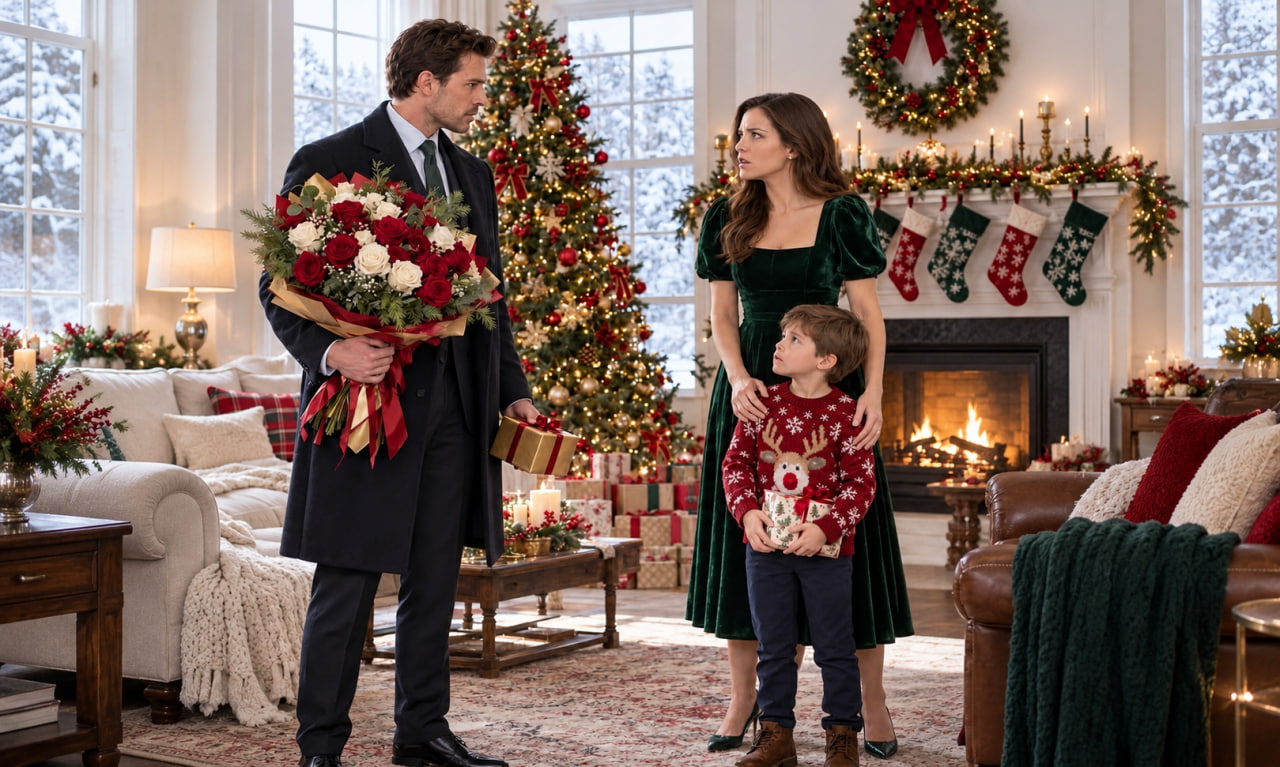
She stood beside the Christmas tree, listening without moving.
My mother continued.
“After your father died, you were all I had. When you married Lauren, everything changed. You stopped coming over as often. You made plans with her family. You talked about moving. Then she became pregnant, and I knew I would lose you completely.”
“You didn’t lose me,” I said. “You pushed me away from everyone else until I had no idea what was real.”
“I thought you would eventually understand.”
“No. You thought you could make the decision for me.”
My mother sobbed.
I wanted to comfort her.
That was the hardest part.
Somewhere beneath my anger, I still loved her. I still remembered her holding my hand at my father’s funeral, still remembered her working double shifts to keep food on the table, still remembered every Christmas she had made special when we could barely afford a tree.
Those memories were real.
So was what she had done.
Both things could be true.
“I’m not going to pretend this didn’t happen,” I told her. “And I’m not going to let you near Ethan until we know he can be safe with you.”
“Please, Liam.”
“I love you, Mom. But I won’t lie for you.”
I ended the call.
For a while, neither Lauren nor I spoke.
Then she sat down beside me.
“I’m sorry,” she said.
I turned toward her, startled.
“Why are you apologizing?”
“Because I let her back into our lives without asking enough questions. I wanted to believe that she’d changed. I wanted Ethan to have grandparents, and I thought perhaps I could give him one.”
“You gave him someone he loved.”
Lauren’s eyes filled with tears.
“I thought she loved him, too.”
I looked at the little red truck lying in two pieces on the table.
“Maybe she does.”
Lauren stared at me.
I took a breath.
“Maybe that’s what makes this so difficult. She might love him. She might love me. But she used that love to justify hurting us.”
Lauren reached for my hand.
For the first time in seven years, she didn’t pull away when I touched her.
But neither of us mistook that small gesture for forgiveness.
We were two people sitting in the wreckage of a life we might have shared, trying to decide whether anything could be rebuilt.
Then Ethan came back into the room.
He had changed into a pair of pajamas patterned with tiny snowmen. He held three mugs of hot chocolate, one in each hand and one balanced awkwardly against his chest.
“Mom says you can stay until tomorrow,” he announced.
He set the mugs down carefully.
“Because it’s Christmas.”
I looked at Lauren.
She gave me a tired, uncertain smile.
“Just tonight,” she said.
I nodded.
“Just tonight.”
Ethan climbed onto the sofa and tucked his feet beneath a blanket.
Then he looked at me.
“Do you have kids?”
The question was so innocent that it nearly broke me.
I sat on the other end of the sofa.
“I have you,” I said carefully. “If your mom is comfortable with us getting to know each other.”
He considered that.
“Okay.”
He took a sip of hot chocolate.
“Do you like dinosaurs?”
I blinked.
“What?”
“Dinosaurs. I have a book about them. My favorite is the triceratops, but Mom says I only like it because it has three horns.”
“I think three horns is a pretty good reason.”
Ethan grinned.
And just like that, the conversation moved on.
He told me about school, about a classmate who had eaten a glue stick, and about his dream of becoming a paleontologist. I listened to every word as if I were trying to memorize a language I should have learned years ago.
When he laughed, I laughed.
When he asked questions, I answered them honestly.
And when he leaned against the sofa cushion near me, I resisted the urge to pull him closer.
I had already missed seven years.
I would not make the mistake of believing that wanting something gave me the right to take it.
Later, after Lauren had put Ethan to bed, I stood alone in the kitchen, staring out at the snow.
She came in carrying the folded blanket he had left on the sofa.
“He likes you,” she said.
I swallowed.
“I like him.”
“I know.”
She set the blanket on a chair.
“Liam, there’s something else. Something I haven’t told you.”
I turned.
“What is it?”
She looked down at her hands.
“When Ethan was three, he asked me why other children had fathers who came to school events. I told him his father lived far away and didn’t know how to find us.”
My chest tightened.
“I didn’t want him to think you had deliberately abandoned him.”
“Lauren—”
“I know now that you didn’t know. But I couldn’t tell him that with certainty. I had the letters, the note, everything Margaret told me. I didn’t know which parts were true.”
She took a breath.
“Then, a few months ago, I found a package on my doorstep. It had your old wedding ring inside.”
I stared at her.
“My wedding ring?”
“The one you left on the kitchen counter the night you moved out.”
“I never took it.”
“I know. But there was something else in the package.”
She reached into the pocket of her cardigan and removed a folded sheet of paper.
“This was inside.”
I unfolded it.
The message was typed, not handwritten.
If Liam ever comes back, tell him the truth about the night his father died.
My mouth went dry.
“What does my father have to do with this?”
Lauren shook her head.
“I don’t know. There was no return address. But the package was delivered to my house, and the postmark was from Billings.”
My father had died when I was sixteen.
A heart attack, sudden and devastating. At least, that was what I had been told.
I looked at the message again.
“Did you ask my mother?”
“Yes. She told me to throw it away.”
I felt the room tilt.
For seven years, I had believed my mother’s worst act was keeping me from my son.
Now I wondered whether she had been hiding something long before Lauren and I ever met.
I folded the paper carefully.
“Tomorrow,” I said, “I’m going to ask her everything.”
Lauren nodded.
“Tomorrow.”
But when I finally lay down on the sofa, I couldn’t sleep.
I kept thinking about the note in my handwriting.
About my mother’s voice when I said Ethan’s name.
And about the message that had arrived with my wedding ring.
At 2:17 in the morning, my phone vibrated.
A message from an unknown number.
There was no greeting.
No explanation.
Just one sentence.
If you want to know why your father really died, go to the old Keaton house before sunrise. Come alone.
I sat up.
The old Keaton house had been sold years ago, but I knew exactly where it stood on the outskirts of town.
And I knew who had lived there before the sale.
My father’s younger brother.
Uncle Robert.
He had died six months earlier.
I stared at the message until the screen went dark.
Then I looked toward the hallway, where my son was sleeping.
For the first time that night, I understood that the past hadn’t merely followed me home.
Someone had been waiting for me to return.
The old house stood beneath a pale winter sky, its windows dark and its front steps buried beneath a thin layer of snow.
I arrived at 4:36 a.m.
The key was still where Uncle Robert had always hidden it, beneath a loose brick beside the porch. I found it on my second attempt and let myself inside.
The air smelled of dust, cold wood, and something faintly metallic.
I turned on the flashlight on my phone.
Furniture stood beneath white sheets. A clock on the mantel had stopped at 11:42. Near the fireplace, a small artificial Christmas tree sat folded into a cardboard box.
I moved through the house slowly.
“Hello?”
My voice sounded absurdly loud.
No answer.
Then I noticed a strip of light beneath the door to Robert’s study.
The electricity shouldn’t have been working.
I pushed the door open.
A desk lamp flickered on beside a stack of envelopes.
On top lay a photograph of my father, younger than I remembered him, standing beside Uncle Robert and a woman I didn’t recognize.
Behind the photograph was a handwritten letter.
Liam,
If you have found this, then the truth has finally reached you. I am sorry it took so long.
My fingers tightened around the page.
Your father did not die because his heart simply failed him. He had discovered that your mother had been hiding money from his business for years. He planned to confront her the night he died.
I stopped breathing.
The words blurred.
I was there when they argued. I heard her tell him that if he exposed her, she would lose everything. Your father left the house furious. He drove away in the storm.
I followed him. I found his car off the road.
He was alive when I reached him.
I lowered the letter.
No.
No, that couldn’t be right.
My father had died before the ambulance arrived. My mother had told me that the paramedics had done everything they could.
I read the next lines.
He asked me to call for help. I did. But before the ambulance came, he made me promise something.
He said that if he died, I must protect you from the truth until you were old enough to understand what had happened.
I kept that promise for years. Then I learned that your mother had begun controlling your life in ways your father would never have wanted.
I should have told you everything. I didn’t. That was my failure.
I dropped into the chair.
My father had been alive after the crash.
Someone had been with him.
Someone had known.
And someone had allowed me to believe the story I had been given.
I reached the end of the letter.
Your father left one final message for you. It is in the locked drawer beneath the desk. The key is taped behind this letter.
I turned the paper over.
A small brass key had been taped to the back.
My hands shook as I crouched and unlocked the drawer.
Inside was a cassette recorder, an old envelope, and a small silver watch.
My father’s watch.
I had searched for it after the funeral. My mother had told me it must have been lost in the accident.
I picked up the recorder.
A label was attached to its side.
For Liam, when he’s ready.
I pressed PLAY.
Static crackled.
Then my father’s voice filled the room.
“Liam, if you’re hearing this, your uncle has finally found the courage I couldn’t ask him to find while I was alive.”
I covered my mouth.
I hadn’t heard that voice in twenty years.
“I need you to know something, son. Your mother is frightened. She has made mistakes, and she’s going to make more. But don’t spend your life hating her for them.”
The recording crackled again.
“I’ve spent too much of my life trying to keep peace by refusing to confront the truth. It hasn’t protected anyone. It has only taught the people I love that silence is easier than honesty.”
I closed my eyes.
“If you ever find yourself in a marriage, or a friendship, or any relationship where fear makes you stop asking questions, remember this. Love without trust becomes a cage. And a cage can be built by someone who believes they’re keeping you safe.”
The recording paused.
Then he spoke again, more softly.
“Your mother isn’t a monster, Liam. But she is capable of hurting people she loves. Never let someone else’s fear become your responsibility to carry.”
The tape clicked off.
I sat in the dark for a long time.
My father hadn’t died because my mother had deliberately caused his death.
He had died in an accident after a terrible argument. She had not caused the crash, but she had hidden the truth about what happened afterward. She had allowed me to believe that his final hours had been peaceful, that there had been no argument, no secrets, no unfinished words.
She had tried to protect me from the pain.
And in doing so, she had taught me to mistrust my own questions.
I thought of Lauren.
I thought of the way I’d demanded explanations from her, how I’d treated every unanswered question as evidence of betrayal.
I’d inherited my mother’s fear without inheriting her excuse.
I had done my own damage.
But the letter contained one more page.
It was a copy of an old bank statement, dated three months before my father’s death. Several withdrawals were marked in red ink. The account belonged to the small construction company my father had owned with Robert.
At the bottom, in Robert’s handwriting, were the words:
Margaret repaid every dollar before the estate was settled. She confessed to me after the funeral. The money was never the reason she kept the secret.
I stared at the page.
Then I understood.
My mother hadn’t hidden the truth to keep money.
She had hidden it because she couldn’t bear the thought of being remembered as the last person who argued with my father before he died.
She had wanted to preserve the image of the loving family we had been.
And she had sacrificed every difficult truth to do it.
I gathered the letters and placed them in my bag.
Then I made a decision.
I would not use the truth as a weapon.
But I would not bury it again.
The sun was just beginning to rise when I returned to Lauren’s house.
She was already awake, standing at the kitchen window with a mug of coffee in her hands.
She turned when I entered.
“Where have you been?”
I placed the letters and the recorder on the table.
“I found out what happened to my father.”
Her face tightened.
“Liam, are you all right?”
I sat down.
“No. But I think I will be.”
I told her everything.
About Uncle Robert’s letter. About the argument. About the accident. About the recording.
She listened without interrupting.
When I finished, she reached across the table and covered my hand with hers.
“You don’t have to figure everything out today,” she said.
I looked at her.
“I spent seven years believing I understood what happened between us. I was wrong about almost everything.”
“You weren’t wrong about everything.”
“What wasn’t I wrong about?”
She considered the question.
“You were right that we had problems. We were both frightened. We both kept things from each other. We both let silence grow until it became something neither of us could cross.”
She paused.
“But you were wrong to believe that my silence meant I didn’t love you.”
My throat tightened.
“I did love you.”
“I know.”
“I loved you when I left. I loved you when I told myself I didn’t. I loved you when I convinced myself that being right mattered more than finding out the truth.”
Tears slipped down her cheeks.
“And I loved you,” she whispered. “That’s why it hurt so much.”
I looked down at our joined hands.
“I don’t expect you to forgive me.”
“Good.”
The answer startled a laugh out of me.