
Olivia returned to college to finish a degree she’d abandoned years earlier. She told Grandma that for the first time, she could choose a career based on what she wanted to do rather than what she thought would impress other people.
They weren’t suddenly perfect.
Nobody becomes a different person overnight simply because their bank balance changes.
But something had shifted.
They began calling Grandma more often.
At first, their conversations were awkward. They asked about the weather, the cabin, and whether she needed anything.
Then, gradually, they began asking about her life.
Mom learned how to make Grandpa’s favorite apple pie from the recipe Grandma had kept in an old notebook.
Eric began visiting every month to help maintain the property.
Olivia started sending Grandma photographs from college and asking for advice about her classes.
And Dad?
Dad remained distant.
He called occasionally, but his conversations with Grandma were short. He never apologized for tearing up the check.
I wondered whether he ever would.
Then, six months after Christmas, I received a call from Grandma’s attorney.
He explained that my father had contacted his office to ask about the legal structure of the estate.
I immediately worried that another argument was coming.
But the attorney surprised me.
“Your father has asked for a meeting to discuss the conservation plan,” he said. “He says he wants to understand the arrangements before making any assumptions.”
“Is that good news?”
“It could be. We’ll have to see what he says.”
A week later, Dad called me.
“Daniel, are you going to the cabin this weekend?”
“I was planning to.”
“Can we drive up together?”
I nearly dropped my phone.
“Together?”
“If you don’t mind.”
I hesitated.
Then I said yes.
We drove through the Wyoming countryside in uncomfortable silence for the first hour.
Eventually, Dad turned down the radio.
“I owe you an apology.”
I kept my eyes on the road.
“For what?”
He sighed.
“Don’t make me list everything.”
I almost smiled.
“I’m not.”
He stared through the windshield.
“I shouldn’t have torn up that check. I shouldn’t have mocked your grandmother. And I shouldn’t have called you a fool for taking it to the bank.”
“No,” I said. “You shouldn’t have.”
He nodded.
“I thought she was making fun of us. And when I learned about the property, I thought she’d been keeping things from me because she didn’t trust me.”
“Did you ever ask her why?”
“No.”
He rubbed his hands together.
“I suppose I was too busy deciding what I thought she should do.”
We drove another mile.
Then he said something I hadn’t expected.
“Your grandfather and I argued about money for years. I wanted him to sell the land because I thought it would secure everyone’s future. He thought I was looking at everything as a transaction.”
“Were you?”
“Sometimes.”
He looked at me briefly.
“After he died, I kept thinking that if he’d listened to me, things might have been easier. I never considered that perhaps he was trying to teach me something.”
I didn’t know what to say.
Dad had never been good at admitting he was wrong. Hearing him do it felt like watching a mountain move.
When we arrived at the cabin, Grandma was waiting on the porch.
Dad climbed out of the car and stood in front of her.
For a moment, neither spoke.
Then he reached into his coat pocket and removed something.
Four pieces of paper, carefully preserved inside a transparent sleeve.
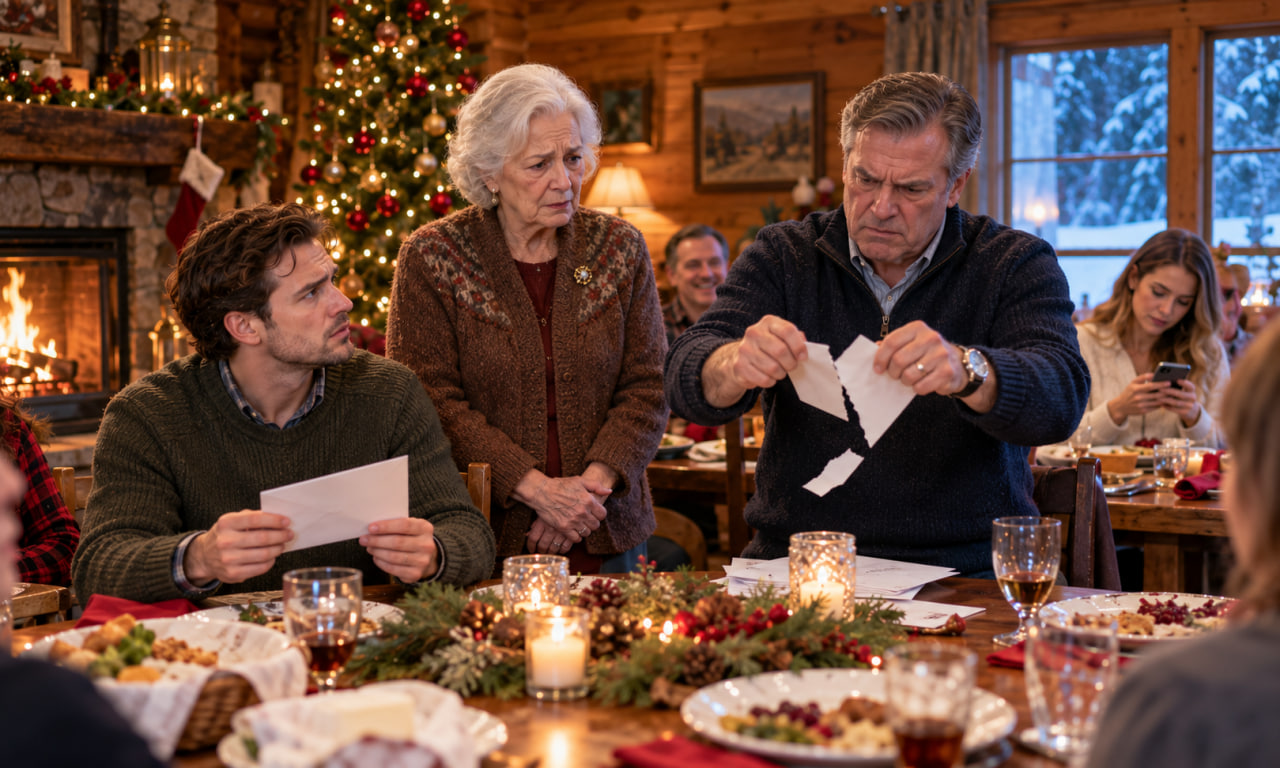
The torn pieces of his check.
I’d never seen them before.
Dad held them out to Grandma.
“I kept them,” he said.
She stared at the sleeve.
“Why?”
“I don’t know. Maybe because I knew I’d made a mistake, even while I was pretending I hadn’t.”
His voice cracked slightly.
“I’m sorry, Mom.”
Grandma took the sleeve.
She didn’t scold him.
She didn’t remind him of every cruel thing he’d said.
She simply reached for his hand.
“Oh, Daniel.”
Dad lowered his head.
“I thought the money was what mattered. Then I thought the land was what mattered. I was so busy thinking about what I might receive that I forgot what I’d already been given.”
Grandma pulled him into a hug.
And my father, a man who had spent most of his life hiding his feelings behind anger, began to cry.
I turned away to give them privacy.
Some apologies arrive too late to erase the hurt.
But sometimes they arrive early enough to begin repairing it.
That afternoon, Dad sat with Grandma for nearly three hours.
He asked about Grandpa’s business, the early years, and the decisions they’d made to protect their savings.
He listened to stories he’d heard a hundred times before.
And when Grandma’s cough grew worse, he noticed.
“Mom, have you seen a doctor about that?”
She waved him away.
“It’s just an old woman’s cough.”
“Then we’ll make an appointment.”
He didn’t ask whether she wanted him to take charge of her life.
He asked whether she would let him help.
It was a small difference.
But it mattered.
Part 6: The Last Christmas at the Cabin
The following December, I drove back to Wyoming for Christmas.
This time, I arrived before sunset.
The driveway had been cleared. The porch railing had been repaired. New firewood was stacked neatly beside the door.
Inside, the cabin smelled of cinnamon, pine, and Grandma’s apple pie.
Mom was setting the table.
Eric was carrying in groceries.
Olivia was hanging ornaments on the Christmas tree while Grandma sat in her favorite chair, giving instructions from a safe distance.
Dad was in the kitchen, trying to prepare Grandpa’s old potato recipe.
He was doing a terrible job.
“You’re adding too much salt,” Grandma called.
“I’ve followed the instructions exactly.”
“You’ve followed your interpretation of the instructions.”
Eric laughed.
Dad pointed the wooden spoon at him.
“Would you like to cook?”
“No, thank you. I have enormous respect for your culinary talents.”
For the first time in years, the laughter in the cabin felt warm.
Not cruel.
Not at anyone’s expense.
Just a family laughing together.
After dinner, Grandma asked everyone to gather around the fireplace.
She had prepared envelopes again.
My heart stopped for a moment when I saw them.
Dad glanced at the table and immediately shook his head.
“Mom, please tell me those aren’t checks.”
Grandma laughed.
“No, son. I believe we’ve had enough excitement with checks for one lifetime.”
She handed each of us an envelope.
Inside was a photograph.
Mine showed Grandpa and me beside the birdhouse we’d built when I was seven. The birdhouse still leaned at a ridiculous angle.
On the back, Grandma had written:
Some things don’t have to be perfect to be worth keeping.
Mom’s photograph showed her as a young woman standing beside Grandma in a garden.
Eric’s showed him riding on Grandpa’s shoulders.
Olivia’s showed her as a toddler asleep against Grandma’s chest.
Dad’s was different.
It showed him as a little boy, holding his father’s hand outside the old hardware store.
For a long time, Dad stared at it.
Then he pressed his lips together and looked away.
Grandma watched us quietly.
“I wanted you to have something that reminded you of where we began,” she said. “Not the money. Not the land. Just the people who loved you before you became whatever the world expected you to be.”
She leaned back in her chair.
“I know none of us will be here forever. That’s why I want you to stop waiting for a special occasion to visit the people you love.”
Nobody laughed.
Nobody checked a phone.
Nobody asked about the value of the property.
For the rest of the evening, we talked.
We told stories about Grandpa. We argued over which recipes were best. Eric admitted that his first business idea had been terrible. Olivia talked about a professor who had encouraged her to become a teacher.
Dad sat beside Grandma and held her hand.
At one point, I noticed that she was watching the Christmas lights reflected in the window.
“What are you thinking about?” I asked.
She turned toward me.
“I’m thinking that your grandfather would have liked this.”
“He would have.”
She smiled.
“He always wanted the family to be together. He just never knew how to make it happen.”
I looked around the room.
Perhaps neither had Grandma.
Perhaps that was why she’d given us the checks.
Not to buy our love.
Not to test us like contestants in some elaborate game.
But to give each of us a chance to reveal what we valued when confronted with something we hadn’t expected.
The money had exposed our flaws.
It had also given us the opportunity to confront them.
And that, I realized, was worth more than the numbers printed on those checks.
Later that night, I helped Grandma to her bedroom.
Before she closed the door, she took my hand.
“Daniel, I want you to promise me something.”
“Anything.”
“Don’t let this money become your entire story.”
I smiled sadly.
“I won’t.”
“Keep teaching. Keep learning. Keep helping people when you can. And don’t forget to visit simply because you miss someone.”
“I promise.”
She kissed my cheek.
“Good night, sweetheart.”
“Good night, Grandma.”
I watched her close the door.
I didn’t know that it would be one of the last Christmases we would spend together.
But I was grateful that we’d spent it differently from the one before.
Part 7: What Grandma Left Behind
Grandma Evelyn died peacefully the following spring.
She was eighty-three.
My father called me early one morning. I could barely understand him through his tears.
I drove to Wyoming that same day.
When I arrived, Mom was sitting beside Grandma’s chair, holding one of her old knitting projects. Eric stood by the fireplace, staring at the logs. Olivia had brought flowers from the garden and placed them in a glass vase beside the window.
Dad was on the porch.
He was holding the photograph Grandma had given him at Christmas.
I stood beside him.
“I’m sorry,” I said.
He nodded.
For a while, we watched the trees moving in the wind.
Then Dad spoke.
“She called me last week.”
I turned toward him.
“What did she say?”
“She wanted to know whether I’d remembered to winterize the pipes before the next cold spell.”
Despite everything, I laughed softly.
“That sounds like her.”
He smiled through his tears.
“Then she asked whether I was happy.”
I waited.
“I told her I was trying to be.”
He swallowed.
“She said that was a good start.”
Dad lowered his eyes.
“I spent so many years thinking happiness was something you achieved once you’d secured enough money, enough property, enough respect. Your grandmother understood something I didn’t.”
“What?”
“That a life can be full even when the house is small. That you can be rich and still be lonely. And that you can lose years chasing things you already have.”
He folded the photograph carefully and placed it in his pocket.
“I wish I’d understood sooner.”
I put my hand on his shoulder.
“So do I.”
We stood there together until the wind grew cold.
Then we went inside.
Grandma’s funeral was held a few days later.
People came from the town, from neighboring farms, and from places I’d never heard of. Some had known her for decades. Others had met her only recently.
One woman approached me after the service.
She was in her early forties and wore a simple blue dress.
“Are you Daniel?” she asked.
“Yes.”
She smiled sadly.
“Your grandmother helped me when I was younger. My mother had died, and I was trying to finish college while working two jobs. Evelyn paid for my textbooks one semester. She told me I could repay her by helping someone else when I was able.”
I felt my throat tighten.
“I didn’t know.”
“She never wanted anyone to know.”
The woman looked toward the photographs beside the altar.
“She was a good person.”
After she left, another person came forward with a similar story.
Then another.
A retired teacher told me that Grandma had quietly donated books to a local school.
A farmer explained that she’d once helped his family repair a damaged water system without accepting repayment.
A young man said she’d encouraged him to apply for a scholarship when he was convinced he wasn’t smart enough.
I stood there, listening, and realized that the fortune we’d discovered was only one part of her life.
The real story was the countless small acts of kindness that had never appeared on a bank statement.
After the funeral, the estate was administered according to the legal documents Grandma had prepared. Her financial gifts remained separate from the arrangements for the property and the other assets.
The conservation plan proceeded through the necessary reviews.
The scholarship fund expanded.
The cabin remained standing.
And the family, slowly, learned to gather there without treating every conversation as an opportunity to discuss money.
A year later, I returned to the cabin alone.
Snow covered the porch.
The old rocking chair stood beside the window.
Grandma’s favorite mug remained on the kitchen shelf, exactly where she’d always kept it.
I walked through the rooms, touching the familiar furniture, remembering her voice.
Then I sat beside the fireplace and took out Grandpa’s letter.
I’d carried it in my bag for months.
I read it one more time.
You are allowed to use it wisely.
I thought about the students who had received scholarships.
I thought about the home I’d bought, modest but comfortable, where I could finally invite friends over without worrying about rent.
I thought about my father, who now called me every Sunday, sometimes with nothing important to say.
And I thought about Grandma, who had given us the opportunity to become a better family without demanding that we become perfect.
I folded the letter and returned it to its envelope.
Then I walked outside.
The sky above the mountains was turning gold.
For a moment, I could almost hear Grandpa laughing from the porch, telling me that the birdhouse we’d built together was still the ugliest thing he’d ever seen.
I smiled.
“I’m trying, Grandpa,” I whispered.
And for the first time since Grandma died, I felt peaceful.
Epilogue: The Check That Changed Everything
Three years later, my father and I were cleaning out a storage cabinet in the cabin when he found an old envelope tucked behind a stack of photographs.
He pulled it free.
Inside were the four torn pieces of his original six-million-dollar check, still preserved in the transparent sleeve.
He stared at them for a long time.
Then he handed them to me.
“Keep this,” he said.
“Why?”
“Because I need to remember the man I was when I received it.”
I shook my head.
“You don’t have to keep punishing yourself.”
“I’m not.”
He looked toward the living room, where Mom and Olivia were preparing lunch while Eric argued with a delivery driver about the best route to the property.
“I’m reminding myself that I nearly threw away something valuable because I decided I already knew what it was.”
He paused.
“And I don’t mean the money.”
I understood.
The check had been worth six million dollars.
The land had been worth tens of millions more.
But neither could buy the Christmas dinners we’d missed, the phone calls we hadn’t made, or the years Grandma had spent waiting for someone to stay a little longer.
Those things could only be given freely.
And they could only be appreciated while there was still time.
That afternoon, we gathered around the table for lunch.
Nobody brought up the estate.
Nobody discussed investments.
Dad told a terrible joke about Grandpa’s old birdhouse, and everyone groaned.
Then we laughed.
As I looked around the table, I remembered that first Christmas, when my family had laughed at Grandma’s gift and my father had torn his check into four pieces.
I remembered the bank manager’s pale face.
I remembered the secrets, the arguments, the apologies, and the woman who had quietly watched us reveal ourselves.
And I finally understood why Grandma had never defended the checks.
She hadn’t needed to.
The truth had been there all along.
My grandmother’s six-million-dollar gift didn’t make our family wealthy. It revealed what we had been too distracted to recognize: we already possessed something money could never replace, and we’d almost lost it while arguing over what we might inherit.
I still have my original check tucked inside Grandpa’s letter.
Not because I need proof of the money.
But because whenever I look at it, I remember the most important lesson my grandparents ever taught me.
The greatest inheritance isn’t what someone leaves you when they die. It’s what they teach you while they’re still alive.