
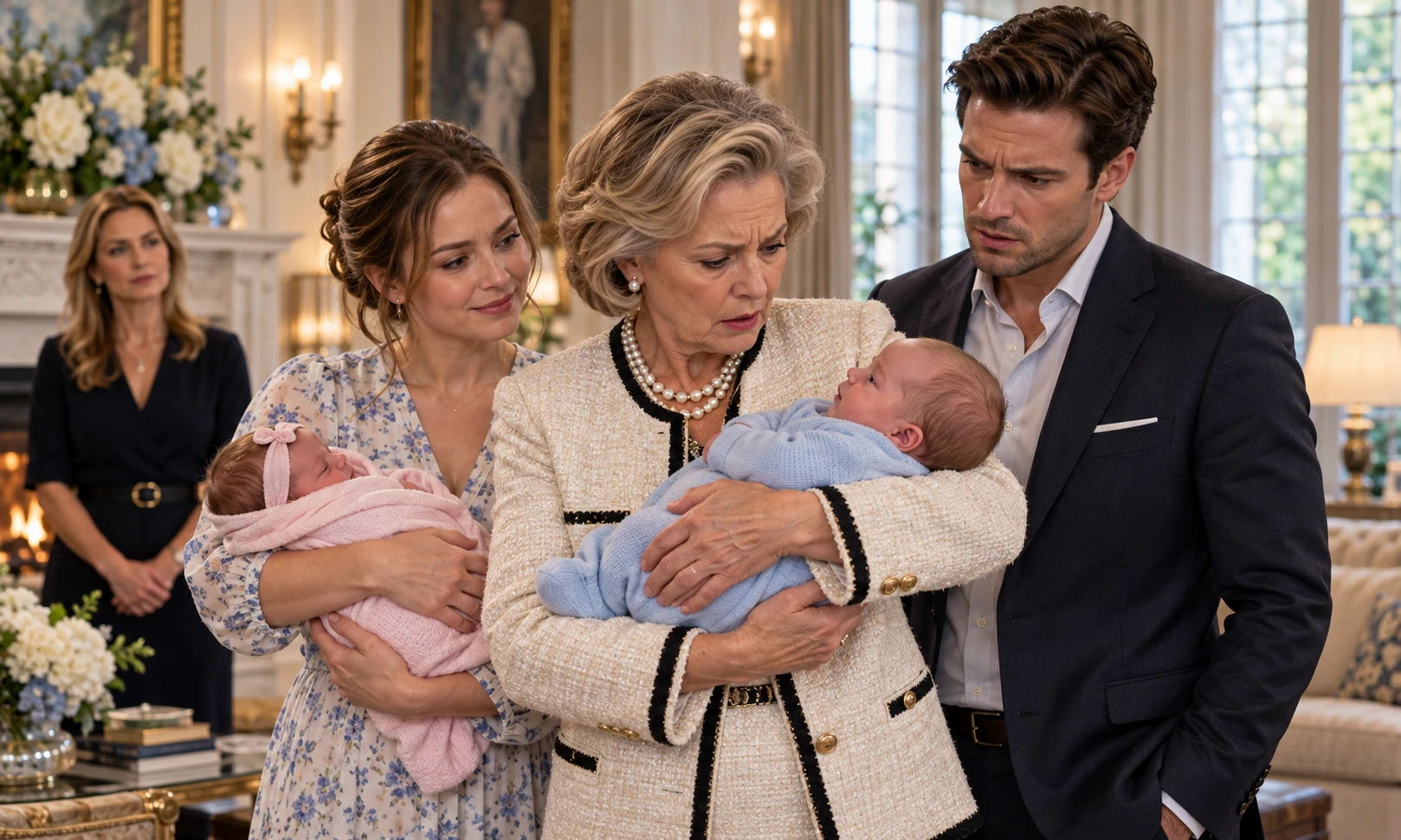
“Yes.”
“I already know that.”
“No,” she said.
“You know what we told you.”
My throat tightened.
“What are you saying?”
She slid a document across the table.
I looked down.
It was my original laboratory report.
Then she placed another document beside it.
Blake’s.
I read the first page.
Then the second.
Then I stopped breathing.
There were two sets of results.
One had been included in the medical file.
The other had been removed.
“Blake’s test,” I whispered.
Dr. Grant nodded.
“His results were not normal.”
“How abnormal?”
She hesitated.
“Severely.”
I stared at her.
“Then how are there twins?”
She didn’t answer immediately.
Instead, she opened another section of the file.
“We need to talk about something that happened during your treatment.”
My hands began trembling.
“What?”
Dr. Grant looked directly into my eyes.
“There was a specimen mix-up.”
I couldn’t speak.
“Years ago,” she continued, “during one of the procedures, another patient’s genetic material was mistakenly entered into the system.”
I swallowed.
“Whose?”
“We don’t know.”
“But you said there was a mix-up.”
“Yes.”
“And Lauren?”
Dr. Grant shook her head.
“Lauren wasn’t your patient.”
My mind raced.
“Then why are you telling me this?”
She leaned forward.
“Because after the twins were born, another doctor reviewed their records.”
She pushed one final document toward me.
I looked at the page.
There was a phrase highlighted in yellow.
PATERNITY DISCREPANCY.
My entire body went numb.
“Whose children are they?” I whispered.
Dr. Grant looked at me.
“We don’t know yet.”
“Does Blake know?”
Her silence answered the question.
Then my phone vibrated.
A message from an unknown number appeared on the screen.
You need to come home, Natalie. Before Blake brings those babies to his family.
I stared at the words.
The message had been sent that morning.
But the date attached to the photograph I’d received was from three weeks earlier.
And suddenly, one thought terrified me more than anything else.
What if the person who sent me the message wasn’t trying to protect me?
What if they were warning me because someone had already discovered the truth?
I looked back at Dr. Grant.
“Who knows about this?”
She closed the folder.
“That’s the problem.”
“Why?”
“Because the first person who asked for the twins’ records wasn’t Lauren.”
My blood ran cold.
“Who was it?”
Dr. Grant hesitated.
Then she said:
“Diane Calloway.”
My ex-mother-in-law.
The woman who had spent years believing I was responsible for her son’s infertility.
The woman who had welcomed Lauren into the family.
The woman who had just become grandmother to twins.
I stood so quickly that my chair scraped against the floor.
“Why would she request their records?”
Dr. Grant looked at me with something close to fear.
“Because she already suspected the babies weren’t Blake’s.”
I stared at her.
“And if she suspected that…”
Dr. Grant nodded.
“Then someone else probably did too.”
That evening, I received one final message.
This time, there was no photograph.
No warning.
Just six words.
Blake knows who their father is.
PART 4
Blake knows who their father is.
I read the message three times.
Then I turned the phone face down on the café table.
For several seconds, neither Dr. Grant nor I spoke.
The noise around us seemed distant.
Coffee machines hissed.
People laughed at nearby tables.
A waiter dropped a spoon.
But all I could hear was that sentence repeating in my head.
Blake knows who their father is.
I looked at Dr. Grant.
“Did you send that message?”
She shook her head.
“No.”
“Do you know who did?”
“No.”
I took a slow breath.
“Then tell me everything.”
Dr. Grant opened the folder again.
“This is difficult to explain because some of what happened was discovered after you left the clinic.”
“I don’t care how difficult it is.”
I pointed at the papers.
“I’ve spent years believing I was incapable of giving my husband a child. If there’s something you know, I want the truth.”
She nodded.
“After your divorce, a quality-control review was conducted at the fertility center. Your treatment records were among several files flagged for inconsistencies.”
“What inconsistencies?”
“Your original records showed that your fertility testing was normal. But there were changes in the electronic system.”
“Changes made by whom?”
“We couldn’t establish that immediately.”
I stared at her.
“But you know now.”
She hesitated.
“We know someone accessed your file using credentials associated with a physician who wasn’t involved in your treatment.”
My stomach tightened.
“Blake?”
“No.”
“Lauren?”
“No.”
“Then who?”
She slid another document across the table.
A name appeared on it.
Dr. Samuel Pierce.
I stared at it.
“Pierce?”
Dr. Grant nodded.
“Lauren’s father.”
I felt the air leave my lungs.
“He was a physician?”
“A reproductive endocrinologist. He retired several years ago.”
I leaned back.
“So Lauren’s father had access to the clinic?”
“Not directly. But he had professional relationships with several physicians there.”
“Why would he access my records?”
“We don’t know.”
I looked at the documents again.
“Then what do we know?”
Dr. Grant’s voice became quieter.
“We know that your husband’s sperm analysis was significantly worse than what he told you.”
I frowned.
“How much worse?”
“He had extremely low viable sperm counts in multiple tests.”
I remembered Blake sitting across from me after our second appointment.
His expression.
His irritation.
His words.
Maybe your body knows you don’t have room for a baby.
I suddenly felt sick.
“He knew.”
Dr. Grant nodded.
“He was informed.”
“And he blamed me anyway.”
“Yes.”
I closed my eyes.
For eleven years, I had carried shame that never belonged to me.
I opened them again.
“What happened after that?”
“Blake requested that his records remain confidential.”
“That makes sense.”
“But then there was another test.”
“What test?”
“A private genetic screening.”
I stared at her.
“Why?”
“Because someone requested confirmation of paternity.”
My heart began pounding.
“Who?”
Dr. Grant looked at me.
“Blake.”
I sat completely still.
“He knew the twins might not be his?”
“He suspected it.”
“Before they were born?”
“Yes.”
“Then why did he announce them as his?”
She didn’t answer.
I already knew.
Because Blake didn’t care about truth.
He cared about appearances.
I left the café with copies of every document Dr. Grant could legally provide me.
On the drive home, I called my attorney.
He answered immediately.
“Tell me you didn’t contact Blake.”
“I didn’t.”
“Good.”
“I know who requested the paternity test.”
“Who?”
“Blake.”
There was silence.
Then my attorney said,
“That changes everything.”
“I know.”
“Come to my office tomorrow morning.”
“I’ll be there.”
I barely slept that night.
At 6:17 the next morning, my phone rang.
It was Diane Calloway.
I almost didn’t answer.
Then I did.
“Hello?”
Her voice was trembling.
“Natalie?”
“Yes.”
“I need to see you.”
“Why?”
“Because I owe you an apology.”
I sat up in bed.
“What happened?”
“I finally know the truth.”
My chest tightened.
“About what?”
“The twins.”
I said nothing.
Diane continued.
“Blake is bringing them to my house tomorrow.”
“Why?”
“He wants to introduce them to the entire family.”
I almost laughed.
“And?”
“And I don’t think they’re his.”
“I know.”
The silence on the other end was immediate.
“You know?”
“Yes.”
“How?”
“That isn’t important.”
“It is to me.”
“Diane, you believed for years that I was the reason your son couldn’t have children.”
“I was wrong.”
“You weren’t the only one.”
Her voice broke.
“I know.”
I heard her crying.
For a moment, I felt something I hadn’t expected.
Pity.
Not forgiveness.
Not yet.
But pity.
“What did you discover?” I asked.
“I found something in Blake’s study.”
“What?”
“A DNA report.”
My heart stopped.
“Paternity?”
“Yes.”
“What did it say?”
“I don’t understand all the medical language.”
She inhaled shakily.
“But it said the probability that Blake was the biological father of the twins was less than one percent.”
I closed my eyes.
“So he knew.”
“Yes.”
“Does Lauren know?”
“I don’t know.”
“Why did Blake bring the babies to you?”
Diane hesitated.
“Because he wants the family to publicly accept them.”
“Why?”
“Because his father left a provision in the family trust.”
I immediately understood.
“The inheritance.”
“Yes.”
“What provision?”
Diane’s voice dropped.
“Calloway family assets can only pass to direct descendants.”
I stared at the wall.
“So Blake needs the twins to be recognized as his children.”
“Yes.”
“Even if they’re not.”
“Yes.”
That explained the trust.
The mysterious corporate documents.
The unborn beneficiaries.
The forged signature.
Everything.
Blake wasn’t building a family.
He was constructing an inheritance strategy.
But there was one thing I still didn’t understand.
“Diane, if you knew the twins weren’t Blake’s, why didn’t you confront him?”
“I did.”
“What did he say?”
“He told me the test was wrong.”
“And you believed him?”
“I wanted to.”
Her voice cracked.
“He is my son.”
I looked down at my hands.
“So what do you want from me?”
“I want you there tomorrow.”
“No.”
“Please.”
“I don’t belong in your family anymore.”
“You are the person who knows what Blake is capable of.”
“That should have been obvious to you years ago.”
“I know.”
She cried again.
“I know.”
I almost ended the call.
Then she said something that made me stop.
“There’s another reason.”
“What?”
“The little boy.”
“What about him?”
“He looks exactly like someone in our family.”
My heartbeat quickened.
“Who?”
“Blake’s younger brother.”
I frowned.
“Blake doesn’t have a younger brother.”
“He did.”
I froze.
“What?”
Diane took a shaky breath.
“His name was Daniel.”
I remembered nothing about Daniel.
Because Blake had never mentioned him.
Not once.
“Where is he?”
Diane whispered,
“He died twenty-two years ago.”
My skin prickled.
“How?”
“A car accident.”
“Why would the baby look like him?”
“I don’t know.”
“Diane, what aren’t you telling me?”
She was silent for so long that I almost thought the call had disconnected.
Then she said,
“Daniel was Lauren’s biological father.”
I stopped breathing.