
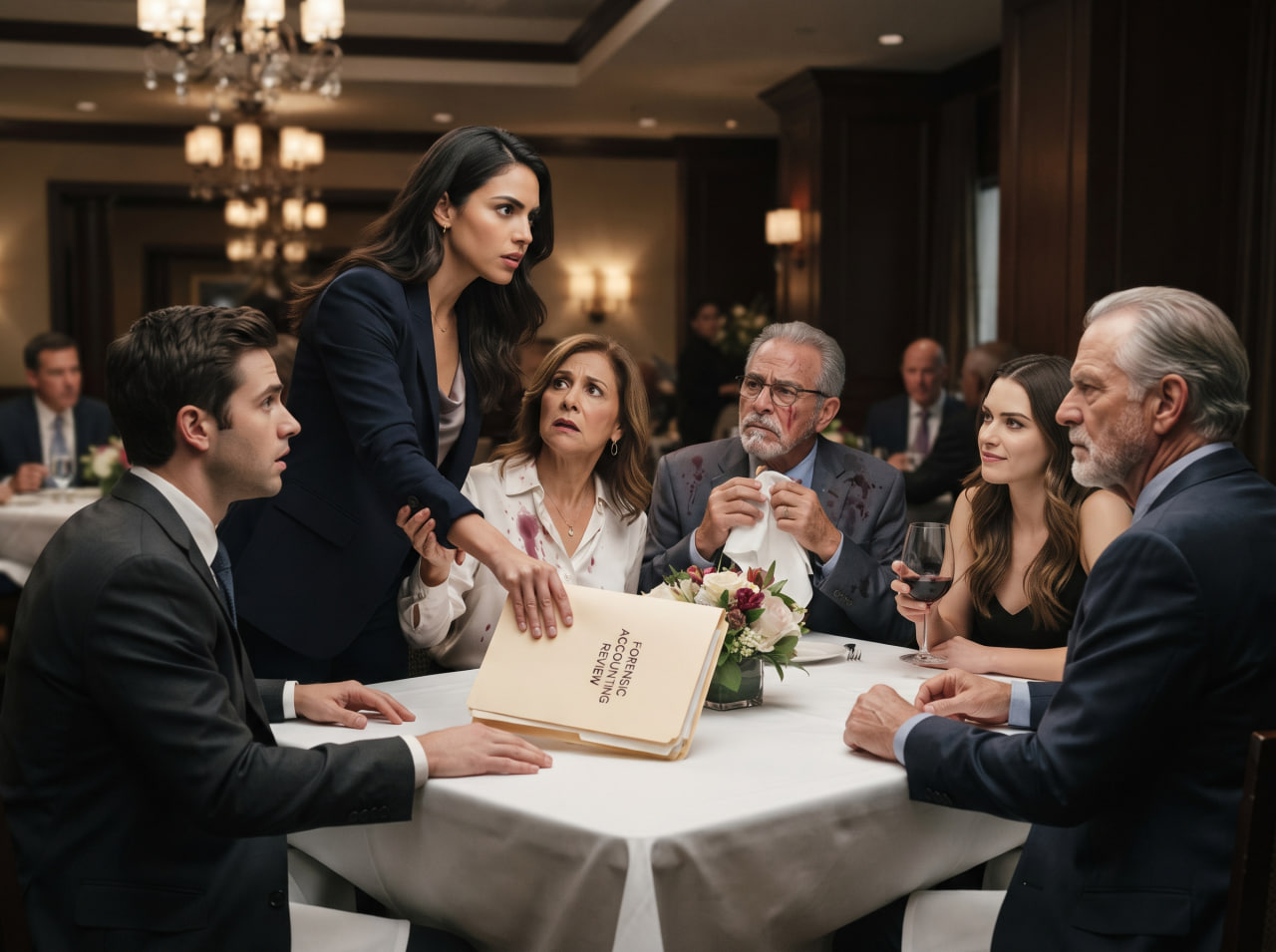
“About what?”
“The money.”
“Which money?”
“All of it.”
I said nothing.
He rubbed his hands together.
“I knew Dad moved money around.”
“How much?”
“I don’t know.”
“You knew.”
“Yes.”
“When?”
“About two years ago.”
My chest tightened.
“And you said nothing.”
“I thought it was tax planning.”
“You never asked?”
“I did.”
“What did he say?”
“That it was temporary.”
“Did you believe him?”
“I wanted to.”
There it was.
The truth.
Not innocence.
Not guilt.
Something more painful.
Cowardice.
Daniel looked at me.
“I was scared.”
“So was I.”
“I thought if I confronted him, I’d lose everything.”
I stared at him.
“You were afraid of losing your inheritance.”
“No.”
“You were afraid of losing your father’s approval.”
He didn’t answer.
That was enough.
“I spent years thinking your father controlled you,” I said.
“He did.”
“No.”
Daniel looked up.
“You let him.”
His eyes filled.
“I know.”
That was the first honest thing he had said in years.
He pulled an envelope from his jacket.
“What is that?”
“My resignation.”
I didn’t touch it.
“From Harrington Group?”
“Yes.”
“Why?”
“Because I’m done.”
He placed it on the table.
“I’ve hired an attorney. I’m cooperating with the investigation.”
I studied him.
“Why now?”
“Because I finally realized something.”
“What?”
“If I keep protecting my family, I’ll lose the only person who ever actually stood beside me.”
My heart hurt.
But I didn’t reach for him.
“You already lost me.”
His eyes filled with tears.
“I know.”
He nodded slowly.
“I just wanted you to know that I understand why.”
For several minutes, neither of us spoke.
Then he said:
“I loved you.”
I looked at him.
“I believe you.”
His eyes lifted.
“But love isn’t enough.”
He nodded.
“I know.”
I slid a document across the table.
It was the first draft of our divorce agreement.
He looked at it.
Then signed.
No shouting.
No threats.
No dramatic scene.
Just a pen moving across paper.
Eight years of marriage ending in less than a minute.
When he stood, he hesitated.
“Claire?”
“Yes?”
“I am sorry.”
This time, I believed him.
But forgiveness didn’t mean returning.
I simply nodded.
“Goodbye, Daniel.”
He walked away.
I watched the door close.
And for the first time, I didn’t feel abandoned.
I felt free.
The investigation lasted eight months.
Eight months of subpoenas.
Audits.
Interviews.
Bank records.
Emails.
Corporate filings.
And thousands of pages of documents.
The forensic accountants eventually reconstructed what had happened.
Charles had created a network of related companies.
Money moved from Harrington Group to outside vendors.
Those vendors transferred portions of it to intermediary companies.
Some of those companies paid for personal expenses.
Some purchased property.
Some provided consulting agreements for services that never existed.
Madison had benefited from the arrangement.
Her luxury expenses were only the smallest visible part.
Charles had used company funds to support properties and investments that were never properly disclosed.
And the missing $14.7 million was not simply one act.
It was years of financial manipulation.
The evidence was overwhelming.
But there was one surprise.
Daniel had not designed the scheme.
He hadn’t created Meridian Advisory.
He hadn’t established the shell companies.
And he hadn’t knowingly participated in most of the transfers.
His biggest mistake had been knowing something was wrong and choosing silence.
That distinction mattered legally.
It also mattered personally.
Because I finally understood something about betrayal.
Sometimes betrayal isn’t what someone does.
Sometimes it’s what they refuse to do.
They refuse to speak.
They refuse to defend you.
They refuse to ask questions.
They refuse to stand beside you when standing beside you costs them something.
Daniel had spent years choosing silence.
And silence had consequences.
Madison eventually called me.
It was six months after the dinner.
I almost didn’t answer.
But I did.
“Hello?”
She was crying.
“I need to talk to you.”
“About what?”
“Everything.”
“I don’t think there’s anything left to discuss.”
“Please.”
I remained silent.
She continued.
“I know you hate me.”
“I don’t hate you.”
“Then why did you destroy my life?”
I took a breath.
“I didn’t.”
“You gave them the documents.”
“Yes.”
“You knew what would happen.”
“I knew the truth would come out.”
She began crying harder.
“I didn’t know Dad was doing all that.”
I believed she hadn’t known everything.
But I also remembered the Miami hotel.
The expense reports.
The lies.
“You knew enough to ask questions,” I said.
She was silent.
“I was stupid.”
“Maybe.”
“I was spoiled.”
“Yes.”
She sniffed.
“I was cruel to your parents.”
“Yes.”
“I thought they were beneath us.”
I said nothing.
“I was wrong.”
That was the first apology she had ever given me.
It wasn’t enough to erase what happened.
But I accepted it.
“Madison, I hope you learn from this.”
“I will.”
Then she whispered:
“Your mother never deserved that.”
“No.”
“She was always kind to me.”
I closed my eyes.
“She was.”
We ended the call.
I never spoke to her again.
My parents recovered.
Not financially.
Emotionally.
That took longer.
Mom still refused to wear white silk to formal dinners.
Dad stopped attending Harrington family events completely.
One afternoon, I found him sitting in his backyard reading a newspaper.
I sat beside him.
“Dad?”
“Hmm?”
“I’m sorry.”
He lowered the paper.
“For what?”
“For bringing you into that family.”
He smiled.
“You didn’t bring me anywhere.”
“What do you mean?”
“I came because I loved my daughter.”
My eyes filled.
He folded the newspaper.
“Claire, listen to me.”
I looked at him.
“You were never responsible for how other people treated us.”
“But—”
“No.”
He shook his head.
“You spent too much of your life trying to make other people behave.”
He put a hand over mine.
“You can’t control people’s character.”
I nodded.
“But you can control who gets access to you.”
That sentence stayed with me.
A year after the dinner, I opened my own financial consulting firm.
Nothing huge.
No marble lobby.
No family name above the door.
Just a small office downtown and three employees who cared about doing good work.
My first major client was a manufacturing company struggling with internal controls.
My second was a nonprofit.
My third was a family-owned business.
I almost laughed when they told me why they hired me.
“We heard you don’t tolerate financial nonsense.”
I smiled.
“I don’t.”
My parents helped me choose the office furniture.
Mom picked the curtains.
Dad assembled the bookshelves incorrectly and insisted they were supposed to lean.
I let him believe it.
For the first time in years, my life was quiet.
Then, one Friday afternoon, an envelope arrived.
No return address.
Inside was a photograph.
It was from the night of the anniversary dinner.
Someone had taken a picture of my mother and father immediately after the wine was thrown.
Mom was looking down.
Dad was cleaning his glasses.
And I was standing behind them.
My face was turned toward Daniel.
On the back of the photograph, someone had written:
You were right to leave.
I stared at the handwriting.
I recognized it.
Daniel.
There was no message from him.
No request.
No attempt to reopen anything.
Just the photograph.
I placed it inside a drawer.
Then I closed it.
Some memories don’t need to be destroyed.
They simply need to stop controlling you.
Two years later, I saw Daniel again.
It happened unexpectedly.
I was walking into a coffee shop when I saw him sitting near the window.
He looked older.
Not dramatically.
Just different.
He stood when he saw me.
“Claire.”
I smiled politely.
“Daniel.”
“How are you?”
“Good.”
He smiled.
“Really?”
“Really.”
We stood there for a moment.
He looked toward my left hand.
No wedding ring.
Then back at me.
“I heard about your company.”
“Congratulations.”
“Thank you.”
“I heard you left Harrington Group.”
“I did.”
“What do you do now?”
“I teach accounting at a community college.”
I smiled.
“That sounds like you.”
He laughed softly.
“I’m better at explaining numbers than I was at explaining myself.”
“That might be true.”
He looked down.
“I never remarried.”
I didn’t respond.
He quickly added:
“You don’t have to say anything.”
“I wasn’t going to.”
We both laughed.
It was the first time we had laughed together in years.
Then he became serious.
“I want you to know something.”
“What?”
“I finally understand what you meant that night.”
I waited.
“You weren’t asking me to choose between you and my family.”
His eyes met mine.
“You were asking me to choose whether I was going to stand beside you.”
I nodded.
“And I didn’t.”
“No.”
“I thought staying silent kept the peace.”
“It kept the peace for everyone except me.”
“I know.”
He swallowed.
“I wish I had understood sooner.”
“So do I.”
We stood silently.
Then he said:
“I hope you’re happy.”
“I am.”
He smiled.
“Good.”
I smiled back.
“Take care, Daniel.”
“You too.”
And that was it.
No reconciliation.
No dramatic embrace.
No second chance.
Just two people who had once loved each other finally accepting that love could end without becoming hatred.
I walked out of the coffee shop.
The afternoon sun was bright.
Cars moved through the street.
People hurried past me carrying coffee, groceries, briefcases, flowers.
Ordinary life.
Beautiful ordinary life.
I stopped on the sidewalk.
For years, I had thought my life would collapse if my marriage ended.
Instead, my life had finally begun.
Three months later, I invited my parents to dinner.
Nothing fancy.
Just a small restaurant with warm lighting and good food.
Mom wore a blue dress.
Dad wore the same expensive suit he had worn to the Harrington anniversary.
The stain was gone.
Mostly.
He had refused to throw it away.
When we sat down, Mom smiled.
“Why did you bring us here?”
“I wanted to celebrate.”
“Celebrate what?”
I reached into my purse.
Not a forensic file.
Not legal documents.
Not financial statements.
A photograph.
I placed it on the table.
It was the three of us outside my office.
Mom smiled.
Dad looked proud.
I looked happy.
Mom touched the photograph.
“You look different.”
“I feel different.”
Dad raised his glass.
“To new beginnings.”
Mom raised hers.
“To family.”
I lifted mine.
“To choosing people who choose you back.”
We touched glasses.
And I realized something.
That night at the Harringtons’ anniversary dinner, I had thought my five-minute timer was the end of my marriage.
I was wrong.
It was the beginning of my life.
The wine had stained my mother’s blouse.
It had stained my father’s suit.
It had stained a tablecloth that probably cost more than my first car.
But the stain that mattered most wasn’t on the fabric.
It was on the illusion I had carried for years.
The illusion that keeping quiet was the same as keeping peace.
It wasn’t.
Silence had protected people who didn’t deserve protection.
My voice had finally protected the people who did.
I had once walked into the Harrington family believing I needed their approval.
I left understanding that I never had.
And when I think about that night now, I don’t remember the chandelier.
I don’t remember the wine.
I don’t remember Madison’s laughter.
I don’t even remember the exact moment the timer hit zero.
I remember my father putting his glasses back on.
I remember my mother reaching for my hand.
And I remember realizing that sometimes the strongest thing a person can do isn’t to fight harder.
Sometimes it’s simply to stop standing where they are not respected.
So I chose my parents.
I chose my dignity.
I chose the truth.
And, finally, I chose myself.
That was the real consequence nobody at that table had expected.
Not the forensic file.
Not the investigation.
Not the divorce.
Not the collapse of the Harrington empire.
The real consequence was that I stopped asking people to love me correctly.
I simply walked away from those who wouldn’t.
And for the first time in my life…
I didn’t look back.
THE END