
I touched the frame.
“We finally made it, sweetheart,” I whispered.
For the first time since his funeral, I felt that the future might contain something other than grief.
That evening, Helen and I sat on the porch drinking tea.
We talked about our childhood, our parents, and the ridiculous things Arthur used to do when he thought he was being funny.
We laughed until my cheeks hurt.
And when Helen finally went home, I entered my quiet house and realized something remarkable.
I wasn’t lonely.
I was alone, certainly.
But loneliness and solitude were not the same thing.
One felt like being unwanted.
The other felt like finally having room to breathe.
The first phone call
Colin called the following afternoon.
I watched his name appear on my phone for several seconds before answering.
“Hello, sweetheart.”
“Mom.” His voice sounded exhausted. “Have you settled in?”
“Yes. The house is lovely.”
“I’m glad.”
Silence followed.
Then he said, “Jessica and I have been talking.”
“That’s good.”
“We’ve realized that things haven’t been right for a long time.”
I waited.
He continued.
“Dad wouldn’t have wanted us treating you like that.”
Hearing Arthur’s name brought a sharp ache to my heart.
“No,” I said softly. “He wouldn’t.”
“I’m sorry, Mom.”
This time, his voice cracked.
“I know I’ve been selfish. I kept telling myself that because you were living with us, everything was fine. I never stopped to think about what you were giving up.”
I closed my eyes.
It was the first time Colin had acknowledged my sacrifices without immediately explaining them away.
“I appreciate you saying that,” I replied.
“Can I come visit you?”
I wasn’t ready to say yes.
“Not yet, sweetheart. I need some time.”
He exhaled slowly.
“Okay.”
Before hanging up, he added, “I love you, Mom.”
I looked out at the roses.
“I love you too, Colin.”
And I meant it.
But love, I was learning, did not require me to abandon myself.
The truth about the money
Over the next few weeks, I settled into my new life.
I joined a local gardening club, started attending a weekly book group, and volunteered twice a month at a community kitchen.
I also worked with Richard to establish the college funds for my grandchildren.
The money was protected for their education, with clear rules about how and when it could be used. Their parents couldn’t simply withdraw it for household expenses.
I had made that decision deliberately.
I wanted Lucas and Sophie to have opportunities, not obligations.
I wanted them to understand that generosity was something freely given, never something they could demand.
I also established a charitable fund in Arthur’s memory to help older people who were struggling to remain independent.
Arthur had always believed that people deserved dignity, especially when life had taken away much of their control.
I could think of no better way to honor him.
Meanwhile, Colin and Jessica searched for another rental property.
The process wasn’t easy. Moving was expensive, and they had grown accustomed to relying on my unpaid labor and the stability of their existing home.
But they found a three-bedroom rental before the deadline.
Richard handled the legal details professionally, and they moved out without any further dispute.
I didn’t celebrate their difficulties.
I didn’t want them to suffer.
I simply wanted them to learn to stand on their own feet.
Then, one Sunday morning, I received a letter from Sophie.
My granddaughter was sixteen, thoughtful, and far more observant than the adults around her realized.
Dear Grandma,
Dad says you have a beautiful new house. I’m glad you found somewhere you like.
I miss you. I miss your pancakes and the stories you tell me about Grandpa.
I also miss how you used to sit with me when I was upset about school. I didn’t realize how much I depended on you until you weren’t there.
I hope you’re happy.
Love, Sophie.
I read the letter twice.
Then I sat at my kitchen table and wrote back.
I told her that I was happy, that I missed her too, and that she was always welcome to visit me when we could arrange it with her parents.
I also told her something I wished someone had taught me when I was young.
You can love your family deeply without being responsible for making everyone else happy.
Never forget that your feelings matter, too.
I sealed the letter and mailed it that afternoon.
It was the first of many.
The visit I never expected
Three months after I left, Colin arrived at my cottage alone.
He stood on the porch holding a small paper bag.
For a moment, I hardly recognized him.
He looked tired, but there was something different in his expression. He seemed less certain that the world owed him an easy answer.
“Hi, Mom.”
I opened the door.
“Hello, sweetheart.”
He held up the bag.
“I brought you something.”
Inside was a small lemon cake from a bakery in town.
I smiled.
“You remembered.”
“Your favorite.”
I stepped aside.
“Come in.”
We sat at the kitchen table, and I made coffee.
For a while, we talked about ordinary things. The weather. My garden. His work. The grandchildren.
Then Colin placed both hands around his cup.
“I need to tell you something.”
I waited.
“When you left, I was angry.”
I nodded.
“I know.”
“I told myself you were punishing us. That you’d won money and suddenly thought you were better than everyone else.”
He swallowed.
“But after we moved, things got difficult. We had to do everything ourselves. Cooking, cleaning, arranging childcare, keeping track of bills.”
He gave a small, embarrassed laugh.
“And I realized that when you lived with us, I hardly ever asked whether you were tired.”
I looked at him quietly.
“Did you ever wonder why I kept doing everything?”
He lowered his eyes.
“Because you loved us.”
“Yes,” I replied. “But love doesn’t mean I never get tired.”
He nodded.
“I understand that now.”
I wanted to believe him.
But I had lived long enough to know that an apology was a beginning, not proof of change.
“Colin,” I said, “I don’t need you to repay me for everything I did. I never kept a list of your childhood expenses or counted the dinners I cooked.”
He smiled faintly.
“But I need you to understand something. I am not moving back into your house. I am not going to become your full-time housekeeper again. And I won’t give you money simply because you have come to visit.”
He looked up quickly.
“I wasn’t going to ask for money.”
“Good.”
Then I reached across the table and took his hand.
“If we are going to rebuild our relationship, it must be because we want to know one another again. Not because of what I can provide.”
He squeezed my fingers.
“I want that, Mom.”
For the first time, I believed he might mean it.
Before leaving, Colin walked through the garden with me. He admired the roses and helped me carry a heavy bag of soil to the shed.
It wasn’t a grand gesture.
It was a small act of kindness offered without an audience.
And perhaps that was the kind I had needed all along.
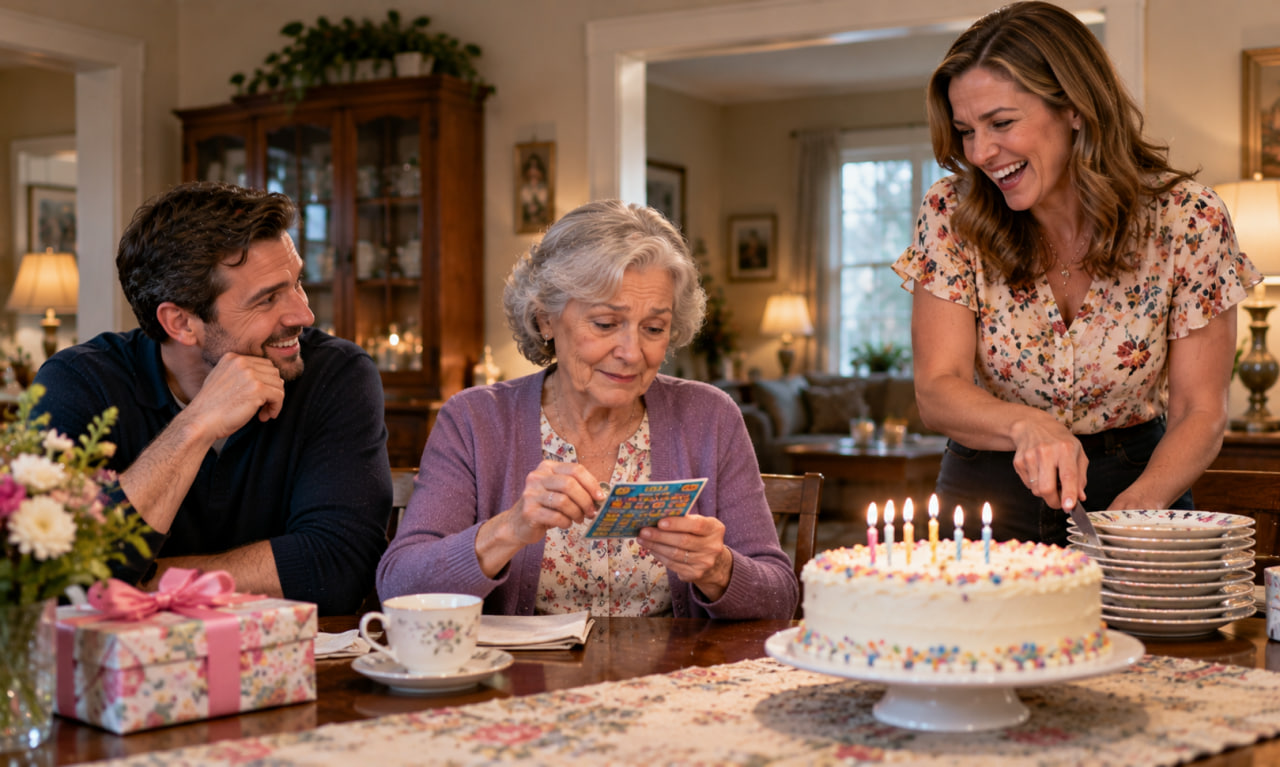
My seventy-fourth birthday arrived on a bright spring morning.
Helen came over early to help me prepare lunch. We made roast chicken, mashed potatoes, green beans, and the chocolate cake Arthur had loved.
I had invited a few friends from my gardening club.
For once, I didn’t spend my birthday working in the kitchen while everyone else enjoyed themselves.
We ate together, laughed together, and washed the dishes together.
Then came a knock at the door.
Colin stood on the porch with Jessica, Lucas, and Sophie.
For one brief moment, I wondered whether I was ready to see them all together.
Then Sophie ran forward and hugged me.
“Happy birthday, Grandma!”
I held her tightly.
Lucas followed with a shy smile and a handmade card.
Jessica remained near the doorway.
She looked nervous.
“Happy birthday, Margaret,” she said. “I hope it’s okay that we came.”
I stepped aside.
“Of course. Come in.”
They had brought flowers, a small box of chocolates, and a gift bag.
Inside the bag was a soft blue cardigan.
It was beautiful, but it wasn’t the gift that moved me.
It was the card tucked inside.
Jessica had written it herself.
Margaret,
I have thought a great deal about how I treated you. I told myself that I was being practical, that I was planning for the family’s future. But I never stopped to consider that I was making decisions about your future without respecting you.
I am sorry for making you feel unwanted in a home where you had given so much.