
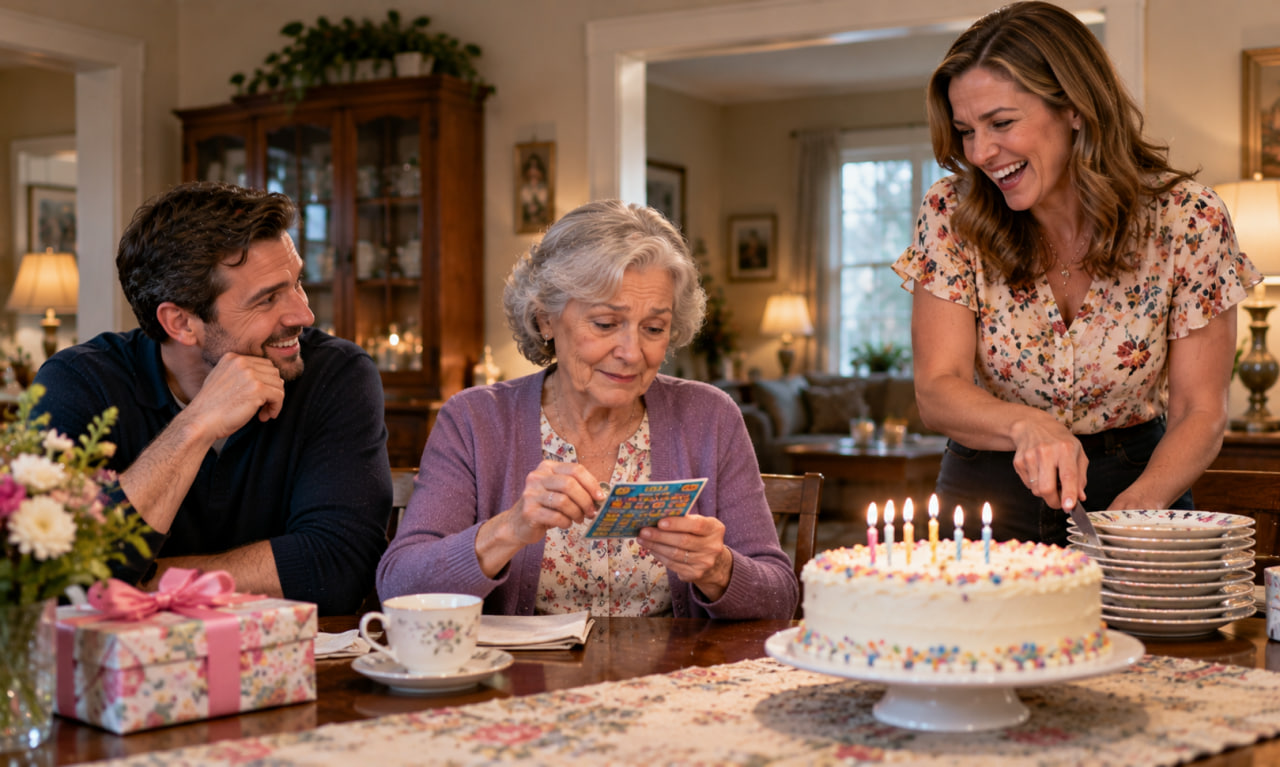
I cannot undo what happened, but I hope that, with time, I can become someone you feel comfortable having in your life again.
Happy birthday.
I read the message slowly.
Then I looked at her.
“Thank you, Jessica.”
Her eyes were wet.
“I know a card doesn’t fix anything.”
“No,” I said gently. “It doesn’t.”
She nodded, accepting my answer without arguing.
“But it’s a start,” I added.
She let out a shaky breath.
We spent the afternoon together.
Jessica helped Helen serve lunch. Colin cleared the table. Lucas asked me about the old stories of his grandfather, and Sophie insisted on seeing every rose in my garden.
Nobody treated me like a servant.
Nobody complained that I was taking up space.
When it was time for them to leave, Colin lingered on the porch.
“Mom, I have something else for you.”
He handed me a small envelope.
Inside was a photograph of Arthur holding baby Colin in the hospital.
On the back, Colin had written:
Thank you for loving me before I knew how to love you properly.
I pressed the photograph to my chest.
“Oh, sweetheart.”
He hugged me.
And for the first time in a very long time, I felt no need to hide my tears.
What I did with the winnings
Over the following year, my relationship with Colin slowly improved.
He began calling regularly, not just when he needed something. He asked about my garden, my friends, and the books I was reading.
Sometimes we disagreed.
Sometimes old hurts resurfaced.
But I learned to speak honestly instead of swallowing every disappointment to keep the peace.
And Colin learned that hearing the word no didn’t mean he had lost his mother.
Jessica changed more slowly, but she changed too. She stopped making assumptions about my availability and began asking before arranging family visits.
The grandchildren visited during school holidays, and my cottage became a place where they could make memories with me without anyone treating my presence as an inconvenience.
I never bought Colin a house.
I never paid off Jessica’s debts or funded their lifestyle.
Instead, I continued building the life I had chosen for myself.
I traveled with Helen, planted more roses, supported the charitable fund in Arthur’s name, and watched my grandchildren grow.
The money gave me security.
But it was the choices I made with that security that gave me peace.
Sometimes people ask me whether I regret keeping the lottery win secret.
I always give them the same answer.
I don’t regret protecting myself.
I wish I had understood sooner that I didn’t need millions of dollars to deserve respect. I had deserved it when I was cooking dinner in someone else’s kitchen, when I was folding laundry, and when I was sitting quietly at a birthday table while people laughed at a gift they believed was worthless.
The money didn’t make me valuable.
It simply gave me the freedom to stop accepting a life in which other people decided my value for me.
And that is something I will never forget.
On my seventy-fifth birthday, I sat on my porch in my blue cardigan, watching the afternoon sunlight settle over the roses.
My phone rang.
It was Colin.
“Happy birthday, Mom,” he said. “I love you.”
I smiled.
“I love you too, sweetheart.”
After we hung up, I looked at Arthur’s photograph beside the door.
“We did all right,” I whispered.
Then I picked up my gardening gloves and went outside.
My life was peaceful. My home was mine. My future belonged to me.
And for the first time in many years, I no longer needed to wonder whether I was welcome.
I was exactly where I wanted to be.
PART 4
Two years passed, and my little yellow cottage became everything I had dreamed it would be.
The roses grew thicker along the fence, the porch became my favorite place to read, and the kitchen was often filled with the smell of freshly baked bread.
I turned seventy-six that spring.
By then, Colin and I had rebuilt much of our relationship, slowly and carefully. He visited when he could, called without needing a favor, and began treating my time as something valuable.
Jessica had changed, too. We were never as close as sisters, but she learned to ask instead of assume, and I learned that forgiveness did not mean pretending the past had never happened.
Then, one afternoon, Colin arrived with Sophie and Lucas.
“Grandma,” Sophie announced, “Dad has something to tell you.”
Colin looked embarrassed.
“I got promoted at work.”
I hugged him.
“That’s wonderful, sweetheart!”
He smiled, then became serious.
“I also wanted to tell you that Jessica and I have started volunteering at a local organization that helps older people who need assistance living independently.”
I stared at him in surprise.
“Really?”
He nodded.
“After everything that happened, I realized how easily people can overlook older family members. We thought we could do something useful.”
I felt tears gather in my eyes.
Not because he was trying to prove himself to me, but because he had finally begun to understand something I had wanted him to understand for years.
Respect was not a gift you gave someone when it was convenient.
It was something they deserved simply because they were human.
Later that evening, after the children had gone home, I sat on the porch with a cup of tea and thought about the woman I had been before that lottery ticket.
I had believed that being a good mother meant always saying yes.
I had believed that keeping the peace was more important than speaking honestly.
And I had believed that if I sacrificed enough, the people I loved would eventually recognize how much I mattered.
I was wrong about those things.
Love should never require a person to disappear.
The lottery ticket had given me financial security, but the most valuable thing it had given me was the chance to see my life clearly.
I no longer confused being needed with being loved.
I no longer believed that growing older meant surrendering my right to choose.
And I no longer apologized for wanting a home, a future, and a little happiness of my own.
A week later, I received a letter from Sophie.
She had written it for a school assignment about someone who had taught her an important life lesson.
My grandmother taught me that being kind doesn’t mean letting people treat you badly. She loves our family, but she also knows how to take care of herself. When I grow up, I want to be brave enough to do both.
I read those words several times.
Then I placed the letter beside Arthur’s photograph.
I wished he could have seen the woman I had become.
That night, I sat beneath the porch light, listening to the wind move through the roses.
I thought about my seventy-third birthday, the little scratch-off ticket, and the laughter around the dinner table.
At the time, they had believed I was an old woman with nothing left to offer.
They had been wrong.
But the greatest lesson was not that I had secretly become wealthy.
It was that I had always deserved dignity, even before I won a single dollar.
I had simply needed to learn to demand it for myself.
And if I could offer one piece of advice to anyone reading my story, it would be this:
Never wait until you have money, power, or proof of your worth before you begin treating yourself as someone who matters.
You mattered when you were young.
You matter when you grow old.
You matter even when the people you love forget to show you.
As for me, I still live in my little yellow cottage. My roses bloom every spring, my grandchildren visit whenever they can, and Colin calls me every Sunday.
I have enough money to live comfortably for the rest of my life.
But when I count my blessings, the number in my bank account is no longer the first thing that comes to mind.
I think of the sunlight on my kitchen floor.
The sound of my grandchildren laughing on the porch.
The photograph of my husband beside my favorite chair.
And the simple, beautiful feeling of waking up every morning in a home where nobody gets to decide that I am a burden.
At seventy-six, I finally understand something that took me a lifetime to learn.
The greatest prize I ever won wasn’t the lottery. It was the freedom to live the rest of my life on my own terms.
And this time, nobody was going to scratch that freedom away from me.