
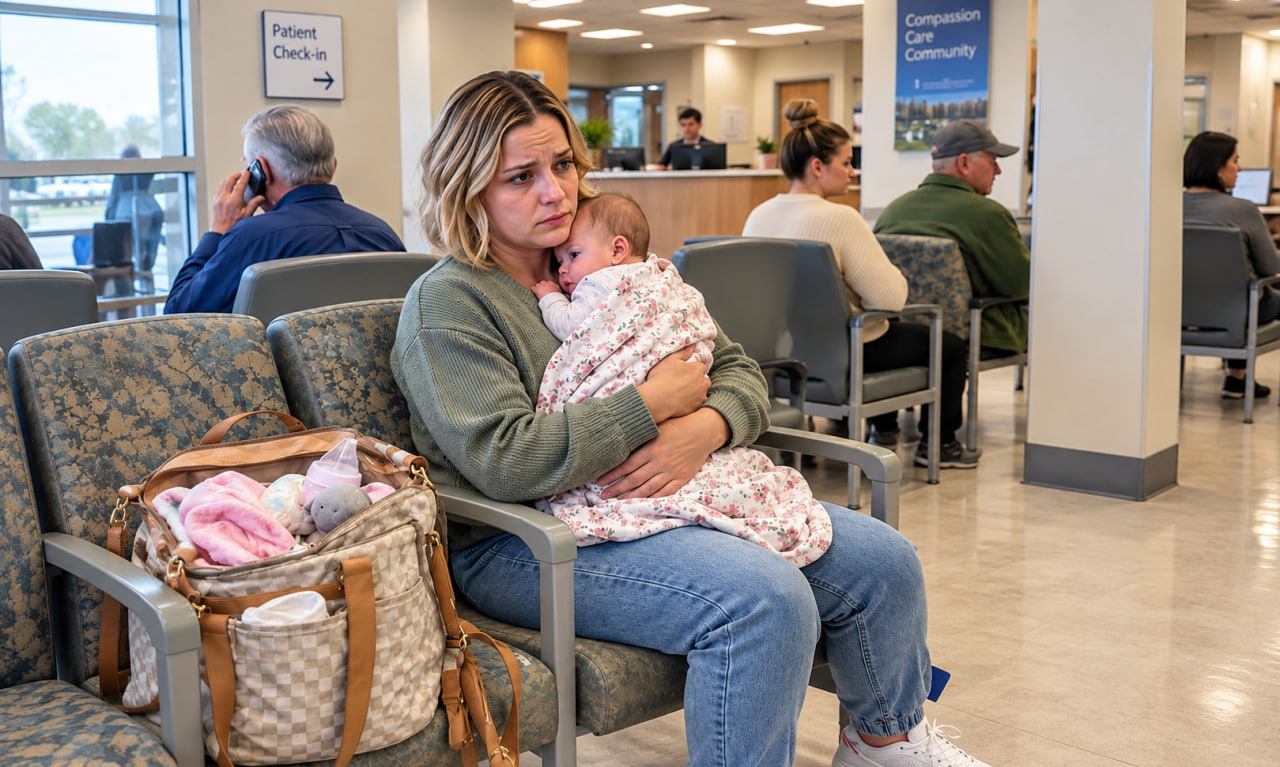
And for several seconds, he didn’t say a word.
Sylvia looked from him to the woman.
Then back to him.
“Ethan?”
He didn’t answer.
The woman walked directly toward us.
She stopped a few feet away and looked at me first.
“Rachel Donnelly?”
I nodded.
“Yes.”
“I’m Karen Miller.”
She opened the leather folder.
“I’m the hospital’s overnight patient advocate and social services representative.”
Sylvia immediately stepped forward.
“Social services?”
Karen looked at her calmly.
“Yes.”
Sylvia’s face hardened.
“There has been a misunderstanding.”
Karen didn’t react.
“I’m sure there has.”
She turned toward me.
“You called the hospital’s family support line and requested that someone come down because you were concerned about your infant’s safety and the circumstances surrounding her care.”
Ethan finally spoke.
“That isn’t what happened.”
Karen looked at him.
“Then perhaps you can explain what did happen.”
He opened his mouth.
Nothing came out.
I looked down at our daughter.
Her eyes were half closed.
Her tiny fingers were curled against my shirt.
She had been crying for hours.
I could feel every tiny breath against my chest.
Karen lowered her voice.
“How old is she?”
“Four months.”
“And she has a documented temperature of?”
“One hundred and four.”
Karen’s expression became more serious.
“Has she been evaluated by a physician yet?”
“Not yet.”
“And you’re her mother?”
“Yes.”
She looked toward Ethan.
“And you’re her father?”
He nodded.
“Yes.”
Karen closed the folder.
“Then why was there a concern that the father was leaving?”
Sylvia stepped between us.
“Because my son has an important professional obligation in the morning.”
Karen looked at her.
“I’m sorry?”
“My son has a presentation at nine o’clock. He’s been awake all night. His wife is perfectly capable of staying with the baby.”
Karen’s eyes moved slowly toward me.
Then toward Ethan.
Then back to Sylvia.
“Did the child’s physician instruct the parents to come to the emergency department?”
“Yes,” I said.
“And the child is currently waiting to be evaluated?”
“Yes.”
Karen nodded.
Then she asked Ethan one question.
“Are you planning to leave?”
The room became silent again.
Ethan looked at his mother.
Then at me.
Then at our daughter.
“I…”
He stopped.
Sylvia immediately answered for him.
“He’s going home for a few hours.”
Karen didn’t even look at Sylvia.
She kept her eyes on Ethan.
“Is that your decision?”
He swallowed.
“I don’t know.”
That answer hurt.
Not because it was cruel.
Because it was honest.
He really didn’t know.
He had spent so much time letting other people decide what he should do that, when someone finally asked him directly, he had no answer.
Karen nodded slowly.
“Okay.”
She turned toward me.
“Rachel, I’d like to speak with you privately.”
Sylvia scoffed.
“Why?”
Karen looked at her for the first time.
“Because she’s the child’s mother.”
Sylvia’s expression changed.
I followed Karen a few steps away.
She lowered her voice.
“I want to make something clear. I’m not here to punish anyone.”
“I know.”
“My role is to make sure the child’s immediate needs are being addressed and that both parents understand their responsibilities.”
I nodded.
“I understand.”
She looked at my face.
“Are you afraid your husband will leave?”
I hesitated.
Then I answered honestly.
“Yes.”
“Why?”
I looked over at Ethan.
“Because this isn’t the first time.”
Karen waited.
I took a breath.
“He doesn’t leave physically every time. Sometimes he just… disappears emotionally.”
“What does that mean?”
“It means when things are easy, he’s a wonderful father. When our daughter smiles, he takes pictures. When she laughs, he plays with her. But when she cries for hours, or she gets sick, or I haven’t slept for two days, suddenly everything becomes my responsibility.”
Karen listened without interrupting.
“And tonight?”
“Tonight his career became more important than his daughter.”
I paused.
“Or at least that’s what it felt like.”
Karen glanced toward Ethan.
Then she said quietly,
“You may want to think carefully about what you want to happen next.”
“What do you mean?”
“Because tonight isn’t just about whether he stays in this waiting room.”
She looked at our daughter.
“It’s about whether he understands what being a parent actually requires.”
Before I could answer, a nurse called my name.
“Rachel Donnelly?”
I turned immediately.
“Yes.”
“The pediatric team is ready for her.”
Relief hit me so hard my knees almost weakened.
I hurried forward.
A nurse guided us toward a treatment room.
Ethan followed.
Sylvia followed him.
But Karen stopped her.
“Family only.”
Sylvia stared at her.
“I’m her grandmother.”
“I understand.”
“I have a right to be there.”
“Not if the child’s mother doesn’t want you there.”
Sylvia looked at me.
For once, she had no words.
I simply walked through the doorway.
Ethan followed.
And for the first time since we arrived, we were alone.
A doctor examined our daughter.
They checked her temperature again.
They drew blood.
They listened to her lungs.
They asked me questions.
When had the fever started?
Had she been eating?
How many wet diapers?
Was she vomiting?
Was she unusually sleepy?
Had anyone else been sick?
I answered every question.
Ethan stood beside me.
Silent.
At one point, the doctor asked,
“Has she received anything for the fever?”
I answered.
Ethan didn’t.
The doctor nodded.
“We’re going to run several tests.”
My heart tightened.
“What do you think it is?”
“We don’t know yet.”
Those four words were terrifying.
We don’t know yet.
The doctor left.
I sat beside the bed.
Ethan stood at the foot of it.
Finally he whispered,
“Rachel.”
I didn’t look at him.
“What?”
“I’m sorry.”
I stared at our daughter.
“Are you?”
“Yes.”
“Because your mother came here?”
“No.”
“Because she told me to handle it?”
“No.”
“Then why?”
He took a breath.
“Because I was actually going to leave.”
I closed my eyes.
There it was.
The truth.
Not his mother.
Not the presentation.
Not exhaustion.
Him.
He had been ready to walk out.
I turned toward him.
“Why?”
“I don’t know.”
“You do.”
He looked away.
“I was scared.”
That wasn’t the answer I expected.
“Scared of what?”
He rubbed his face.
“Everything.”
He sat down.
“I’ve never seen her that sick before.”
Neither had I.
“But you thought leaving would make it better?”
“No.”
“Then why?”
He stared at the floor.
“Because my whole life, when things got overwhelming, Mom handled them.”
I said nothing.
“And tonight she came in and told me she’d take me home. For a second, I felt relieved.”
I looked at him.
“Relieved to leave your sick daughter?”
His eyes filled with shame.
“Yes.”
The word hung between us.
I didn’t know what to say.
He continued.
“I knew it was wrong.”
“Then why didn’t you stop her?”
“Because some part of me wanted someone else to take responsibility.”
I looked down at our baby.
“So you’ve been letting me be that person.”
He nodded.
“Yes.”
A tear rolled down his cheek.
“I didn’t realize how bad it had gotten.”
I almost laughed.
Not because it was funny.
Because sometimes people don’t realize how much damage they’ve caused until someone finally stops protecting them from the consequences.
The door opened.
The doctor returned.
My heart stopped.
“We have some preliminary results.”
Ethan stood immediately.
“What is it?”
The doctor looked at both of us.
“We’re concerned about an infection, and because of her age and the fever level, we want to keep her here for observation and further testing.”