
She didn’t respond.
He continued.
“It isn’t.”
His voice cracked.
“It’s something I chose.”
Silence.
Then Sylvia said,
“I am your mother.”
“I know.”
“I sacrificed everything for you.”
“I know.”
“After everything I’ve done—”
“I know.”
He took another breath.
“But that doesn’t mean you get to decide what kind of father I am.”
Sylvia stared at him.
Then she looked at me.
“You’ve turned him against me.”
I shook my head.
“No.”
I looked at Ethan.
“He finally made a decision himself.”
Sylvia’s face hardened.
“This isn’t over.”
Karen stepped forward.
“Actually, it is for tonight.”
Sylvia looked at her.
“Excuse me?”
“The child is admitted. The parents have been advised of the hospital’s concerns. Any further family dispute needs to happen away from the child’s treatment.”
Sylvia opened her mouth.
Then closed it.
She looked at Ethan one final time.
“You’ll regret choosing her.”
Ethan didn’t answer.
Sylvia walked out.
The doors closed behind her.
For the first time since she arrived, the room was quiet.
Ethan sat beside me.
Neither of us spoke.
Then our daughter stirred.
Her little hand moved across the blanket.
Ethan reached for it.
She wrapped her tiny fingers around his.
He started crying.
Not quietly.
Not the kind of tears someone wipes away before anyone notices.
He broke down.
“I almost left.”
I looked at him.
“I know.”
“I almost left her.”
“I know.”
He covered his face.
“I don’t know what’s wrong with me.”
I took a slow breath.
“I think you’ve spent your whole life believing someone else would rescue you whenever things became difficult.”
He nodded.
“And tonight, your mother offered to.”
He looked at our daughter.
“But she can’t rescue you from being her father.”
He shook his head.
“No.”
“And neither can I.”
He looked at me.
“What does that mean?”
“It means I’m not going to carry this for you anymore.”
He understood.
Not immediately.
But eventually.
“I want to change.”
“I hope you do.”
“Can we fix this?”
I looked at our daughter.
Then at him.
“I don’t know.”
The honesty hurt him.
But it was the first honest answer I’d given him in months.
“We don’t have to decide our marriage tonight.”
He nodded.
“But you do have to decide what kind of father you’re going to be.”
“I will.”
“Not tomorrow.”
He looked at me.
“Tonight.”
He nodded.
“I will.”
And he did.
He stayed.
He called his boss and canceled the presentation.
Then he called again and explained that his daughter was hospitalized.
He didn’t make excuses.
He didn’t blame me.
He didn’t say he was exhausted.
He simply said,
“My daughter is sick, and I need to be here.”
I listened from the hallway.
Those words shouldn’t have meant so much.
But they did.
Because for months, I had wanted him to understand that parenting wasn’t something he helped me with.
It was something he shared with me.
Around sunrise, the pediatrician came back with more results.
The infection was treatable.
Our daughter would need to remain in the hospital for monitoring, but the doctors were optimistic.
I cried when I heard that.
Ethan held my hand.
For the first time that night, I let him.
Not because everything was fixed.
It wasn’t.
But because maybe something had finally changed.
Two days later, we brought our daughter home.
Sylvia didn’t come with us.
She didn’t call.
She didn’t apologize.
And surprisingly, I wasn’t waiting for her to.
Ethan eventually met with a counselor.
Not because I demanded it.
Because he realized he needed to understand why he had allowed his mother to control so much of his adult life.
He also began taking a real share of the parenting.
Night feedings.
Doctor appointments.
Laundry.
Baths.
Sleepless nights.
He learned how to recognize our daughter’s different cries.
He learned which bottle she preferred.
He learned how to calm her when she wouldn’t stop crying.
And slowly, painfully, he began becoming the father he should have been from the beginning.
As for Sylvia, she eventually sent Ethan a long message.
She accused me of humiliating her.
She accused him of abandoning his family.
She said I had manipulated everyone.
He read the entire message.
Then he deleted it.
He didn’t respond.
A month later, she called.
He answered.
I wasn’t in the room.
But when he came back, he looked different.
“What happened?”
“She wants to see the baby.”
I waited.
“What did you say?”
“I told her that would depend on whether she could respect you as her mother.”
I stared at him.
“And?”
“She said she wasn’t going to apologize.”
I nodded.
“So I said she wasn’t ready to see her.”
That was the moment I knew things had truly changed.
Not because he had chosen me over his mother.
But because he had finally stopped thinking of it as a choice between two women.
It wasn’t.
It was a choice between being controlled by fear and taking responsibility for his own family.
Months later, our daughter was sitting on the living-room floor, laughing as Ethan made ridiculous faces at her.
I stood in the doorway watching them.
He looked up.
Our eyes met.
He smiled.
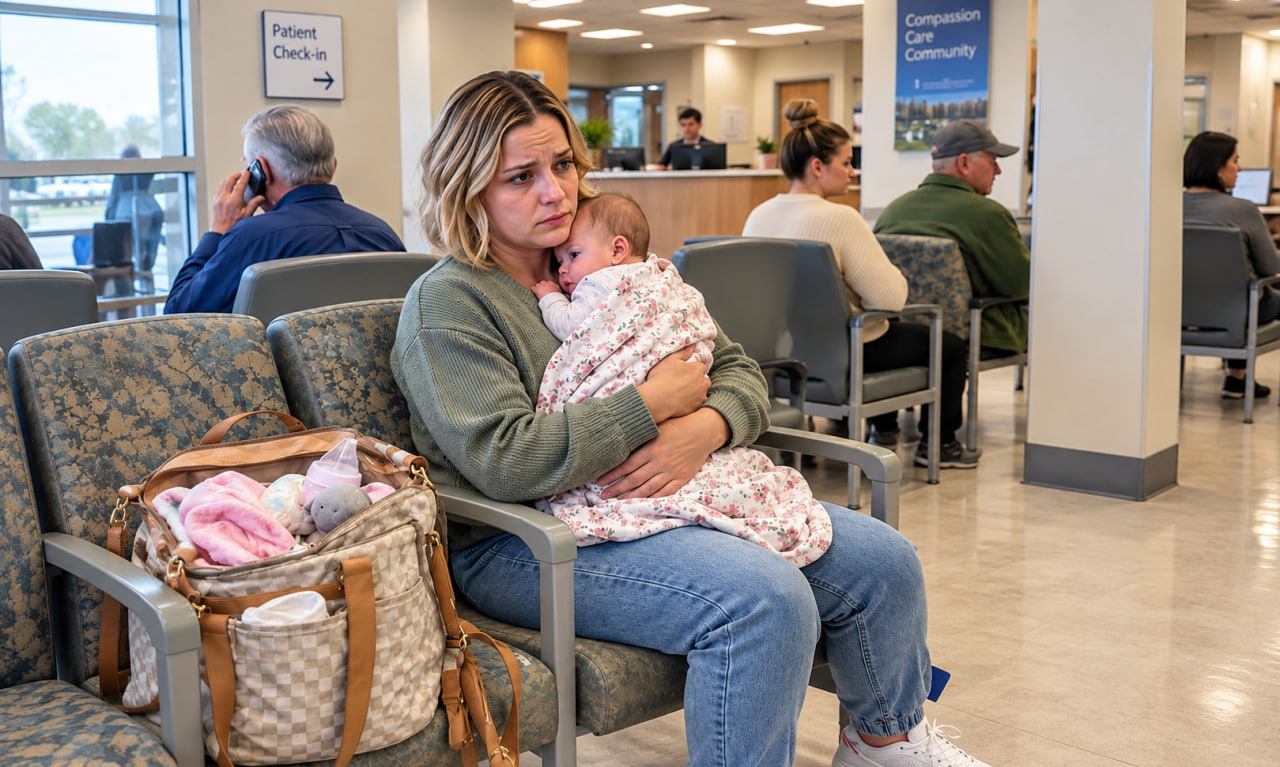
And for a moment, I remembered that night in the emergency room.
The fluorescent lights.
The plastic chair.
Our daughter’s burning forehead.
His mother’s cruel words.
The coat in Ethan’s hands.
The moment I realized I couldn’t keep carrying everyone.
I had thought that night was the beginning of the end of my marriage.
Maybe, in a way, it was.
But it was also the end of something else.
The end of me making excuses for people who wouldn’t make sacrifices for me.
The end of confusing silence with peace.
The end of believing that keeping a family together meant one person had to keep breaking herself apart.
And the most important lesson I learned was this:
Sometimes the moment someone tells you to handle everything alone isn’t the moment your life falls apart.
Sometimes it’s the moment you finally stop doing everything for everyone else.
I looked at my daughter.
Then at Ethan.
He reached for our baby and lifted her into his arms.
She laughed.
This time, he didn’t look at the clock.
He didn’t check his phone.
He didn’t complain about being tired.
He simply held his daughter.
And I realized something.
I hadn’t needed to teach him how to love her.
He already did.
What he had needed to learn was that love without responsibility wasn’t enough.
And that night in the emergency room had forced him to learn it.
The hard way.
The permanent way.
And if Sylvia ever came back into our lives, it would be on one condition:
She would have to understand that our daughter wasn’t a burden.
Motherhood wasn’t a burden.
Fatherhood wasn’t a burden.
And I was never again going to accept being told to “handle it” simply because everyone else was afraid of what responsibility might cost them.
Because I had already handled it.
I had handled the fever.
The fear.
The sleepless nights.
The hospital.
The accusations.
The silence.
And the moment my husband finally had to look at himself and decide who he wanted to be.
This time, I didn’t need to handle it alone.
He stayed.
And that was his choice.
Not his mother’s.
Not mine.
His.