
“Then I need to see you. There’s something you don’t know about the accident.”
“I think I’ve heard enough secrets.”
“This one concerns Peter Collins.”
The name made Mark stand up.
Rebecca continued.
“Peter wasn’t simply a courier. He was an accountant who discovered Victor’s operation before Mark did. He had been gathering evidence for months. When he tried to leave, Victor threatened his family.”
I gripped the phone.
“What happened to his family?”
“They were relocated after he died. His sister believed he had abandoned them. She never knew what happened.”
Mark looked devastated.
“Why didn’t you tell me?” he whispered.
Rebecca heard him.
“Because you weren’t supposed to disappear in the first place,” she replied. “The original plan was to turn the evidence over to the authorities. You changed everything when you decided to fake your death.”
Mark’s face hardened.
“You told me the people behind Victor would kill Laura.”
“I believed they would.”
“You helped me disappear.”
“I helped you survive. But I also made mistakes.”
Rebecca explained that she had kept the original records because she feared the evidence would disappear if Victor discovered where it was stored. She had been entering our house because Mark had once hidden a second set of records among his personal documents.
She had also been looking for a small black ledger that contained account numbers linking Victor to several fraudulent transactions.
But she had lied about one thing.
She had not been working for Mark alone.
For months, she had secretly cooperated with federal investigators, trying to build a case strong enough to withstand Victor’s influence.
She had kept this information from Mark because she no longer trusted him to follow a lawful process.
And after hearing about Daniel’s involvement, she feared the evidence would be destroyed before the investigation could be completed.
“Why the screaming?” I asked.
Rebecca paused.
“I wasn’t screaming.”
“Mrs. Gable heard a woman screaming in my house.”
“I know. I heard the recordings.”
My skin prickled.
“Whose voice was it?”
“Victor’s former accountant. She was on the phone with someone while I was searching your house. I had left a small speaker connected to an old recording device, and it started playing a saved conversation when the system malfunctioned.”
I stared at the phone.
“You left a recording device in my house?”
“Yes.”
“You had no right.”
“I know. I’m sorry.”
Her apology was so quiet that it almost disappeared beneath the sound of my own breathing.
I wanted to hate her.
Part of me did.
But I was beginning to understand that several people had been making decisions in the name of protecting others, and every one of them had left destruction behind.
I told Rebecca that we would not meet privately.
If she had evidence, she would hand it to Melissa and the investigators.
She agreed.
Before hanging up, she said something that changed the entire direction of the case.
“Laura, there’s one more thing. The person who signed the documents with Mark wasn’t Victor.”
“Who was it?”
“Someone much closer to you than you realize.”
The line went dead.
I stared at the phone.
Mark looked at me.
“What did she mean?”
I shook my head.
“I don’t know.”
But deep inside, I had already begun to fear the answer.
That afternoon, we met with the investigators.
The process was not dramatic. There were no instant confessions, no television cameras, and no officers bursting into a room to announce that the case was solved.
There were questions.
Documents.
Statements taken separately.
A careful examination of the evidence.
And hours of waiting.
The investigators verified Mark’s identity through records that had never been publicly released. They also confirmed that the original accident investigation contained inconsistencies that required further examination.
Mark agreed to provide a formal statement about the financial scheme and his disappearance.
I provided copies of the documents found in the wooden box, the security footage showing Rebecca entering my home, and the messages warning me not to trust Daniel.
Melissa advised me to preserve everything and avoid making public accusations before the evidence had been independently verified.
By evening, the investigators had enough information to begin coordinating additional interviews and obtaining records through the proper legal channels.
But the case was far from over.
That night, I returned to my house for the first time since fleeing.
I didn’t go alone.
Melissa accompanied me, and we arranged for an officer to remain nearby while I collected clothes and personal documents.
The house looked exactly as it had the previous morning.
The blue mug still sat on the drying rack.
Mark’s photograph still stood beside the bed.
But now I noticed the things I had overlooked for years.
The locked filing cabinet.
The old laptop he had insisted we keep even after buying a newer one.
The small scratch on the hallway wall where he had once moved a heavy safe.
And the photograph of us on our wedding day.
I took the photograph from the shelf.
For a long time, I stared at the young woman smiling beside her husband.
She believed love meant trusting someone completely.
She believed that if two people loved each other enough, they could survive anything.
I wished I could tell her that love was not the same as surrender.
That marriage did not give one person the right to control the other’s life.
That even the most beautiful memories could become painful when the truth finally arrived.
I placed the photograph in a box.
I wasn’t ready to throw it away.
But I wasn’t ready to display it either.
Before leaving, I checked the front-door camera one final time.
There was a new recording.
Someone had approached the house the previous evening, after I fled.
The person wore a baseball cap and kept his face turned away from the camera.
But when he reached the door, he looked directly into the lens.
I recognized him immediately.
Victor Hale.
He held up a folded piece of paper.
Then he slipped it through the mail slot.
The recording ended.
My hands went cold.
Melissa found the paper on the floor beside the entrance.
It contained a single sentence.
Tell your husband the past is finished. If he comes back, you will pay for his mistakes.
I stared at the words.
For two years, I had been afraid of losing Mark.
Now I was afraid that his return might cost me everything I had left.
Melissa photographed the note and gave it to the investigators.
“We’re going to take this seriously,” she told me. “But you need to let the authorities handle the threats. Don’t respond to Victor, and don’t arrange a meeting with him.”
I nodded.
Then I asked the question that had been haunting me.
“What happens if Mark really did something wrong?”
Melissa met my eyes.
“Then he has to answer for it. Being threatened doesn’t excuse every choice he made. But neither does his wrongdoing mean you deserve to be threatened.”
For the first time, someone had said exactly what I needed to hear.
I wasn’t responsible for repairing Mark’s mistakes.
And I wasn’t required to sacrifice my future to save him.
The investigation continued for several weeks.
Rebecca provided records and messages that helped investigators trace the financial transfers. The evidence revealed a complicated network of shell companies, forged authorizations, and fraudulent insurance activity.
Daniel’s involvement was also examined.
When investigators confronted him with the evidence, he denied wrongdoing. But the messages and recordings contradicted parts of his account, and his role became the subject of a formal investigation.
Victor’s lawyers issued statements denying the allegations.
His company announced an internal review.
For a time, nothing seemed to change.
Victor still appeared at public events.
His name still appeared in business magazines.
People still spoke about him as if he were an untouchable man.
Then the first arrests were announced.
Several executives were charged in connection with the alleged financial scheme. Investigators also announced that they were examining evidence related to the suspicious accident records and the use of false identities.
The case was not resolved in a single day, and not every allegation had been proven. But the evidence was no longer hidden in a wooden box beneath an attic roof.
It was in the hands of people who could investigate it.
Mark continued cooperating with the authorities.
He also faced difficult questions about his own actions, including the decision to disappear and the false records created around his supposed death.
For the first time, he stopped trying to explain everything as an act of love.
He admitted that fear had made him selfish.
He admitted that he had confused protecting me with controlling what I was allowed to know.
And he admitted that, even if his reasons had seemed understandable at the time, the consequences were mine to live with.
I visited him once during the investigation.
We sat in a small conference room, separated by a table covered in paperwork.
He looked tired.
“I don’t expect you to forgive me,” he said.
“Good.”
He nodded.
“I just want you to know that I’m sorry.”
I studied his face.
“Do you know what hurt the most?”
He shook his head.
“It wasn’t just that you disappeared. It was that you made me grieve for a man who was still alive. You let me build a life around a lie. You made every memory feel uncertain.”
He lowered his eyes.
“I know.”
“No,” I said gently. “You know what happened. You don’t know what it felt like.”
He accepted that without arguing.
Then I asked him whether he would make the same decision again.
He took a long time to answer.
“No,” he finally said. “I would tell you the truth. I would let you decide what risks you were willing to take. And if I were afraid, I would tell you I was afraid instead of pretending I knew what was best for you.”
I believed that he meant it.
But believing he was sorry did not mean I could return to the life we had shared.
“I hope you become the man you think you should have been,” I told him. “But I can’t promise to be there when you do.”
He nodded.
“I understand.”
This time, I believed him.
Six months later, the house in Cherry Hill was quiet again.
But it was a different kind of quiet.
I had repainted the bedroom, replaced the curtains, and donated the clothes I no longer wanted to keep. I repaired the lock on the back door and installed a new security system.
The blue mug remained.
Not because I was waiting for Mark to return.
I kept it because it had belonged to a chapter of my life that was real, even if I had misunderstood parts of it.
Some memories could be painful and precious at the same time.
The investigation had resulted in further legal proceedings, and several people connected to the scheme faced charges. The full truth about Peter Collins also began to emerge, giving his family answers they had been denied for years.
I learned that justice rarely arrived as a single dramatic moment.
Sometimes it came through a document finally being read.
A witness deciding to tell the truth.
A frightened person finding the courage to cooperate.
Or a woman refusing to remain silent simply because powerful people expected her to.
Mark and I were no longer living together.
He was cooperating with the authorities and working with his attorney to address the consequences of his own decisions.
We spoke occasionally, usually about practical matters or updates related to the investigation.
Sometimes he asked how I was doing.
I answered honestly.
Some days were good.
Some were difficult.
And some days I missed the man I thought I had married so badly that I could hardly stand it.
But I no longer mistook missing him for a reason to return to him.
One spring morning, Mrs. Gable came over carrying a small pot of white roses.
“I thought you might like these,” she said.
I smiled.
“Thank you.”
She glanced toward the house.
“Everything has been quiet lately.”
I laughed softly.
“Yes. It has.”
She hesitated.
“Laura, there’s something I’ve wanted to tell you. I heard those voices for days before I confronted you. I should have called someone sooner.”
“You did what you thought was right.”
“I was worried about you.”
I took her hand.
“I know.”
After she left, I planted the roses beside the front steps.
For years, I had imagined that my life would be complete only if Mark returned.
I had imagined that happiness meant restoring everything to the way it had been before the accident.
But standing in my garden, with the sun warming my face and fresh soil beneath my fingernails, I finally understood something.
The life I had lost was gone.
The woman I had been before the truth was gone, too.
And that didn’t mean my future had to be empty.
It meant I could build something new.
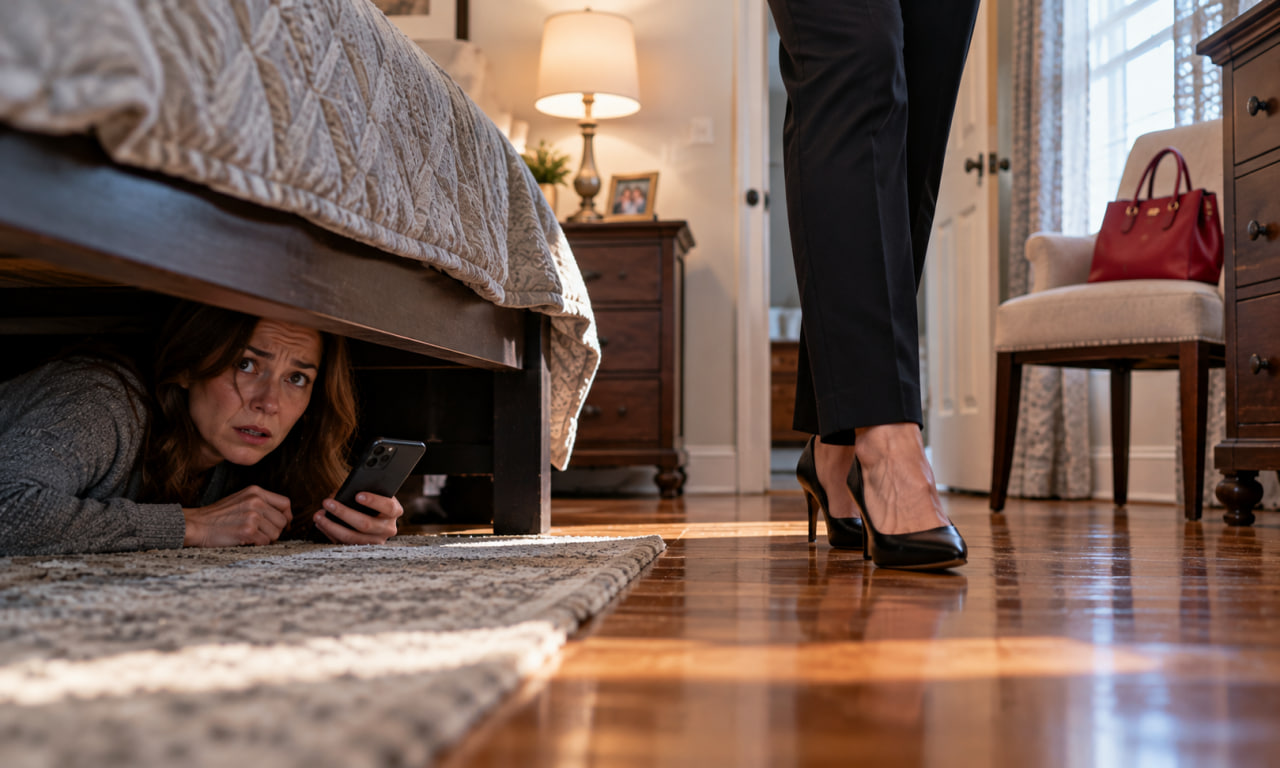
Almost a year after the day I hid beneath my bed, a letter arrived at my house.
The envelope carried Mark’s handwriting.
I stood at the kitchen counter for several minutes before opening it.
Inside was a single page.
Laura,
I have spent a long time thinking about the day you discovered I was alive.
For months, I told myself that I had made every decision because I loved you. It was easier to believe that than to admit I was afraid. I was afraid of losing you, afraid of prison, afraid of the people who wanted to destroy me, and afraid that if you knew the truth, you would see the parts of me I had spent years trying to hide.
So I chose your future for you.
I called it protection, but it was also cowardice.
You deserved the truth. You deserved the chance to be angry, to disagree, to leave, or to stand beside me if that was what you chose.
I took those choices away.
I don’t know whether you will ever forgive me. I no longer believe that forgiveness is something I can ask you to give me simply because I regret what I did.
I want you to know that I am trying to become someone who can tell the truth even when the truth costs him something.
I hope you are happy, Laura.
Not because I want you to remember me kindly.
But because you deserve a life that belongs entirely to you.
Mark.
I read the letter twice.
Then I folded it carefully and placed it inside a drawer.
I didn’t call him.
I didn’t cry.
I simply stood at the window and watched the white roses move gently in the breeze.
For the first time, I could remember our marriage without feeling that I had to defend it or condemn it.
We had loved each other.
We had shared beautiful years.
And he had betrayed me in ways that love alone could never erase.
All of those things were true.
I didn’t have to choose one truth and bury the others.
That evening, I cooked dinner for myself and sat beside the open window.
The house was quiet.
No unexplained footsteps.
No strange voices.
No hidden visitors unlocking doors with keys I had never given them.
Just the sound of the wind moving through the trees and the distant laughter of children playing in the street.
I looked at the blue mug on the counter and smiled faintly.
Then I put it away.
Not because I hated Mark.
Not because I wanted to forget him.
But because I was finally ready to stop living as though the past might walk through my front door at any moment and demand that I become the woman I used to be.
I had spent two years mourning a dead husband.
Then I had spent months confronting the living man who had returned.
Now I understood that the hardest part had never been discovering that Mark was alive.
It had been learning that I could love someone deeply and still choose not to let them back into my life.
I turned off the kitchen light and walked upstairs.
Before getting into bed, I checked the lock on the bedroom door.
Then I laughed at myself.
Old habits took time to disappear.
I pulled back the covers, lay down, and listened to the peaceful silence around me.
For the first time in years, I didn’t feel the need to keep one eye open.
I didn’t wonder who was hiding in my house.
I didn’t wonder whether the person I loved was telling the truth.
I simply closed my eyes.
And slept.
Because the man I had buried was alive, but the woman who had buried herself in grief was finally free.
And this time, when morning came, I would wake up in a life that belonged to me.
THE END