
PART 3
How could I explain that my mother had watched it happen and then allowed Vanessa to walk away wearing my dress?
“Claire?” Adrian asked again. “Talk to me.”
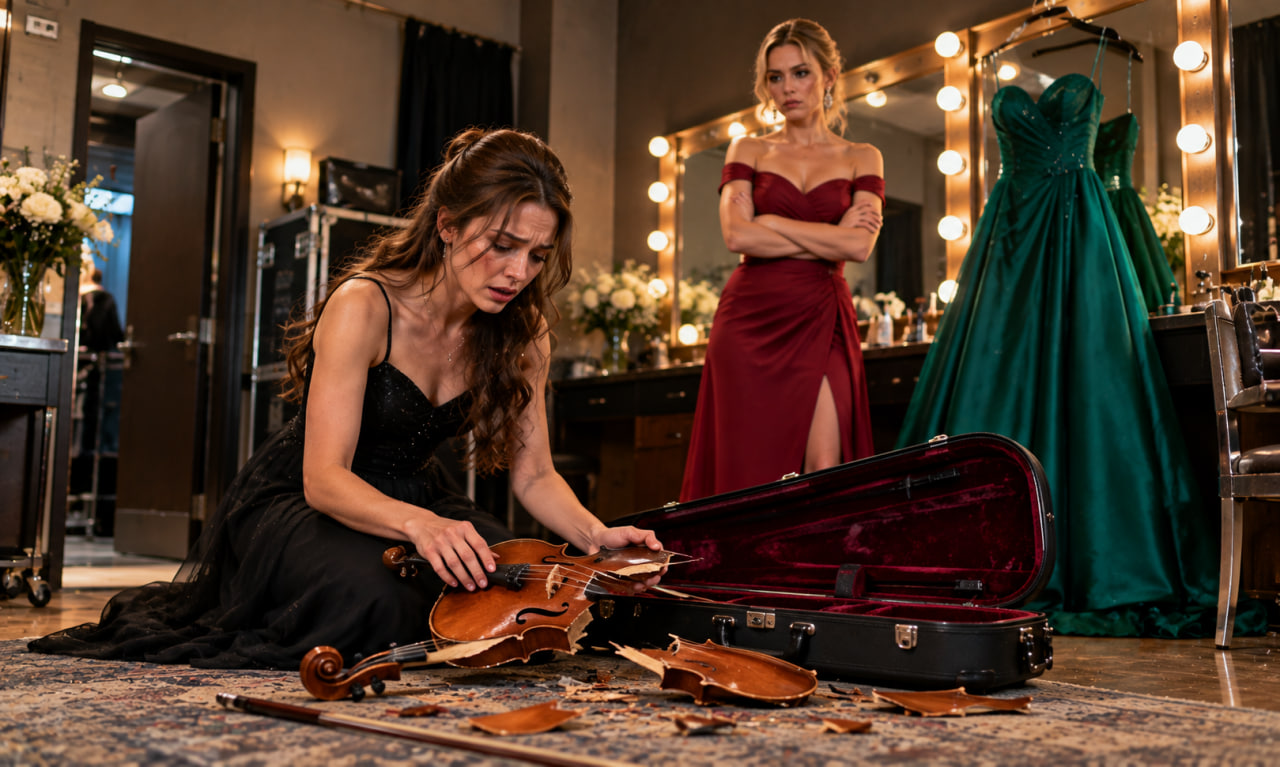
“My violin is broken.”
There was a brief silence.
“What do you mean, broken?”
“My sister destroyed it.”
I heard him inhale sharply.
“Is it repairable?”
“I don’t know.”
“Are you hurt?”
“No.”
“Then listen to me carefully. Don’t touch the strings or try to force the neck back into place. Put every piece somewhere safe. I’ll have someone contact a restoration specialist tonight.”
His calmness nearly broke me.
I pressed my fingers against my forehead.
“Maestro, the performance starts in twenty minutes. I don’t have another instrument.”
“Can you borrow one?”
“I don’t know anyone who has a concert-quality violin nearby.”
“Then we’ll find someone who does.”
I glanced at the clock.
Seventeen minutes.
“Claire, are you still there?”
“Yes.”
“Do you want to perform tonight?”
The question seemed almost absurd.
For years, I had practiced until my fingertips were sore. I had missed birthday parties, school dances, and weekends away because I needed to prepare. I had spent countless nights repeating the same four measures until my teacher finally nodded.
I had endured auditions where judges barely looked up from their papers.
I had watched other musicians receive scholarships while wondering whether I would ever be good enough.
And now, on the night when everything I had worked toward was finally within reach, my sister had tried to erase it all because I refused to lend her a dress.
“Yes,” I whispered.
“Then get backstage. I’ll handle the violin.”
He hung up.
Vanessa had been listening.
She folded her arms across her chest.
“Unbelievable. You’re actually going to make everyone deal with your little emergency?”
I picked up the violin case.
“Move.”
She blinked.
“What did you say?”
“I said move, Vanessa.”
For a moment, we stared at each other.
I had spent most of my life avoiding direct confrontations with my sister. I knew how quickly she could turn a simple disagreement into a family crisis. I knew how she could cry at exactly the right moment, how she could make my parents believe that her cruelty was a reaction to something I had done.
But that evening, I no longer cared whether she thought I was difficult.
I walked past her.
My mother followed me into the corridor.
“Claire, wait.”
I kept walking.
“Claire!”
I stopped near the elevator.
She caught up with me, her heels clicking against the polished floor.
“Your sister didn’t mean for this to become such a disaster.”
I slowly turned toward her.
“Mom, she picked up an $80,000 instrument and deliberately broke it because I wouldn’t give her a dress.”
“She was angry.”
“So was I. I didn’t destroy anything.”
Mom glanced toward the dressing room, making sure Vanessa couldn’t hear us.
“Please don’t embarrass the family tonight. There are important people attending this performance. We don’t need a scandal.”
I stared at her.
That was what mattered to her.
Not Grandpa’s violin.
Not the years I had spent preparing.
Not the fact that her daughter had committed a deliberate act of destruction.
The scandal.
“You’re worried about what people will think?” I asked.
“I’m worried about your future.”
“No. You’re worried about Vanessa’s reputation.”
Her face tightened.
“Don’t speak to me that way.”
I turned back toward the elevator.
“Then stop asking me to protect someone who has never protected me.”
The doors opened.
I stepped inside.
For the first time in my life, I didn’t wait for my mother to follow me.
I pressed the button for the backstage level and watched the doors close between us.
As the elevator descended, I looked down at the violin case in my hands.
I couldn’t bring myself to open it again.
I knew what I would see.
The instrument Grandpa had held so carefully.
The instrument he had once allowed me to carry only after making me promise never to leave it unattended.
The instrument he had trusted me to protect.
My eyes filled with tears.
“I’m sorry, Grandpa,” I whispered.
And for the first time since Vanessa had broken it, I let myself cry.
But only for a moment.
Because the elevator doors were opening.
And I still had a performance to give.
The backstage corridor was already crowded when I arrived.
Musicians hurried past with instrument cases. Stage assistants carried folders and checked their headsets. Somewhere beyond the thick curtains, the audience was settling into its seats.
The sound of people talking drifted through the walls.
I could hear the faint clinking of glasses from the reception area.
Everything was proceeding as planned.
Everyone except me.
A young stage assistant approached me.
“Claire? Maestro Cole asked me to bring you directly to him.”
I nodded.
She glanced at the violin case.
“Is everything okay?”
I couldn’t answer.
She seemed to understand that something was wrong and led me down the corridor.
Adrian was standing near the orchestra’s instrument storage room, speaking with a man I recognized as the concertmaster, Daniel Reeves.
Both men turned when they saw me.
Adrian walked toward me immediately.
“Show me.”
I opened the case.
Daniel’s expression changed.
He bent down slightly, examining the damaged instrument without touching it.
“Oh, my God.”
Adrian closed his eyes for a moment.
“Claire, I’m so sorry.”
I swallowed.
“Can it be repaired?”
Daniel looked at Adrian before answering.
“Possibly. But not quickly. The body is split, the neck is damaged, and we’ll need a specialist to determine the extent of the structural damage. Don’t attempt to play it.”
I nodded.
I already knew that.
Still, hearing someone else say it made the destruction feel final.
“There’s no way I can use it tonight?”
“No,” Daniel replied gently. “And I wouldn’t risk further damage.”
Adrian placed a hand on my shoulder.
“We have another problem. The orchestra’s reserve instruments are already assigned to students whose own instruments are being serviced. I can probably find you something, but it may take a few minutes.”
“How many?”
He checked his watch.
“Ten, perhaps.”
Ten minutes.
The audience was waiting.
The program had already announced my name.
I could imagine the questions that would follow if I failed to appear.
Was I ill?
Had I withdrawn?
Had I panicked?
Would the conservatory directors remember my absence more clearly than they remembered any of my previous performances?
I forced myself to breathe.
“I’ll wait.”
Adrian nodded toward a small room beside the storage area.
“Sit down. Drink some water. Don’t think about the audience yet.”
I sat on a folding chair and placed the closed case beside my feet.
Daniel left to make calls.
Adrian stayed with me.
For a while, neither of us spoke.
Then he pulled another chair closer.
“Claire, may I ask you something?”
I looked up.
“Of course.”
“Did you know your grandfather personally?”
I almost laughed at the question.
“He taught me to play.”
“I know that. But I mean, did you spend much time with him outside music?”
“All the time.”
I looked at the violin case.
“He lived with us when I was little. My parents worked long hours, so Grandpa used to pick me up from school. He made terrible sandwiches, and he always forgot where he put his glasses.”
A small smile appeared on my face despite everything.
“He would spend an hour looking for them before realizing they were on his head.”
Adrian chuckled softly.
“That sounds familiar.”
“He taught me music because he said it was a way to tell the truth without having to explain yourself.”
My voice faltered.
“When I was twelve, I asked him why he never bought a newer violin. He told me that an instrument wasn’t valuable because it was old or expensive. It was valuable because of the music people had trusted it to carry.”
I wiped my eyes.
“He made me promise that if I ever became a professional musician, I would never let money or applause become more important than the music.”
Adrian looked at the case.
“He would be proud of you.”
I shook my head.
“I couldn’t even protect his violin.”
“Claire, protecting an object and honoring the person who gave it to you are not the same thing.”
I looked at him.
He continued.
“Your sister made a choice. That choice belongs to her. You didn’t make her do it, and you couldn’t have prevented it simply by giving her a dress. If you’d given her the dress, perhaps she would have found something else to demand next time.”
His words settled into the silence.
I had spent years believing that if I could become patient enough, generous enough, and accommodating enough, my family would finally treat me with the same consideration they gave Vanessa.
But there had always been another demand.
Another sacrifice.
Another reason why my feelings could wait.
Maybe Adrian was right.
Maybe I had spent too long trying to protect a peace that existed only because I kept surrendering.
A knock sounded at the door.
Daniel returned, holding a black violin case.
“I found one.”
My heart jumped.
He set the case on the table and opened it.
Inside lay a beautiful modern violin with a warm, reddish-brown finish.
It wasn’t Grandpa’s violin.
It didn’t have the little scratch beside the chin rest.
It didn’t carry decades of memories.
But it was intact.
Daniel lifted it carefully.
“This belongs to a former orchestra member who lives about ten minutes away. She keeps it here whenever she’s rehearsing with us. I reached her by phone, and she gave us permission to use it tonight.”
I stared at the instrument.
“Will it work for Sibelius?”
“It should. It’s a good instrument. You’ll need a moment to adjust to its response, but it’s certainly capable of handling the piece.”
He handed it to me.
My fingers trembled as I lifted it beneath my chin.
I drew the bow across the strings.
The first note sounded brighter than I expected.
I tried another.
The sound was unfamiliar, but clear.
I adjusted the bow pressure and played a short passage from the opening section of the concerto.
Daniel listened.
“Good. A little more weight on the lower strings, but you’ll adapt.”
I played the passage again.
This time, the sound settled.
For a few seconds, the room disappeared.
There was only the instrument, the bow, and the music I had practiced for years.
Then Adrian checked his watch.
“Eight minutes.”
I lowered the violin.
“I can do this.”
He smiled.
“Yes, you can.”
Daniel helped me secure the damaged instrument in its case. We placed the case in a locked storage room so no one could accidentally disturb the broken pieces.
Then I took the borrowed violin and followed Adrian toward the stage entrance.
I was almost there when I heard a familiar voice.
“Claire!”
I stopped.
Vanessa was hurrying toward us.
She was still wearing my emerald dress, but her face had changed. Her makeup was smudged beneath her eyes, and her hands were shaking.
My mother followed close behind her.
“Claire, thank goodness,” Mom said. “You need to help your sister.”
I looked at Vanessa.
“What happened?”
She opened her mouth, but no words came out.
For the first time that evening, my older sister looked genuinely frightened.
And whatever had frightened her, it had nothing to do with my violin.
Vanessa grabbed my wrist.
“Claire, please. You have to do something.”
I pulled my hand away.
“What are you talking about?”
She glanced toward the stage entrance, then back at me.
“It’s the performance.”
I stared at her.
“What about it?”
She swallowed.
“Someone found out.”
My mother hurried forward.
“Claire, listen to me. This is a misunderstanding.”
I looked between them.
“What misunderstanding?”
Vanessa’s eyes filled with tears.
“The dress.”
I almost laughed.
“You mean the dress you’re wearing right now?”
She looked down at herself as if she had forgotten what she was wearing.
Then she whispered, “It’s not mine.”
“No. It isn’t.”
“Claire, please. Just listen.”
I tightened my grip on the violin.
“I have to perform in a few minutes. Whatever you need, it can wait.”
“No, it can’t!” she cried.
Her voice was loud enough to draw the attention of two stage assistants passing nearby.
Vanessa lowered her voice immediately.
“Please. I know what I did was wrong, but you have to help me.”
I looked at her for a long moment.
Twenty minutes earlier, she had stood over the broken pieces of my grandfather’s violin and told me my big night was over.
Now she was asking me to save hers.
“What exactly do you want me to do?” I asked.
She hesitated.
Then she said the words that changed everything.
“Tell them you gave me the dress.”
I stared at her.
She rushed on.
“If you tell them you lent it to me, everything will be fine. Nobody will blame me. We can say you offered it because you had another outfit.”
“Why would I do that?”
“Because you’re my sister!”
The familiar demand rang through the corridor.
Not an apology.
Not an acknowledgment of what she had done.
A demand.
My mother stepped between us.
“Claire, your sister has an important opportunity tonight. She was invited to meet several people from the foundation sponsoring the orchestra. She was supposed to attend the reception afterward.”
I looked at Vanessa’s dress.
Then at my mother.
“Why does any of that involve me?”
Mom lowered her voice.
“Because Vanessa told them the dress belonged to her. She said it was a designer piece she had purchased for the occasion.”
I stared at her.
“You’re joking.”
“She didn’t think it would become a problem.”
“What problem?”
Vanessa’s face crumpled.
“The designer.”
For a moment, I couldn’t understand what she meant.
Then I remembered the small label inside the dress.
The emerald-green dress had been a limited release from a designer whose work I had followed for years. I had purchased it from an authorized boutique, and the store had included a certificate of authenticity because the fabric came from a special collection.
I had planned to wear it for the reception after the performance.
I had saved for months to buy it.
Vanessa knew all of that.
She also knew that the designer’s representatives would be attending the event.
“What did you tell them?” I asked.
She wiped her cheeks.
“I said I had bought it from the designer’s private collection.”
“Why?”
“Because I wanted them to take me seriously.”
“Seriously as what?”
My mother answered before Vanessa could.
“She’s trying to build a career in fashion communications. She hoped to meet the designer’s representatives and introduce herself.”
I looked at Vanessa.
“You lied about buying my dress to impress people at a reception you hadn’t even been invited to attend?”
“I was invited!”
“By whom?”
She hesitated.
Then she looked away.
I understood.
She had probably used my invitation, my performance, and my connection to the orchestra as an opportunity to place herself in a room where she could pretend she belonged.
It was the same pattern I had known since childhood.
Vanessa wanted something.
She decided she deserved it.
And when the truth threatened to catch up with her, she expected me to help her escape the consequences.
“What happened?” I asked again.
This time, Vanessa answered.
“One of the designer’s assistants recognized the dress. She asked me where I bought it. I told her it was from a private sale, but she said the designer’s office had records of every dress from that collection.”
My stomach tightened.
“And?”
“She asked for the certificate.”
I closed my eyes briefly.
Of course.
The certificate was in the small pocket of my handbag, which I had left in the dressing room.
Vanessa had taken the dress but hadn’t known about the document.
“When she couldn’t produce it,” my mother continued, “the assistant became suspicious. She asked Vanessa to wait while she contacted the boutique.”
I looked at Vanessa.
“And now you’re worried they’ll discover you lied.”
She began crying harder.
“They’ll never take me seriously again.”
I could barely believe it.
She had destroyed an irreplaceable family heirloom and then stolen my dress to advance her own ambitions.
Yet somehow, she still believed her future was the emergency.
I glanced at the stage entrance.
The orchestra manager was signaling to Adrian.
Four minutes.
“I need to go.”
Vanessa caught my arm again.
“Claire, please! You can tell them I gave you permission to wear it. You can tell them I borrowed it from you. It doesn’t have to be a big deal.”
I looked directly into her eyes.
“You broke Grandpa’s violin.”
She flinched.
“I know.”
“You didn’t even apologize.”
“I said I was sorry!”
“No, you didn’t. You said my performance was over.”
Her lips trembled.
“I was angry.”
“So was I.”
“Claire, please!”
I stepped back.
“You wanted me to lose something important because I wouldn’t give you what you wanted. Now you’re afraid of losing something important yourself, and you want me to protect you.”
I shook my head.
“That isn’t how being sisters works.”
My mother looked furious.
“How can you be so heartless?”
I turned toward her.
“Heartless?”
“Yes! Your sister is terrified. She made a mistake, and you could help her fix it with one sentence.”
I stared at her.
“One sentence won’t make her tell the truth. It will only make me responsible for another lie.”
“Claire—”
“No.”
The word came out quietly.
But it was final.
“I won’t lie for her.”
Vanessa stared at me as though I had slapped her.
Then a woman’s voice sounded from the far end of the corridor.
“Miss Vanessa?”
A tall woman in a black suit approached us, carrying a tablet.
Beside her walked a man I recognized from the event program: the representative of the fashion house whose dress Vanessa was wearing.
The woman stopped a few feet away.
“I’m afraid we need to resolve this matter before you enter the reception.”
Vanessa went pale.
My mother immediately stepped forward.
“I’m sure there’s been a misunderstanding.”
The woman glanced at the emerald dress.
“Perhaps. But we need to verify the ownership of the garment and the information provided to our representative.”
She turned toward me.
“Miss Claire?”
I nodded.
“Yes.”
“Are you the purchaser of this dress?”
Vanessa looked at me desperately.
My mother shook her head almost imperceptibly.
They were both waiting.
For the familiar surrender.
For the moment when I would make myself smaller so Vanessa could escape the consequences.
I took a breath.
“Yes,” I said. “I purchased it.”
The woman nodded.
“Do you have the purchase documentation?”
“Yes. It’s in my handbag in the dressing room.”
“Would you be willing to show it to us?”
“Of course.”
Vanessa made a strangled sound.
“Claire, don’t.”
I turned toward her.
“Don’t what?”
She couldn’t answer.
I looked back at the representative.
“I can show you the receipt and certificate of authenticity. I can also explain exactly how the dress came to be in my sister’s possession.”
The corridor fell silent.
My mother stared at me.
Vanessa looked as though she had just realized that, for the first time in her life, I wasn’t going to rescue her.
The representative nodded.
“Thank you. That’s all we’re asking.”
I glanced at the stage entrance one final time.
Adrian was waiting.
The orchestra was ready.
And somewhere inside that concert hall, hundreds of people were waiting to hear music that had nearly been silenced before the first note.
“I’ll explain everything,” I said. “But first, I have a performance.”
The representative stepped aside.
“Of course.”
I walked toward the stage.
Behind me, I heard Vanessa whisper my name.
I didn’t turn around.
Because the truth was, I had spent years turning around whenever she called.
And tonight, for the first time, I had something more important to do.
I had music to play.
And I was going to play it.
PART 4
The moment I stepped onto the stage, the audience rose into a soft wave of applause.
Hundreds of faces turned toward me beneath the warm concert lights. I could see the orchestra members taking their places, the conductor lifting his baton, and several distinguished guests sitting in the front rows.
For a moment, I forgot how to breathe.
This was the performance I had dreamed about for years.
And I was standing there without my grandfather’s violin.
I held the borrowed instrument beneath my chin and closed my eyes.
In my mind, I saw Grandpa sitting in his favorite armchair, his silver hair slightly untidy, his glasses resting at the end of his nose.
I remembered the way he used to tap his finger against the music stand whenever I rushed a passage.
“Music isn’t a race, Claire. You don’t have to arrive before everyone else. You just have to know why you’re going.”
When I was younger, I thought he was talking about tempo.
As I grew older, I realized he had been talking about life.
I took a slow breath.
Then I looked at Maestro Adrian Cole.
He gave me a small nod.
I lifted my bow.
The first notes of Sibelius’s Violin Concerto rose into the concert hall.
And everything else disappeared.
There was no Vanessa.
No emerald dress.
No broken violin.
There was only the music.
I played the opening passage with a restraint that surprised even me. The borrowed violin responded differently from Grandpa’s instrument. Its tone was brighter, its resistance unfamiliar, and its sound carried a slightly different character.
But the notes were there.
Every measure I had practiced.
Every difficult transition I had repeated until my fingers seemed to know it without my permission.
Every moment of frustration, exhaustion, and doubt that had brought me to that stage.
I played through the first section, listening carefully to the orchestra.
When the music grew more intense, I allowed the sound to expand.
The instrument vibrated against my collarbone.
My right arm moved almost instinctively, and the melody climbed above the orchestra.
Then, in the middle of a particularly demanding passage, I remembered Grandpa’s hands.
He had once taken my small fingers in his and shown me how to relax my wrist.
“Never fight the instrument,” he had told me. “Listen to it. It will tell you what it needs.”
I listened.
I adjusted my bow.
And I continued.
By the time I reached the final movement, the fear that had followed me backstage was gone.
I was no longer trying to prove that Vanessa hadn’t defeated me.
I was no longer trying to demonstrate that I could survive the worst night of my life.
I was simply playing the music.
And somehow, that made the performance more powerful than anything I had imagined.
When the final notes rang through the hall, the last chord seemed to hang in the air.
For one extraordinary second, nobody moved.
Then the audience erupted.
People rose from their seats.
Applause thundered through the hall.
I lowered my bow, stunned by the sound.
Maestro Cole turned toward me, smiling broadly, and gestured for me to acknowledge the audience.
I bowed once.
Then again.
As I straightened, I saw something that made my throat tighten.
In the front row, beside one of the conservatory directors, sat an elderly woman with silver hair.
She was holding a white handkerchief.
She was crying.
I didn’t recognize her at first.
Then she stood, and I noticed the small silver brooch pinned to her jacket.
A violin.
I had seen that brooch in photographs many times.
It belonged to Evelyn Hart, one of the most respected violin restoration specialists in the country.
She had known my grandfather.