
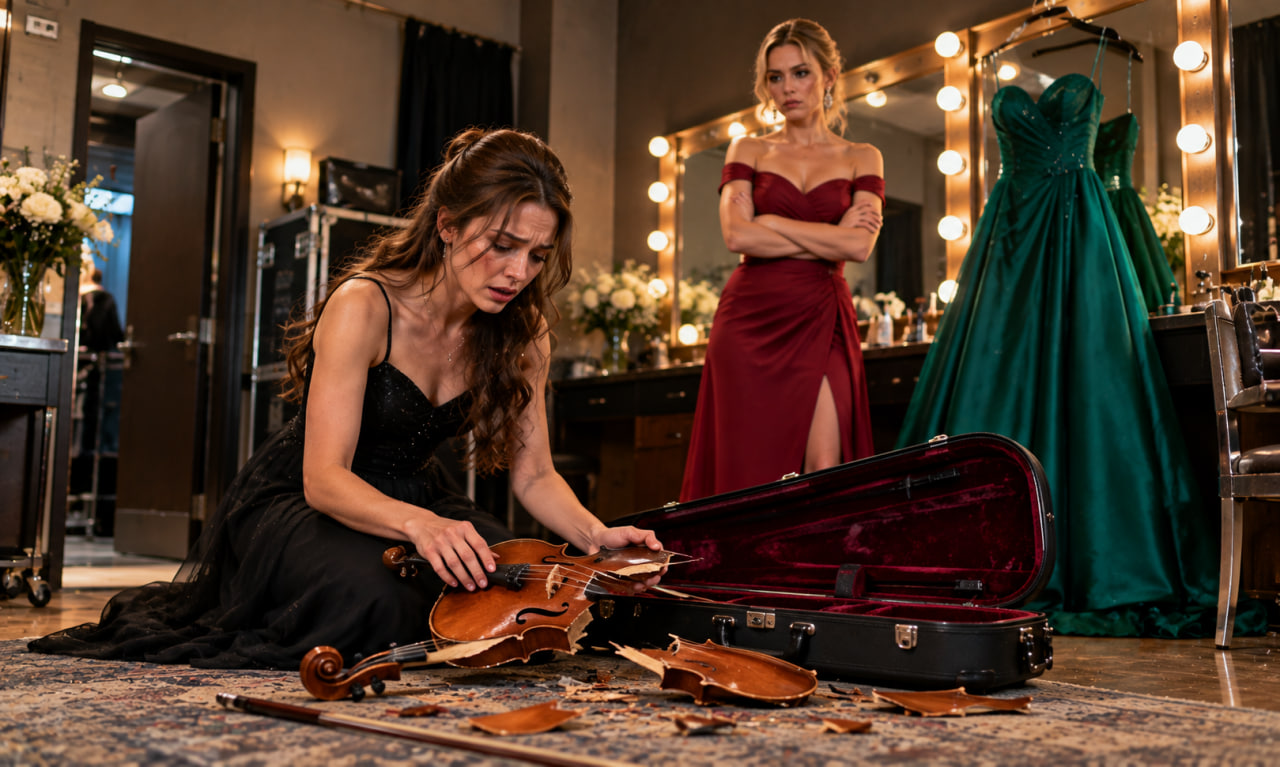
And, as I would learn later, she had been one of the last people he had spoken to about his instrument.
But at that moment, all I could do was bow and try not to cry myself.
The applause continued for what felt like an eternity.
I had done it.
Despite everything, I had done it.
And my grandfather’s music had survived the night.
Backstage, Maestro Cole embraced me.
“That was extraordinary.”
I laughed through my tears.
“I thought I was going to fall apart.”
“You didn’t.”
“I almost did.”
“But you didn’t.”
He stepped back and studied my face.
“Do you know what I heard out there?”
I shook my head.
“I heard someone who had every reason to be angry and every reason to be frightened, yet chose to make music instead.”
I looked down at the borrowed violin.
“I wish Grandpa could have heard it.”
Adrian’s expression softened.
“Perhaps the important part is that you heard him.”
Before I could answer, Daniel hurried into the corridor.
“Claire, Evelyn Hart wants to speak with you.”
I stared at him.
“Evelyn Hart?”
He nodded.
“She’s waiting in the greenroom. She said she knew your grandfather.”
My heart began beating faster.
I carefully returned the borrowed violin to its case and followed Daniel.
Evelyn stood beside a small table covered with refreshments. Up close, she looked older than she had in the photographs I remembered, but her eyes were bright and attentive.
When she saw me, she reached for both my hands.
“You look so much like him.”
I swallowed.
“You knew my grandfather?”
“Very well.”
She glanced toward the violin case Daniel was carrying.
“I heard what happened to his instrument. Adrian told me the essentials.”
My face fell.
“I’m sorry. I should have protected it.”
Evelyn gently squeezed my hands.
“Your grandfather would have been far more concerned about whether you were all right than whether you protected a piece of wood.”
“But it was his violin.”
“Yes. And it was a remarkable instrument. But he never confused the instrument with the musician.”
She paused.
“May I ask you something? When you realized it was broken, what did you do?”
“I called my conductor. I found another violin. I performed.”
“Exactly.”
She smiled.
“Your grandfather once told me that he hoped you would become the kind of musician who could lose everything familiar and still find the music.”
My eyes filled.
“He said that?”
“He did.”
Evelyn reached into her handbag and removed a small envelope.
“I’ve been carrying this for several years. Your grandfather asked me to give it to you when I believed you were ready to understand it.”
I stared at the envelope.
It was yellowed with age, and my name was written across the front in Grandpa’s unmistakable handwriting.
Claire.
Nothing more.
My fingers trembled as I accepted it.
“What’s inside?”
“I don’t know,” Evelyn replied. “He sealed it himself. He told me not to open it and not to give it to you simply because you were old enough. He wanted you to receive it when you understood something important about music and life.”
I looked at the envelope.
“What did I need to understand?”
Evelyn smiled sadly.
“That being a good person doesn’t mean allowing people to hurt you. And that forgiveness, if you ever choose it, should never require you to lie about what happened.”
I stared at her.
Those words sounded so much like Grandpa that, for a moment, I felt as if he were standing beside us.
I opened the envelope carefully.
Inside was a handwritten letter and a small photograph.
The photograph showed Grandpa standing outside a modest music school, holding his violin case. A much younger Evelyn stood beside him.
On the back, he had written:
For Claire, who will one day understand that music is not the instrument, but the courage to begin again.
I unfolded the letter.
My eyes moved across the page.
My dearest Claire,
If you are reading this, then I hope you have discovered something I spent most of my life learning.
People will sometimes tell you that love means giving everything away. They may tell you that being kind means staying silent when you are hurt. They may even tell you that keeping the peace is more important than telling the truth.
Please remember that none of these things is always true.
You can love someone and still say no.
You can forgive someone without trusting them again.
You can be generous without allowing yourself to be used.
And you can lose something precious without losing the person you are.
I stopped reading.
My tears fell onto the paper.
I had heard Grandpa say versions of those words before, but never quite like this.
I continued.
I am leaving you my violin because I want you to have something that connects you to the music I loved. But if the day ever comes when you cannot play it, I hope you will not believe that the music has abandoned you.
The violin is wood, strings, and craftsmanship. Its value is not in its price or its history alone. Its value is in what it helps you express.
If it breaks, grieve for it. Repair it if you can. Remember it always.
But never believe that someone else has the power to destroy the music inside you.
With all my love,
Grandpa.
I pressed the letter against my chest.
For the first time that evening, the pain I had been carrying felt different.
It was still there.
My grandfather’s violin was still broken.
My sister had still done something cruel and deliberate.
My mother had still failed to defend me.
But I finally understood that none of those things had the power to take away the years Grandpa and I had shared.
Vanessa had broken an instrument.
She hadn’t broken my childhood memories.
She hadn’t erased his lessons.
And she hadn’t taken away my ability to make music.
Evelyn waited quietly until I had finished reading.
Then she asked, “May I see the instrument?”
I nodded.
Daniel brought the case from the storage room.
When Evelyn opened it, her expression became serious.
She examined the broken body, the damaged neck, and the fragments of wood.
For several minutes, she said nothing.
Finally, she looked up.
“This is serious damage. It will require painstaking work, and I can’t promise that it will ever return to its former playing condition.”
My heart sank.
“But?”
She gave me a thoughtful look.
“But I have restored instruments in worse condition. Some take months. Some take years. We will need to assess every piece carefully, and there may be limits to what can be repaired without compromising the instrument.”
“Would you try?”
Evelyn smiled.
“Your grandfather was one of my oldest friends. I would be honored to examine it properly.”
I closed my eyes in relief.
“Thank you.”
“Don’t thank me yet. Restoration requires patience. And you must understand that the violin may never sound exactly as it did before.”
I nodded.
“I understand.”
She gently closed the case.
“Then we’ll begin with an honest assessment. No promises we can’t keep.”
For the first time since Vanessa had broken the violin, I felt a small flicker of hope.
Not because everything would return to the way it had been.
But because something precious might still be saved.
I had barely finished speaking with Evelyn when my phone began vibrating.
Messages flooded the screen.
Friends congratulated me on the performance.
My former teacher sent a string of exclamation marks followed by a message that made me laugh.
You magnificent girl. Call me tomorrow.
There were messages from musicians I hadn’t spoken to in years, people who had watched the livestream, and several strangers who wanted to tell me how deeply the performance had affected them.
Then a message arrived from my mother.
Where are you? We need to talk.
Another followed.
Vanessa is in trouble. Please don’t make this worse.
I stared at the screen.
Not one message asked whether I was all right.
Not one mentioned Grandpa’s violin.
I turned the phone facedown.
A few minutes later, Adrian returned with a woman wearing a dark blue suit.
“Claire, I’d like you to meet Dr. Margaret Lewis, the director of the Hartwell Conservatory’s scholarship program.”
My heart skipped.
I recognized her from the front row.
Dr. Lewis smiled and extended her hand.
“Congratulations on your performance. You handled a difficult situation with remarkable composure.”
“Thank you.”
“I understand that you had to use a borrowed instrument at the last minute.”
“Yes.”
“That couldn’t have been easy.”
I considered the question.
“It wasn’t. But I had practiced the music for years. The instrument changed, but the work I had done was still there.”
She nodded thoughtfully.
“That’s an excellent answer.”
She opened a folder.
“I won’t pretend that one performance determines an entire career. It doesn’t. But tonight, you demonstrated something we value greatly in our fellowship candidates: the ability to respond to an unexpected challenge without abandoning your responsibilities.”
My fingers tightened around the envelope containing Grandpa’s letter.
“We would like to invite you to a formal audition for our advanced performance fellowship.”
I stared at her.
“The fellowship?”
“Yes. It includes funding for further study, access to our master classes, and the opportunity to work with several internationally recognized musicians. If you are selected, the program can also help connect you with performance opportunities.”
I couldn’t speak.
I had dreamed of opportunities like this for years.
But I had never expected one to arrive on the night when everything seemed to be falling apart.
“When would the audition be?” I finally asked.
“In six weeks.”
Six weeks.
Enough time to prepare.
Enough time to learn from tonight’s experience.
Enough time to remember that my future didn’t depend on whether everything went according to plan.
“I would be honored to audition,” I said.
Dr. Lewis smiled.
“Excellent. We’ll send you the details tomorrow.”
After she left, Adrian gave my shoulder a gentle squeeze.
“See? The night isn’t over.”
I looked at Grandpa’s letter.
“No,” I whispered. “It isn’t.”
Unfortunately, the night wasn’t over for Vanessa either.
When I finally returned to the corridor outside the dressing rooms, I found my mother sitting on a bench.
Vanessa stood beside her, still wearing my dress.
The fashion representative was speaking quietly with another staff member.
When Vanessa saw me, she hurried forward.
“Claire, please.”
I stopped several feet away.
“What now?”
Her face was streaked with tears.
“They want me to leave the reception.”
I said nothing.
“They’re saying I misrepresented the dress and gave them false information about how I obtained it.”
“Did you?”
She looked down.
“Yes, but—”
“Then what do you want me to do?”
“I want you to explain that I borrowed it from you.”
I studied her face.
“Would that change the fact that you told them you purchased it?”
She swallowed.
“Maybe if you explain—”
“No.”
Her eyes widened.
“You haven’t even heard me out!”
“I heard you out in the dressing room. I heard you out backstage. And I’ve heard you out just now.”
I paused.
“You want me to tell the truth about the dress, and I will. You want me to lie about your intentions, and I won’t.”
My mother stood.
“Claire, enough. You have made your point.”
I looked at her.
“Have I?”
“Your sister has apologized.”
Vanessa opened her mouth, but I raised my hand.
“No. She hasn’t.”
Mom’s expression hardened.
“Don’t be cruel.”
“Mom, I am not the person who broke Grandpa’s violin. I am not the person who took someone else’s property without permission. And I am not the person who lied to the event organizers.”
I turned toward Vanessa.
“You can tell them the truth yourself.”
She looked as though she couldn’t believe what she was hearing.
“And what am I supposed to do about the violin?” she demanded suddenly.
I stared at her.
“What?”
She threw up her hands.
“I said I’m sorry! What else do you want from me?”
I felt a cold sadness settle over me.
“Do you really want to know?”
She nodded impatiently.
“I want you to understand that what you did was wrong even if nobody ever finds out. I want you to stop treating other people’s belongings as things you can destroy whenever you’re angry. I want you to stop expecting me to clean up every mess you make.”
I paused.
“And I want you to understand that an apology doesn’t automatically restore trust.”
Vanessa’s face tightened.
“So you’re never going to forgive me?”
“I didn’t say that.”
“Then what are you saying?”
“I’m saying that forgiveness isn’t something you can demand from me while refusing to take responsibility for what you’ve done.”
She looked away.
For once, she had no immediate response.
The fashion representative approached.
“Miss Vanessa, we need the dress returned to its owner.”
Vanessa looked at me.
I nodded.
“Please give it to them.”
She slowly began unzipping the back.
My mother gasped.
“Vanessa, what are you doing?”
“What she asked me to do!”
I stepped forward.
“Wait.”
Vanessa froze.
For one brief moment, hope appeared in her eyes.
Then I continued.
“There’s a changing room over there. You can change privately. I don’t want you walking through the building half-dressed.”
Her expression crumpled again.
I wasn’t doing it to save her from the consequences of her actions.
I was doing it because I didn’t want to become someone who enjoyed another person’s humiliation.
There was a difference.
The representative escorted Vanessa to the changing room.
A few minutes later, she returned wearing her own black dress.
The emerald gown was carefully placed in a garment bag and handed back to me.
The representative apologized for the disruption and explained that the organization would document the incident internally.
There was no shouting.
No dramatic public announcement.
No crowd gathering to watch Vanessa being punished.
Just a clear record of what had happened and a decision that she would not be admitted to the private reception that evening.
It was enough.
Vanessa had lied, and her lie had been exposed.
She had tried to use my success to advance her own ambitions, and now she had to face the consequences.
As she passed me, she whispered, “I hope you’re happy.”
I looked at her.
“I’m not happy about any of this.”
“Then why won’t you help me?”
“Because helping you doesn’t mean helping you lie.”
She shook her head and walked away with our mother.
I watched them disappear around the corner.
For the first time, I didn’t chase after them.
The next morning, my father called.
I almost didn’t answer.
But I had avoided enough difficult conversations in my life, and I knew that silence alone would not solve anything.
“Hello, Dad.”
“Claire.”
His voice sounded tired.
“Your mother told me what happened last night.”
I waited.
“She says Vanessa was upset, that things got out of hand, and that you refused to help her afterward.”
I closed my eyes.
Of course that was how the story had been told.
“Did she tell you why Vanessa was upset?”
“She said you wouldn’t lend her a dress.”
“And did she tell you what she did to Grandpa’s violin?”
There was a pause.
“She said there was an accident.”
I stared at the wall.
“An accident?”
“She said she was trying to put it back in the case and—”
“Dad, she deliberately broke it. She bent it over her knee while I begged her to stop.”
Silence.
I heard him breathe.
“Are you sure?”
I felt something inside me sink.
“Yes, Dad. I was there.”
Another silence followed.
Then he said, “I didn’t know.”
I almost told him that he should have known.
That he should have asked me before accepting Vanessa’s version.
That I was tired of having to produce evidence before anyone believed my feelings mattered.
But I was too exhausted to argue.
“Well, it’s done now,” he said. “The important thing is that your performance went well.”
I stared at the phone.
“Is that all?”
“What do you mean?”
“Are you going to ask Vanessa to pay for the damage? Are you going to tell her what she did was wrong? Are you going to stop telling me that I have to share everything with her?”
He sighed.
“Claire, she’s your sister.”
“And I’m your daughter.”
He said nothing.
I continued.
“I have spent my entire life being told that I’m the one who has to understand. I’m the one who has to give in. I’m the one who has to forgive first because Vanessa gets emotional.”
My voice trembled, but I continued.
“Last night, she destroyed something Grandpa left me. And Mom’s first concern was that I shouldn’t make a scene.”
“Your mother was trying to keep things calm.”
“By asking me to pretend nothing happened.”
“That’s not what she meant.”
“Then what did she mean, Dad?”
He didn’t answer.
For the first time, I heard something in his silence that I had spent years refusing to acknowledge.
He didn’t know how to defend what had happened.
He had spent so long avoiding conflict that he had mistaken the absence of arguments for the presence of peace.
Finally, he spoke.
“What do you want us to do?”
I took a breath.
“I want you to stop asking me to sacrifice my dignity to protect Vanessa from consequences.”
He exhaled slowly.
“And the violin?”
“Evelyn Hart is going to assess the damage. I’ll send you the restoration estimate when I have it.”
“Your mother says the instrument was insured.”
“It was. The insurance covers certain types of damage, but I don’t know what the policy will cover in this situation. Either way, the money won’t replace the memories.”
“I understand.”
I wasn’t sure he did.
But for the first time, he sounded as though he was listening.
“Claire,” he said quietly, “I’m sorry.”
I closed my eyes.
It was the first apology I had received from a parent that morning.
And even though it didn’t fix anything, it mattered.
“Thank you, Dad.”
“I should have asked you what happened before I judged the situation.”
“Yes, you should have.”
He didn’t argue.
We spoke for another few minutes, then ended the call.
I placed my phone on the table and looked at Grandpa’s letter.
There was still a long way to go.
But at least one person in my family had finally begun to listen.
Over the following weeks, I learned that the most difficult part of standing up for yourself isn’t always the confrontation.
Sometimes it’s what comes afterward.
It’s the silence.
The guilt.
The messages from relatives who hear only one side of the story.
The sudden realization that people who benefited from your lack of boundaries may not appreciate it when you finally establish them.
Vanessa didn’t speak to me for eleven days.
My mother sent several messages explaining that families should forgive one another and that I shouldn’t allow one unfortunate evening to damage our relationship.
I answered politely, but I refused to pretend that the incident had been a misunderstanding.
I also refused to turn my life into a public campaign against my sister.
I didn’t post photographs of the broken violin.
I didn’t contact Vanessa’s professional acquaintances.
I didn’t share the story online to humiliate her.
I simply told the truth when people asked what had happened.
And when nobody asked, I concentrated on the things I could control.
My music.
My work.
My future.
Evelyn began examining the violin.
The first report was sobering.
The damage was extensive, and the restoration would be expensive. Several structural components had been broken, and some pieces had splintered into fragments that required careful stabilization.
The insurance company requested documentation, photographs, and a formal account of the incident.
I provided everything.
Because the damage had been deliberately caused by someone who knew the instrument’s value, the insurer required additional investigation before determining the final coverage.
I hired an attorney to help me understand the process and to communicate with the insurer.
I didn’t do it to punish Vanessa.
I did it because the violin belonged to me, and I had a responsibility to protect what remained of it.
The attorney explained that the available remedies would depend on the insurance terms, the evidence, and applicable law. I followed the formal process and refused to accept pressure from my family to withdraw the documentation simply to make things easier for Vanessa.
That decision caused another argument.
My mother called one evening, furious.
“Your sister is frightened that this could affect her future employment!”
I stood by the kitchen window, watching rain slide down the glass.
“Then she should have thought about that before she broke the violin.”
“She’s your sister!”
“And the violin was Grandpa’s.”
“You care more about an object than your own family!”
I closed my eyes.
“No, Mom. I care about what that object meant. And I care about the fact that Vanessa needs to understand that her actions have consequences.”
“You could destroy her future over this.”
“I am not responsible for every consequence of her choices.”
My mother fell silent.
Then she said something that hurt more than I expected.
“Your grandfather would be ashamed of the way you’re treating her.”
For several seconds, I couldn’t speak.
Then I looked down at his letter.
You can love someone and still say no.
I took a breath.
“No, Mom. Grandpa taught me to be kind. He never taught me to lie.”
I ended the call.
My hands shook afterward, and I cried for nearly an hour.
But I didn’t call her back.
That was the difference.
I could be hurt without surrendering.
I could love my family without agreeing with them.
And I could miss the way things used to be without pretending those things had been fair.
Six weeks after the concert, I walked into the Hartwell Conservatory for my fellowship audition.
This time, I carried a violin I had borrowed from a former teacher.
The instrument was modest, well-maintained, and familiar enough that I could concentrate on the music rather than adjusting to a new sound.
I had practiced every day.
Some mornings, I began before sunrise.
Some evenings, I finished after midnight.
There were days when I remembered Vanessa bending Grandpa’s violin and felt anger rise so sharply that I had to put down my bow.
But I learned to let the feeling pass.
I couldn’t change what had happened.
I could decide what I did next.
When I entered the audition room, three judges sat behind a long table.
Dr. Lewis was among them.
She greeted me warmly.
“Welcome back, Claire. Are you ready?”
I looked at the music on the stand.
Then I thought about Grandpa.
“Yes.”
I began.
The first passage was difficult, but my hands remained steady.
I played with everything I had learned over the years: patience, discipline, restraint, and the willingness to listen.
When I reached the most demanding section, I remembered the night of the concert.
For a moment, I saw the broken pieces on the dressing-room floor.
Then I saw Grandpa sitting in his armchair, smiling at me.
I kept playing.
When I finished, the judges thanked me.
They asked questions about my training, my goals, and the challenges I had faced as a young musician.
Dr. Lewis asked one final question.
“Claire, what do you think makes someone a great performer?”
I considered my answer carefully.
“Technical skill matters. So does discipline. But I think a great performer must also understand why the music matters to them. If you’re playing only to impress people, one bad night can make you feel as though everything you’ve worked for has disappeared.”