
Caroline’s composure shattered.
She covered her mouth.
Rebecca started crying too.
Daniel stared at the table.
Arthur had created different wounds in different rooms, then spent years walking between them pretending the walls were strong enough to keep truth apart.
They weren’t.
The letter stated that Arthur had created a trust for Caroline.
A substantial one.
Not because money could replace a father.
But because she was his daughter.
The amount stunned everyone.
Caroline’s attorney stopped writing.
Arthur had also left her something personal.
The lake cabin.
Rebecca gasped.
“Our cabin?”
Daniel looked at Mr. Adler.
“That belonged to Mom’s family.”
Mr. Adler nodded.
“Arthur purchased your uncle’s share twenty years ago. Legally, it was his.”
Rebecca looked devastated.
Caroline immediately shook her head.
“I don’t want it.”
“Ms. Vance—”
“I said I don’t want it.”
Rebecca looked at her.
Caroline’s voice broke.
“I came here because I thought he erased me.”
She wiped her face.
“I wanted proof that I mattered.”
Nobody spoke.
“I didn’t come to take your mother’s cabin.”
Rebecca stared at her.
“You’re our sister.”
Caroline looked almost frightened by the word.
Rebecca repeated it.
“Our sister.”
Daniel rubbed his forehead.
“This family is unbelievable.”
Noah whispered to me:
“I thought ours was complicated.”
Despite everything, I laughed.
Then Mr. Adler reached the last paragraph.
Arthur requested that Caroline receive the cabin legally.
But he also wrote:
“What you do with it afterward is your decision.”
Caroline looked at Rebecca.
“I’ll transfer it.”
Rebecca shook her head.
“No.”
“What?”
“We’ll share it.”
Daniel stared.
“Rebecca—”
“She’s our sister.”
Caroline started crying again.
Daniel looked at the ceiling as if asking his father why he had arranged emotional chaos from beyond the grave.
Then he sighed.
“Fine.”
Caroline laughed through tears.
“Fine?”
“That’s my emotional ceiling for today.”
For the first time, all three siblings smiled.
The will challenge ended before it truly began.
Caroline kept her trust.
The cabin became jointly owned by all three siblings.
Noah kept the house.
But the biggest surprise came after the meeting.
Caroline stopped me outside.
“Emily?”
“Yes?”
“Can I ask you something?”
“Of course.”
“Ethan Carter.”
My heart skipped.
“What about him?”
Her eyes narrowed.
“You know he worked for my father.”
“Yes.”
“I found something among my mother’s papers.”
She opened her bag.
An envelope.
Old.
Yellowed.
“Your name is on it.”
My pulse jumped.
Emily Dawson.
My maiden name.
“What is this?”
“I don’t know.”
She handed it over.
“It was sealed.”
I opened it carefully.
Inside was a check.
Twenty thousand dollars.
Dated eighteen years earlier.
Payable to me.
And a note from Arthur.
For the baby. Ethan earned every cent.
My knees weakened.
Noah read over my shoulder.
“That’s Dad’s money.”
Caroline nodded.
“But why did my mother have it?”
That was the question.
We called Margaret.
Her silence answered before her words did.
“Arthur’s wife knew.”
Rebecca and Daniel stared at the speakerphone.
“Knew what?” Rebecca asked.
“About Ethan.”
Margaret sighed.
“And the company.”
The story grew darker.
Arthur’s wife, Helen, had discovered what her husband was hiding.
She learned about Ethan’s accident.
Learned about me.
Learned about the baby.
She demanded Arthur send Ethan’s savings to us.
He wrote the check.
But before he could mail it, Helen found out someone was still watching my home.
She kept the envelope.
Not to steal it.
To wait until it was safe.
Then Helen became seriously i/ll.
She d/i/e/d before she ever sent it.
Arthur found the envelope years later.
Instead of sending it, he put the money into the account that eventually became Noah’s college fund.
Noah stared at the old check.
“So even Mrs. Vance knew about me?”
“Yes,” Margaret said.
“In fact, Noah…”
A pause.
“Helen was the one who convinced Arthur to buy the house across from Emily.”
My mouth dropped open.
“What?”
“That house was not random.”
Mr. Vance had moved across from us thirteen years ago.
I had assumed he was simply an aging widower seeking a smaller home.
But Helen had suggested it before her d/e/@/th.
“Why?”
“To watch over you.”
Noah sank into a chair.
Everything returned to that porch.
The quiet old man.
The Saturday lawn.
The nod.
The silence.
Mr. Vance hadn’t stumbled into Noah’s life.
He had placed himself there.
At first, out of guilt.
Then maybe something else grew.
Love.
Not the simple kind.
The messy kind built from regret and repetition.
That evening, Noah sat in Mr. Vance’s porch chair.
Ethan joined him.
Noah told him about Caroline.
About Helen.
About the check.
Ethan listened silently.
Then he began crying.
“Helen tried to help me.”
“You knew?”
“She came to the hospital once.”
I looked at him.
“You never told us.”
“There’s a lot I haven’t told you.”
Noah’s face hardened.
“Then start.”
Ethan nodded.
And he did.
For the next three hours, Ethan told us everything.
Almost.
Because just before midnight, a car pulled up.
A woman stepped out.
She looked around fifty.
Dark coat.
Short brown hair.
She walked straight toward Ethan.
“Mr. Carter?”
He stood.
“Yes?”
She displayed identification.
“My name is Special Agent Lena Brooks.”
My stomach tightened.
“What’s wrong?”
Her expression was serious.
“We need to discuss Arthur Vance’s d/e/@/th.”
Noah stood.
“What about it?”
Agent Brooks looked directly at Ethan.
“We no longer believe he d/i/e/d from natural causes.”
PART 7 — THE LAST SECRET ON THE PORCH
The sentence seemed impossible.
Mr. Vance had been eighty-one.
He had heart problems.
He had grown weaker throughout the previous year.
Everyone believed his d/e/@/th was expected.
Even Mr. Adler.
But Agent Brooks said a toxicology review had found something unusual.
A medication in Mr. Vance’s system at a dosage far above what he had been prescribed.
Noah’s face went white.
“You’re saying someone p/o/isoned him?”
Agent Brooks chose her words carefully.
“We are saying the circumstances require investigation.”
Ethan looked horrified.
“Why would anyone hurt Arthur?”
“That’s what we’re trying to determine.”
The old financial case immediately became relevant.
Arthur had recently agreed to testify.
He knew names.
Accounts.
Documents.
He had also contacted federal investigators days before his d/e/@/th.
Agent Brooks asked Ethan where he had been the night Mr. Vance d/i/e/d.
Ethan’s expression changed.
“I was here.”
I stared at him.
“What?”
“Not inside.”
Noah stepped forward.
“You said you left after talking to him nineteen days before the funeral.”
“I did.”
“That wasn’t the question.”
Ethan hesitated.
“I came back the night he d/i/e/d.”
My stomach tightened.
“Why?”
“Arthur called me.”
Agent Brooks remained expressionless.
“What time?”
“About eleven-thirty.”
“What did he say?”
“He sounded frightened.”
“About what?”
“He wouldn’t explain.”
Noah stared at his father.
“You were here?”
“Yes.”
“And you never told us?”
“I didn’t know his d/e/@/th was suspicious.”
“Stop hiding things!”
Noah’s anger exploded.
“You keep saying you’re done with secrets, then there’s always another one!”
Ethan flinched.
“You’re right.”
“No!”
Noah pointed at him.
“You don’t get to use that sentence every time.”
I stepped closer to my son.
“Let him finish.”
Noah looked at me, furious.
Then nodded.
Ethan said Mr. Vance had called and asked him to come immediately.
When Ethan arrived, Arthur refused to let him inside.
“He said someone had been in the house.”
Agent Brooks asked, “Did you see anyone?”
“No.”
“Any vehicle?”
“A dark SUV at the end of the street.”
“What happened next?”
“Arthur gave me a flash drive.”
Agent Brooks became still.
“Where is it?”
Ethan reached into his coat.
Noah laughed in disbelief.
“You have it on you?”
“I carry it everywhere.”
He handed it to Agent Brooks.
“Arthur told me if anything happened to him, I should give it to federal investigators.”
“And you waited?”
“I didn’t trust anyone.”
Agent Brooks’ face hardened.
“You testified in a federal case.”
“I trusted specific people.”
“Then why not give it to them?”
“Because Arthur told me someone inside the investigation had leaked information years ago.”
That changed everything.
Agent Brooks looked toward her partner waiting near the car.
Then back to Ethan.
“Who?”
“He didn’t know.”
The flash drive was encrypted.
Arthur had apparently used a password.
Noah immediately said:
“318.”
Everyone looked at him.
“The number on the letter.”
Agent Brooks entered it into her secure laptop.
Wrong.
I looked at the frozen watch.
“3:18.”
Wrong.
Noah frowned.
Then he remembered.
“June fourteenth.”
Wrong.
Ethan stared toward Mr. Vance’s lawn.
Then whispered:
“Saturday.”
Agent Brooks tried SATURDAY.
The drive opened.
Noah and I looked at each other.
Of course.
Saturday.
Inside were financial records, scanned contracts, emails, photographs, and audio files.
One folder was labeled:
FINAL INSURANCE
Agent Brooks opened it.
An audio recording began.
Mr. Vance’s voice.
Older.
Weak.
“If you are hearing this, then I finally stopped running.”
He described the fraud network.
Names.
Dates.
Payments.
Then he mentioned a person none of us expected.
Dr. Samuel Reed.
Mr. Vance’s physician.
Agent Brooks frowned.
“Why would his doctor be involved?”
The recording explained.
Dr. Reed’s father had been chief financial officer of the construction company decades earlier.
He had helped create the false contracts.
Samuel Reed inherited money tied to those accounts.
If the federal case expanded, authorities could seize millions.
Mr. Vance had told Dr. Reed he planned to testify.
Three days later, Arthur’s medication changed.
Agent Brooks immediately called her team.
The next hours became chaos.
Questions.
Statements.
Evidence bags.
The porch that had been quiet for years filled with investigators.
Noah sat on our steps watching.
“I hate this.”
“I know.”
“Every time I understand Mr. Vance, another secret appears.”
I sat beside him.
“People don’t become simple because they d/i/e.”
“He did bad things.”
“Yes.”
“He did good things.”
“Yes.”
“Which one was he?”
“Both.”
Noah looked at me.
“That’s annoying.”
“Extremely.”
By sunrise, Agent Brooks had enough to detain Dr. Reed for questioning.
But the case was not finished.
The dosage issue could have been accidental.
The evidence needed testing.
Weeks passed.
Noah began college applications.
Ethan remained nearby.
Our relationship moved more slowly than his with Noah.
He asked me to coffee once.
I said no.
A week later, he asked again.
I said yes.
We sat in a diner where we once ate pancakes at midnight when we were twenty-one.
The booths had changed.
The coffee had not.
“You look the same when you’re angry,” Ethan said.
“Terrible opening.”
“Sorry.”
“You apologize too much.”
“I have inventory.”
I almost smiled.
Almost.
Then I asked:
“Did you love me?”
His expression changed.
“Yes.”
“Do you?”
He looked down.
“That isn’t a fair question.”
“Why?”
“Because if I say yes, it sounds like I expect something.”
“Do you?”
“Yes.”
My breath caught.
He continued quickly.
“But I don’t expect you to love me back.”
I stared at the coffee.
“I loved a twenty-two-year-old version of you.”
“I know.”
“There’s that phrase.”
He smiled sadly.
“Sorry.”
“We’re strangers.”
“Yes.”
“Who share a son.”
“Yes.”
“And a lot of damage.”
“Yes.”
I looked at him.
“You’ve gotten annoyingly agreeable.”
“I had eighteen years to practice imaginary arguments.”
That made me laugh.
Actually laugh.
For the first time with him.
And it terrified me.
Because anger had been safer.
A month later, Agent Brooks returned.
Dr. Reed had confessed to altering Mr. Vance’s medication.
Not intending, he claimed, to k/i/ll him.
Only to make him too confused and weak to testify.
But Arthur’s body couldn’t tolerate the dosage.
Dr. Reed was charged.
The old financial case widened.
Several accounts were frozen.
Restitution funds were established.
Arthur Vance’s final evidence became the key to exposing everything he had once helped hide.
When Noah heard, he walked across the street and sat in the porch chair.
“I wish he’d lived long enough to see it.”
Ethan sat beside him.
“He wanted to fix what he did.”
“Did he?”
Ethan considered that.
“Some of it.”
Noah nodded.
“Maybe that’s all anyone gets.”
That night, Rebecca, Daniel, and Caroline came over.
We ate dinner in Mr. Vance’s house.
At first, the idea felt strange.
Then Rebecca said:
“He’d hate that we’re using the good plates.”
Daniel laughed.
“He’d be counting scratches.”
Caroline looked around.
“I only knew him for one afternoon.”
The room quieted.
“But somehow I miss him.”
Rebecca reached across the table and took her hand.
Noah lifted his glass.
“To complicated people.”
Daniel raised his.
“Unfortunately.”
We all laughed.
Ethan sat at the far end of the table.
He watched Noah.
And I watched Ethan.
For years, I had imagined that if he ever returned, there would be one grand moment.
One confrontation.
One answer.
Instead, healing arrived like Noah mowing the lawn.
Slowly.
Repeatedly.
Without applause.
Saturday after Saturday.
Then came Noah’s nineteenth birthday.
He didn’t want a party.
So naturally, everyone planned one anyway.
Rebecca brought cake.
Daniel brought tools for the Mustang.
Caroline brought a ridiculous balloon arrangement.
Ethan brought nothing.
Noah noticed.
“Forgot my birthday?”
Ethan smiled.
“No.”
He handed him an envelope.
Inside was a single key.
Noah frowned.
“What is this?”
“My place.”
Ethan looked nervous.
“I’m leaving.”
My heart dropped.
Noah’s face hardened immediately.
“What?”
“Not like before.”
“When?”
“Next week.”
“Where?”
“Richmond.”
“Why?”
“I got a job.”
Noah laughed bitterly.
“Of course.”
“Noah—”
“You finally come back, then leave again?”
“It’s two hours.”
“That’s not the point.”
Ethan reached toward him.
Noah stepped away.
“No.”
His voice cracked.
“You don’t get to practice leaving.”
The room went silent.
Ethan looked devastated.
“I thought you’d be happy.”
“Why?”
“Because I don’t want to depend on your inheritance or your mother.”
“That’s stupid.”
“Noah.”
“No. You think being useful is the same as being wanted.”
Ethan froze.
My son continued.
“You disappeared because you thought we’d be better without you.”
“Yes.”
“You stayed away because you thought Mom had moved on.”
“Yes.”
“Now you’re leaving because you think having a job makes you respectable.”
Ethan lowered his eyes.
“What if we just want you here?”
The words landed softly.
Ethan’s face broke.
Noah wiped his eyes angrily.
“You’re my father.”
Silence.
“I’m still mad.”
Ethan nodded.
“I know.”
“I might be mad for years.”
“I understand.”
“But you don’t get to leave because you’re uncomfortable.”
Ethan started crying.
Noah did too.
Then my son crossed the room.
And for the first time in his life, he hugged his father without anger between them.
Not because everything was forgiven.
Because everything no longer had to be perfect before love could exist.
Ethan declined the Richmond job.
He found work locally two weeks later.
Not glamorous.
Not wealthy.
A project manager for a small restoration company.
His first assignment?
Restoring old houses.
Noah laughed for ten minutes when he found out.
“Seriously?”
Ethan shrugged.
“I have experience rebuilding things.”
The joke landed deeper than he intended.
Then, in early spring, Mr. Adler called once more.
I stared at the phone.
“No.”
Noah looked up.
“What?”
“I refuse.”
“Answer it.”
“Every call from that man reveals a secret relative, hidden property, federal evidence, or resurrected father.”
Noah laughed.
“Answer.”
I did.
Mr. Adler sounded amused.
“I promise nobody else is secretly related to anyone.”
“That’s exactly what a lawyer would say before revealing twins.”
Noah nearly fell off the couch laughing.
Mr. Adler continued.
“There is one final item from Arthur’s estate.”
“Final?”
“Truly final.”
“What?”
“A sealed letter addressed to Ethan, Emily, and Noah.”
My laughter disappeared.
We met him the next day.
The envelope contained three train tickets.
Expired.
Dated nineteen years earlier.
And a letter.
Arthur explained that before Ethan’s accident, he had planned to surprise us.
Ethan had asked for time off.
He wanted to take me to the coast.
He had bought a ring.
My heart stopped.
Mr. Adler placed a tiny velvet box on the table.
Inside was a simple silver ring.
Nothing expensive.
Everything important.
Ethan stared.
“I thought it was gone.”
“You bought this?”
“Yes.”
“When?”
“Two days before the accident.”
Noah whispered:
“You were going to propose?”
Ethan nodded.
I couldn’t breathe.
The life we might have had appeared for one painful second.
Then disappeared.
Ethan reached for the ring.
He looked at me.
But I immediately said:
“Don’t.”
He stopped.
“I wasn’t going to—”
“Good.”
Noah covered his face.
“This family is exhausting.”
We laughed.
Even me.
Especially me.
But that ring changed something.
Not because I wanted the past back.
I didn’t.
The past had hurt too much.
But it reminded me that Ethan had not left because he never intended to stay.
Once, long ago, he had planned a future.
The tragedy was not that he never loved us.
It was that fear convinced too many people they could postpone love until life became safe.
And life never becomes safe enough.
PART 8 — THE LAST SATURDAY
One year later, Noah stood on the porch of 418 Meadow Lane wearing a dark blue graduation gown.
He had completed his first year of college with honors and transferred into an engineering program closer to home.
The Mustang sat in the driveway.
Restored.
Polished.
Loud enough to wake half the neighborhood.
Noah adored it.
I tolerated it.
Ethan claimed the engine “needed to sound alive.”
Our neighbors disagreed.
The house had changed.
Not drastically.
Noah refused to erase Mr. Vance.
The porch chair remained.
The old workbench remained.
Even the crooked mailbox stayed.
But inside, the walls were brighter.
The kitchen had been repaired.
Rebecca contributed family photographs.
Daniel restored Mr. Vance’s old radio.
Caroline brought one framed picture of Arthur as a young man holding her mother’s hand at a summer fair.
Nobody objected.
History no longer needed to be edited to keep people comfortable.
That had caused enough damage.
Caroline became part of Rebecca and Daniel’s lives slowly.
There were awkward holidays.
Hard questions.
Tears.
Occasional arguments.
But there was also a lake weekend where all three siblings stayed up until two in the morning laughing about the ridiculous way Arthur sneezed.
Caroline later told me:
“I spent forty years thinking I didn’t have a family.”
Rebecca overheard.
“You had one.”
Caroline looked at her.
“You just didn’t know.”
The sentence described almost all of us.
Ethan and I did not magically reunite.
That would have been too simple.
For months, we remained careful.
Coffee.
Walks.
Dinners with Noah.
Occasionally old memories.
Occasionally new arguments.
He learned that I hated cilantro.
I learned that he now drank tea instead of coffee at night.
He learned I slept with the television on when stressed.
I learned he still hummed while fixing things.
We were not rebuilding the relationship we had at twenty-two.
Those people were gone.
We were meeting again.
That was different.
Better, maybe.
One evening, nearly a year after his return, Ethan came to my porch.
Not Mr. Vance’s.
Mine.
He held no flowers.
No ring.
No dramatic speech.
“Would you go on a date with me?”
I stared.
“We’ve had dinner fifty times.”
“With Noah.”
“Sometimes without.”
“Those were not dates.”
“Why?”
“You made me split the check.”
“I believe in equality.”
He smiled.
“I’m asking properly.”
I looked at him.
“Where?”
“The diner.”
“That terrible diner?”
“The historically significant terrible diner.”
I sighed.
“One date.”
“One.”
“No promises.”
“None.”
“And don’t bring that ring.”
He looked offended.
“I wasn’t planning to.”
“Good.”
“I bought a new one.”
My eyes widened.
He burst out laughing.
For half a second I almost hit him.
Then I laughed too.
That first date lasted four hours.
The second happened three days later.
The third involved Ethan attempting to cook.
We nearly called the f/i/re department.
Six months later, I realized something frightening.
I loved him.
Not the boy from twenty years ago.
Not the ghost I had mourned.
The man.
Flawed.
Regretful.
Patient.
Funny.
Still cowardly sometimes.
But learning not to run.
I didn’t tell him immediately.
I needed to trust the feeling before naming it.
Then one Saturday morning, I crossed the street.
Ethan and Noah were repairing the porch railing.
“You’re doing it wrong,” Noah said.
“I’ve done this professionally.”
“You’ve done it professionally badly.”
“You inherited disrespect from your mother.”
“I heard that,” I said.
Ethan looked up.
“Good morning.”
I leaned against the railing.
“Are you busy?”
“Yes,” Noah said.
“No,” Ethan said simultaneously.
I smiled.
“Ethan, walk with me.”
His face became suspicious.
“Am I in trouble?”
“Usually.”
We walked around the block.
The same route Noah had taken with the mower countless times.
When we returned, I stopped across from Mr. Vance’s house.
“I forgive you.”
Ethan froze.
I continued before he could speak.
“That does not mean what happened was okay.”
“I know.”
“It doesn’t erase eighteen years.”
“I know.”
“It doesn’t make everything fixed.”
“I know.”
“There’s that phrase again.”
He smiled weakly.
“I’m nervous.”
“Good.”
I took his hand.
“But I forgive you.”
His eyes filled.
“And I love you.”
He actually stepped backward.
“What?”
“Don’t make me repeat it.”
“You love me?”
“Apparently.”
He laughed and cried simultaneously.
It was deeply unattractive.
I loved him anyway.
“Emily—”
“No speeches.”
“I had one prepared for the hypothetical future.”
“Burn it.”
He hugged me.
Across the street, Noah shouted:
“FINALLY!”
I pulled away.
“You were listening?”
“No!”
“You absolutely were.”
“I was observing from a distance.”
Ethan laughed.
“Runs in the family.”
One year later, Ethan proposed.
Not with the old ring.
I had been serious about that.
The first ring belonged to a life that never happened.
He gave it to Noah instead.
Not as jewelry.
As history.
“Keep it,” Ethan said.
“Why?”
“Because it reminds me that plans mean nothing if you don’t show up.”
Noah placed it in Mr. Vance’s old desk drawer beside Ethan’s letters.
The new proposal happened in our kitchen.
I was making spaghetti.
Ethan dropped a spoon.
Then went down to retrieve it.
When he stayed there too long, I said:
“Did you hurt your back?”
“No.”
“Then why are you—”
He held up a ring.
I stared.
“No speech?”
“You told me not to.”
“That was two years ago.”
“I remember instructions.”
I laughed.
Then cried.
Then said yes.
Noah insisted the wedding happen on a Saturday.
Of course.
We held it in Mr. Vance’s backyard.
Rebecca decorated the porch.
Daniel handled food.
Caroline arranged flowers.
Margaret Bell attended in a bright purple dress and cried through the entire ceremony.
Mr. Adler officiated.
When he introduced himself, Noah whispered:
“Careful. Every time he opens a folder, our family doubles.”
Even Mr. Adler laughed.
The ceremony was small.
No elaborate promises.
No pretending the past hadn’t happened.
Ethan looked at me and said:
“I spent half my life believing love meant staying away to protect someone.”
He swallowed.
“I was wrong.”
My eyes filled.
“Love means showing up.”
Noah lowered his head.
Ethan continued.
“Especially when you are afraid.”
When it was my turn, I looked at the man I had once hated.
Then lost.
Then found.
“I spent years believing forgiveness meant pretending something didn’t hurt.”
I took his hands.
“I was wrong too.”
The yard was silent.
“Forgiveness means the hurt no longer gets to decide what happens next.”
Ethan cried.
Again.
Still unattractive.
Still mine.
After the ceremony, Noah disappeared.
I found him on the porch.
Sitting in Mr. Vance’s chair.
“You okay?”
“Yeah.”
“You’re missing cake.”
“I know.”
I sat beside him.
For a while, we watched everyone laughing in the yard.
Then Noah said:
“Do you think Mr. Vance would be happy?”
I considered the question.
“Yes.”
“Even after everything?”
“Especially after everything.”
Noah nodded.
“I’m still mad at him sometimes.”
“So am I.”
“I miss him.”
“So do I.”
He smiled.
“That’s weird.”
“People are weird.”
The old porch boards creaked.
A summer breeze moved through the maple trees.
Across the lawn, Ethan waved at us.
Noah waved back.
Then my son said:
“You know what’s strange?”
“What?”
“If Mr. Vance had just told us everything fourteen years ago, our lives would have been completely different.”
“Yes.”
“Maybe better.”
“Maybe.”
“Maybe worse.”
“Maybe.”
He looked toward the yard.
“But this wouldn’t exist.”
He meant the wedding.
The siblings.
Caroline laughing with Rebecca.
Daniel arguing with Margaret over cake portions.
Ethan standing in sunlight.
A family formed not because nothing had gone wrong, but because everything had.
I squeezed Noah’s hand.
“No.”
“This wouldn’t exist.”
Years passed.
Noah graduated college.
Civil engineering.
Of course.
He said he liked building things that lasted.
Ethan pretended not to cry at graduation.
Failed.
Noah took a job nearby.
Then surprised everyone by buying the vacant lot beside Mr. Vance’s house.
“What are you building?” I asked.
He smiled.
“You’ll see.”
For months, construction crews came and went.
Then one Saturday morning, a sign appeared.
THE VANCE SATURDAY PROJECT
I stared.
“What is this?”
Noah stood beside me.
“A community workshop.”
“For what?”
“Teenagers.”
He explained.
Free classes.
Car repair.
Woodworking.
Basic home maintenance.
Tutoring.
College application help.
A place where teenagers could volunteer with older residents who needed help maintaining their homes.
Lawn care included.
I started crying.
“Noah.”
He shrugged, embarrassed.
“Mr. Vance was lonely.”
“Yes.”
“I think there are probably a lot of Mr. Vances.”
Ethan stood behind us.
“And probably a lot of kids who need someone too.”
Noah nodded.
The program opened that autumn.
At first, twelve teenagers joined.
Then thirty.
Then nearly one hundred.
Every Saturday, groups spread across the neighborhood.
Mowing lawns.
Painting fences.
Repairing porches.
Delivering groceries.
Sometimes doing nothing more than sitting beside someone and listening.
Noah insisted on one rule.
Nobody could accept money.
“If you want to pay them,” he told residents, “come teach something at the workshop.”
So retired teachers tutored.
Mechanics taught engines.
Nurses taught first aid.
Accountants taught budgeting.
Widows taught cooking.
Veterans taught woodworking.
Loneliness became exchange.
Exchange became community.
And Mr. Vance’s house became the center of it.
Noah never sold it.
Instead, he converted the downstairs into offices for the program.
He kept the porch exactly as it had been.
Including the chair.
Especially the chair.
On the fifth anniversary of the project, a local reporter interviewed Noah.
She asked:
“Why did you start helping Mr. Vance when you were fourteen?”
Noah smiled.
“His grass was long.”
The reporter laughed.
“No, really.”
“I’m serious.”
“What made you continue for four years?”
Noah looked toward the porch.
“He kept needing it.”
“And what did you get in return?”
Noah thought for a moment.
“A father.”
The reporter looked confused.
Noah smiled.
“Eventually.”
That evening, we gathered at 418 Meadow Lane.
Me.
Ethan.
Noah.
Rebecca.
Daniel.
Caroline.
Margaret.
Even Mr. Adler.
Noah unveiled a small bronze plaque beside the porch.
Not large.
Not dramatic.
It read:
ARTHUR VANCE
HE MADE MISTAKES.
HE MADE AMENDS.
AND EVERY SATURDAY, HE REMEMBERED TO OPEN THE DOOR.
Daniel laughed.
“He would hate that.”
Rebecca touched the plaque.
“He’d secretly love it.”
Caroline stood quietly.
Then whispered:
“I wish I had known him longer.”
Noah looked at her.
“You know what he taught me?”
“What?”
“That time matters.”
Caroline smiled sadly.
“He wasted a lot of it.”
“We all do.”
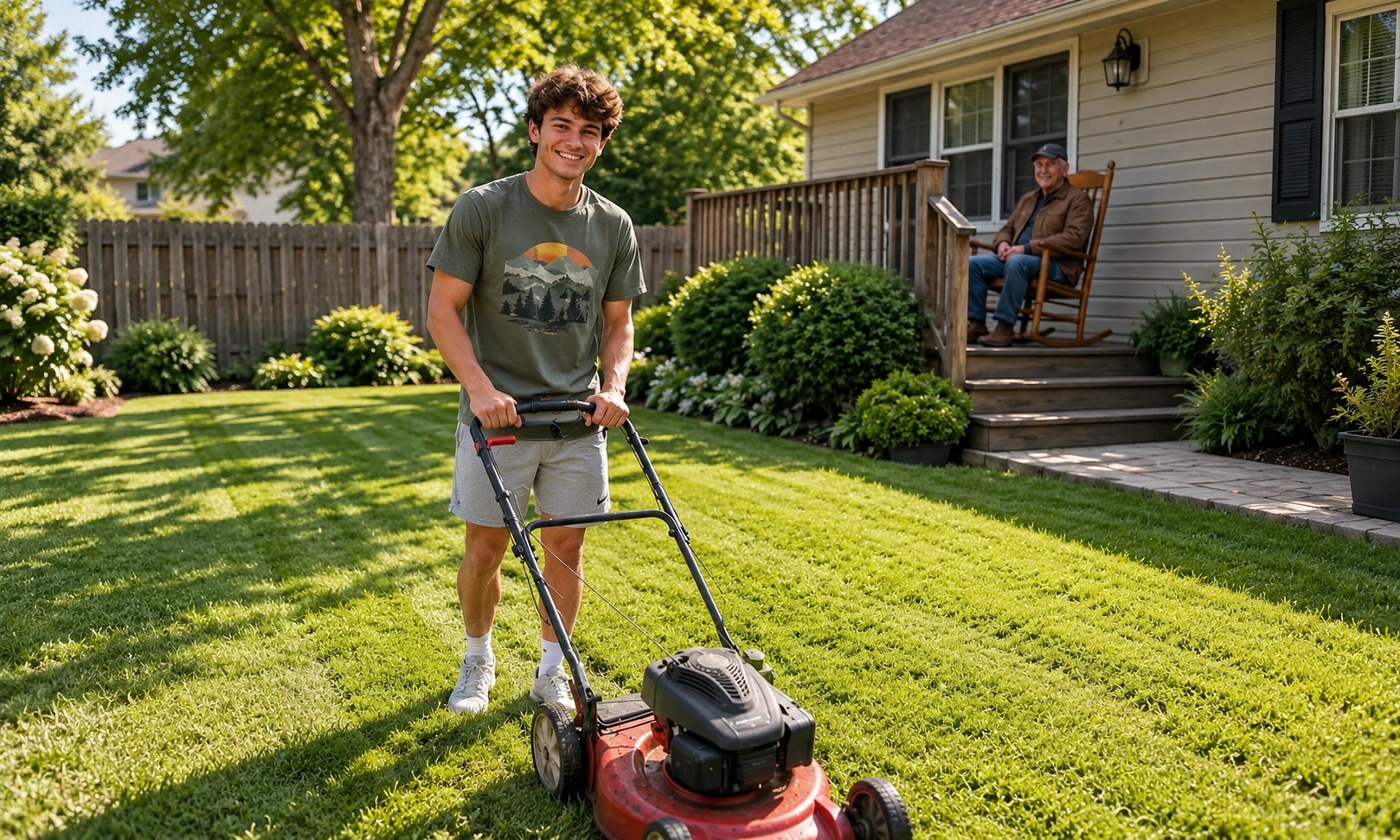
Then Noah started the old red mower.
The same mower.
Ethan stared.
“That thing still runs?”
“Barely.”
“You have a restored Mustang and you keep that?”
Noah looked offended.
“This is historic equipment.”
He pushed it toward the lawn.
Ethan followed.
“So I assume I’m helping.”
“You missed eighteen years of chores.”
“That seems mathematically unfair.”
“No appeals.”
They began mowing.
Together.
I sat in Mr. Vance’s chair.
The sun lowered over Meadow Lane.
Children laughed outside the workshop.
Someone hammered wood.
A teenager argued with a retired mechanic about tire pressure.
Music played through an open garage door.
Life everywhere.
For years, that porch had represented loneliness.
Then guilt.
Then secrets.
Now it represented something else.
A place where people returned.
Ethan stopped the mower halfway across the lawn and looked at me.
He smiled.
That crooked smile.
Noah had inherited it.
I once thought that smile belonged to the man who abandoned us.
Then I believed it belonged to a ghost.
Now it belonged to two men standing side by side in fresh-cut grass.
Ethan called:
“You okay?”
I nodded.
More than okay.
Noah finished the final strip and shut off the mower.
Silence settled for half a second.
Then somewhere inside the workshop, a teenager started another mower.
Across the street.
Then another.
Farther down.
Then another.
The sound traveled through the neighborhood.
Engines starting.
People showing up.
Saturday continuing.
Noah sat beside me.
“You know what Mr. Vance wrote?”
“What?”
“That I gave him a reason to come outside every Saturday.”
“I remember.”
He looked around.
“I think he gave me one too.”
I squeezed his hand.
Ethan joined us.
Three people sitting on one porch.
A family that should have existed twenty years earlier.
A family that nearly never existed at all.
The life we lost could never be returned.
But another life had grown in its place.
Stranger.
Messier.
Fuller.
And perhaps that was the final lesson Mr. Vance had left behind.
Kindness is rarely small.
A boy thinks he is mowing a lawn.
An old man thinks he is watching grass being cut.
A frightened father watches from somewhere far away.
A mother believes she is simply surviving.
None of them understands that every ordinary Saturday is quietly building a bridge.
Until one day, years later, they finally realize they have all crossed it.
Noah leaned back in the faded porch chair and smiled.
“Same time next Saturday?”
Ethan laughed.
“I’ll be here.”
Noah looked at him.
“Promise?”
Ethan’s smile disappeared.
He understood the question beneath the question.
“Yes.”
He reached over and squeezed his son’s shoulder.
“I promise.”
And this time, when Saturday came—
he showed up.
THE END