
The business belonged to Graham and Celeste.
The transactions totaled $74,600.
All supposedly had my approval.
Every signature was forged.
I’d already retained an independent forensic accountant and a lawyer.
But I hadn’t confronted Adam because we were still tracking the missing funds.
Now the final piece was standing in front of me.
“Adam,” I said softly, “who prepared that authorization?”
He shrugged.
“You signed it months ago.”
“Where?”
“At home.”
“Interesting. Because the date on that document is March eighteenth.”
His expression shifted.
“So?”
“On March eighteenth, I was in Switzerland.”
Vanessa quickly interrupted.
“You could have signed it electronically!”
“Perhaps. May I inspect it?”
Sofia gave me the copy after Adam reluctantly agreed.
I immediately recognized the signature.
It had been copied from an insurance form I’d signed eleven years earlier. Even the distinctive gap in the last letter was identical.
I photographed the document.
Adam’s tone grew sharp.
“Stop treating me like a criminal!”
I faced him.
“Then stop behaving like one.”
Celeste gasped dramatically.
“How dare you accuse your own son!”
Ignoring her, I addressed Sofia.
“Would you please check whether this account has any restrictions?”
Sofia checked her tablet.
Her expression shifted.
“Yes, Mrs. Whitmore. The account requires personal approval for all third-party charges.”
Adam moved forward.
“That’s ridiculous! We used it last month!”
“That’s precisely the problem,” I replied.
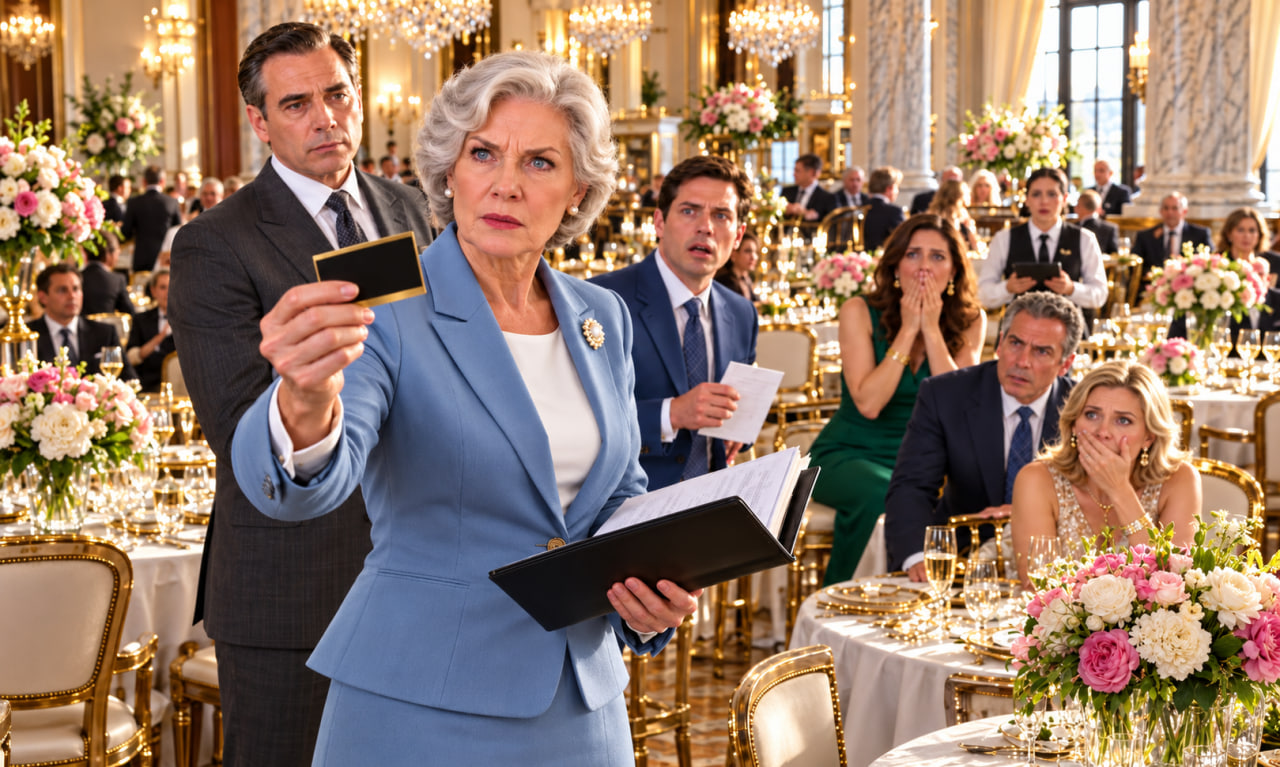
I reached into my purse and took out a thin leather folder.
It contained disputed invoices, banking records, and preliminary findings from my attorney.
Graham went pale.
“Where did you get those?”
“From my own financial records.”
Vanessa grabbed Adam’s arm.
“Adam, tell her she can’t do this!”
He turned toward the manager.
“She’s confused. My mother doesn’t even understand what this membership is.”
I nearly laughed.
Twenty-seven years earlier, my late husband, Richard, and I had put our life savings into a struggling restaurant company.
We worked sixteen-hour days. I negotiated leases, oversaw renovations, and managed the accounting myself.
That investment eventually grew into a profitable hospitality group with seven restaurants.
After Richard passed away, I hired professional managers and stepped back from daily business.
Adam assumed I’d sold my ownership interests.
He never asked.
He knew about my Founder’s Reserve membership because I’d once used it to cover his anniversary dinner.
What he didn’t understand was the meaning of founder.
I turned to Sofia.
“Could you call Mr. Romano, please?”
The manager stood straighter.
“Of course, Mrs. Whitmore.”
Graham laughed uneasily.
“And who exactly is Mr. Romano?”
“The company’s managing director.”
Adam smirked.
“Good. Maybe he’ll explain that you’re wasting everyone’s time.”
I closed the folder.
“He’ll certainly explain something.”
## PART 3: THE MOTHER WHO OWNED THE TABLE
Twelve minutes later, Anthony Romano, the restaurant’s managing director, appeared from the private dining corridor.
He was a distinguished man in his fifties, dressed in a charcoal suit.
Spotting me, he walked straight over.
“Mrs. Whitmore. I wasn’t expecting you tonight.”
“Happy Mother’s Day, Anthony.”
He gave me a warm smile.
“Happy Mother’s Day. Is everything satisfactory?”
“Unfortunately, we’ve encountered an attempted unauthorized charge.”
I motioned toward Adam.
“My son has presented a forged document to access my Founder’s Reserve account.”
Adam laughed.
“Forged? Anthony, don’t listen to her. She’s just an elderly woman who doesn’t understand business.”
Anthony’s expression hardened.
“Mr. Whitmore, I suggest you choose your next words carefully.”
Graham approached.
“Excuse me. Who is this woman to tell us how to use a membership?”