
The turkey was beautifully browned.
Sweet potatoes were warming in the oven.
Green bean casserole sat on the counter.
Fresh rolls.
Pumpkin pie cooling nearby.
Everything Karen had prepared for the people she believed deserved a seat at the table.
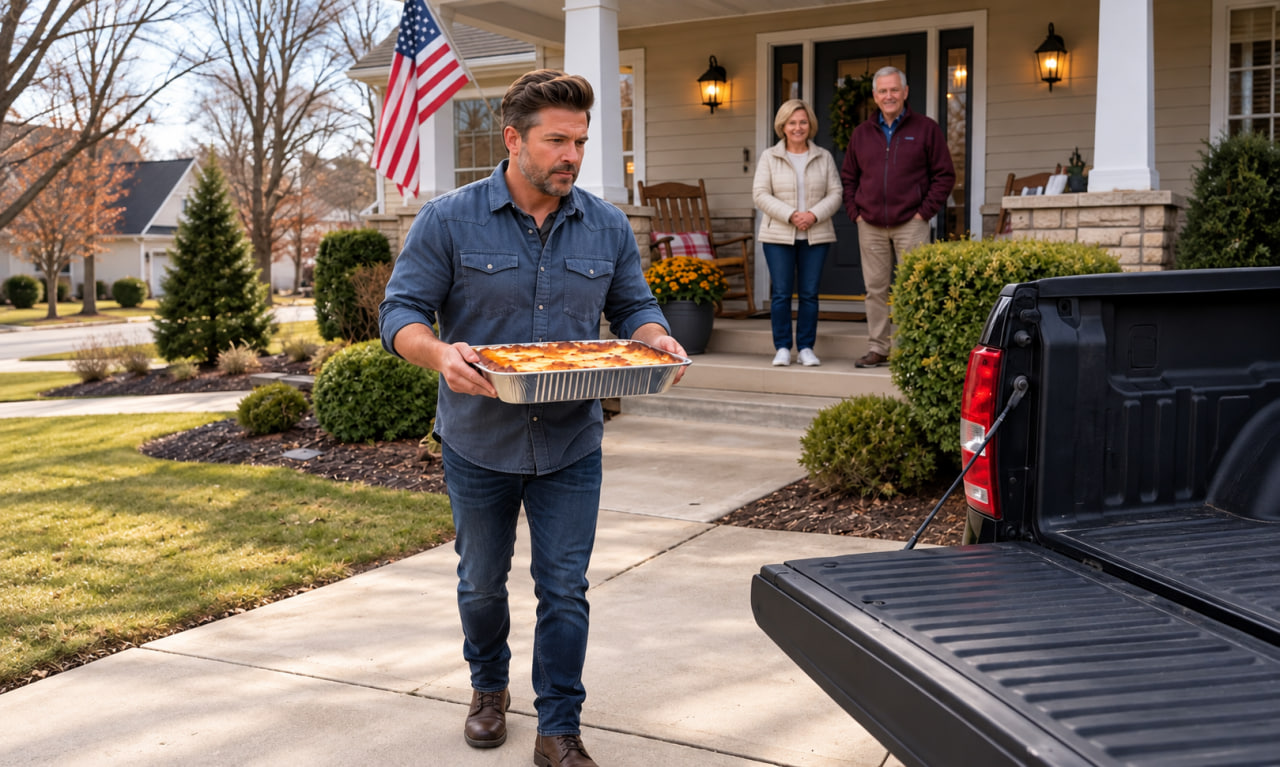
I opened the cabinet above the refrigerator and pulled out several foil trays.
Karen appeared in the doorway.
“What are you doing?”
“Packing dinner.”
“Rick.”
I kept working.
“I heard you tell my father he wasn’t welcome in his son’s home on Thanksgiving because he smells like the work he spent fifty years doing.”
She stared at me.
“I’m not sitting down to dinner after that.”
“So you’re ruining Thanksgiving?”
“No.”
I covered the sweet potatoes with foil.
“I’m having Thanksgiving with my father.”
Karen told me I was being childish.
She said her parents would be embarrassed.
She said I couldn’t simply take the food and leave.
She said I was making a mistake.
I listened while packing everything into my truck.
But I didn’t argue.
There was nothing left to debate.
I drove to Dad’s house.
The trip usually took twenty-two minutes.
That morning, with most people already where they planned to spend the holiday, it took seventeen.
Dad lived in a small 1960s ranch house on a corner lot.
His detached garage had never had an empty bay for as long as I could remember.
There was always something inside being repaired.
A neighbor’s lawn mower.
An old pickup.
A friend’s snowblower.
Something.
The porch light was on.
It almost always was.
I knocked.
Dad opened the door, looked at me, then at the foil trays in my arms.
Then back at me.
“Rick?”
“Happy Thanksgiving, Dad.”
He stared another second.
“You planning on standing out there all day?”
He stepped aside.
His house smelled like coffee, pine cleaner, and the faint trace of motor oil that seemed permanently woven into everything he owned.
I had always found it comforting.
I put the food on his kitchen table.
Dad watched me uncover the trays.
“Karen know you’re here?”
“She knows.”
He was quiet.
“Everything all right?”
I looked at him.
At the man who had worked half a century.
The man who fixed our furnace without being asked.
The man who had tried to protect me from conflict by pretending being excluded didn’t bother him.
“No,” I said.
“But it will be.”
Dad nodded once.
Then he went to the cabinet and took out two plates.
We ate Thanksgiving at the kitchen table he had built himself in 1987.
The turkey was excellent.
The sweet potatoes had gotten a little soft during the drive.
Dad took two servings anyway.
We watched the end of the parade.
Then a football game neither of us cared much about.
Mostly we talked.
About my work crew.
About the old Silverado carburetor he was rebuilding for a neighbor.
About winter.
About whether I needed to replace the weatherstripping around his garage doors.
He never asked again what had happened.
He understood.
Later, over coffee and pie, Dad said quietly,
“You didn’t have to do this.”
“Yes, I did.”
“She’s your wife, Rick.”
“I know.”
I looked at him.
“And you’re my father. I should have said something years ago.”
Dad stared into his coffee.
“I really didn’t mind staying here.”
I knew what he was doing.
Trying to make it easier for me.
“You should have been there,” I said. “You’ve always deserved to be there.”
He didn’t answer.
After a while, he looked at his plate.
“Good pie.”
I smiled.
“Karen made it.”
Dad nodded.
“She’s a good baker.”
That was my father.
Seventy-four years old.
Excluded from Thanksgiving by his daughter-in-law.
Still complimenting her pie.
My phone had been buzzing most of the afternoon.
Karen called several times.
Don called twice, which was unusual because he had never called me directly in twelve years.
By late afternoon, Karen’s messages had changed from anger to worry.
I stayed with Dad until evening.
When I left, I hugged him and promised to return Saturday to check the garage.
He told me to bring a decent lunch because he was tired of sandwiches.
When I arrived home, Karen was sitting in the living room.
Her parents were gone.
The dining table was still set.
Six untouched places.
The good silverware.
Crystal glasses.
Everything arranged beautifully for a meal that had been eaten twelve miles away on a table my father built with his own hands.
Karen had clearly been crying.
“Sit down,” I said.
We sat across from each other.
And I finally said what I should have said years earlier.
“My father is not something you manage around.”
Karen looked at me.
“He is the reason I know how to work. He taught me to show up when people need help. He taught me how to fix things instead of throwing them away.”
I pointed toward the untouched table.
“When you called him and told him there wasn’t room for him, you weren’t protecting your parents’ comfort. You were telling him that their preferences mattered more than everything he has meant to me.”