
PART 1
My father had been dead for twenty-three days when my mother, Evelyn, called to say she wanted to settle his estate over coffee at her house.
I was fifty-eight years old, tired from handling the funeral bills she kept forgetting to pay, and stupid enough to think we were finally going to sit down like two adults.
When I pulled into her driveway in Columbus on a gray Tuesday morning, I noticed four unfamiliar sedans parked along the curb.
Two of them had gold county bar stickers in the back windows.
I sat in my Honda for a minute with the engine off, looking at those cars.
My mother lives on a quiet cul-de-sac where the biggest weekly event is Thursday trash pickup. Four sedans at ten in the morning meant something was already arranged.
I took my leather tote bag off the passenger seat, checked that my phone was on silent, and walked up the front steps.
The front door wasn’t locked.
“Claire?” my mother called from the dining room. “Come on back. Everybody’s already here.”
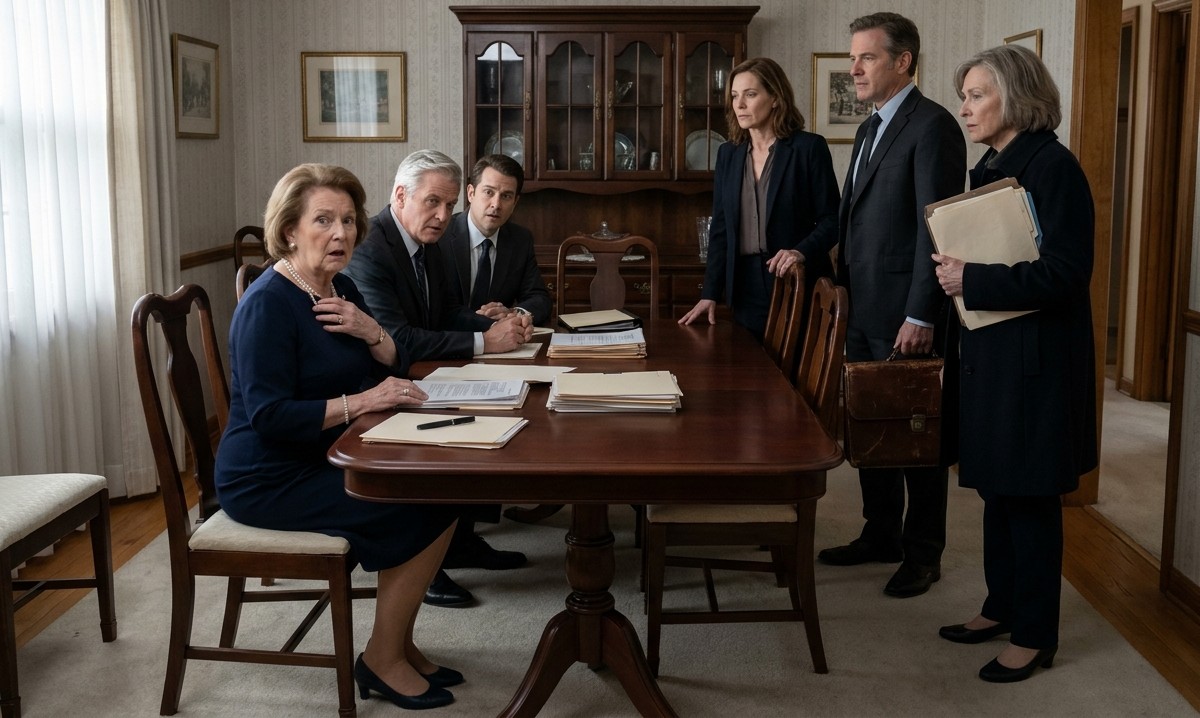
Everybody turned out to be five people sitting around her mahogany dining table, plus my mother at the head of it. Three men and two women, all in dark suits, all with open leather folders and printed packets stacked neatly in front of them.
My mother was wearing her good navy dress and her pearls, the ones she only puts on for church Easter Sunday and hospital board luncheons.
“Sit down, sweetheart,” she said, pointing to the single empty chair at the far end of the table, the one with its back to the kitchen. “I wanted to make this simple for you.
You’ve had a hard month, and I know legal paperwork isn’t really your area.”
I didn’t sit right away.
I stood behind the chair and counted them. Five attorneys. One for my mother, I assumed, and four others sitting beside her like a wall.
“Who are all these people, Mom?” I asked.
“This is Arthur Pendelton, my estate counsel,” she said, gesturing to the silver-haired man on her right. “And these are his associates and tax specialists.
We’ve been going over your father’s holdings since last week, and we put together a clean family settlement agreement so nobody has to drag things through probate court.”
I looked at the stack of paper sitting in front of my empty chair. On top of it lay a heavy black Montblanc pen.
“You brought five lawyers to a coffee meeting,” I said.
Arthur Pendelton gave me a thin, polite smile. “Mrs. Holloway wanted to make sure every question you might have could be answered on the spot, Claire.
It’s actually a courtesy. Most families spend months going back and forth.”
“And what exactly am I agreeing to?” I asked, still standing.
My mother sighed, the way she always did when I asked a direct question at Thanksgiving or in front of her bridge club. For forty years, my job in that family had been to nod, bring the potato salad, and let my mother handle the important things.
My younger brother, Darren, got the praise and the business introductions; I got the errands and the quiet smile.
“Your father left a mess of joint accounts and commercial property titles,” my mother said softly. “If you try to claim your half right now, the taxes and management fees will eat it alive.
Arthur has drawn up a waiver transferring your residual interest in the three Oak Street parcels and the investment trust into my sole management.
In return, I’ll give you a clean lump sum of $45,000 today so you can pay off your mortgage and stop worrying.”
I looked down at the paper. The Oak Street parcels alone were three brick storefronts Dad had bought in the eighties and paid off twelve years ago.
The investment trust had been built from thirty-five years of his engineering firm profits.
“Forty-five thousand dollars,” I repeated.
“Tax-free gift,” Arthur said smoothly. “Signed, notarized, and wired by four o’clock this afternoon. Honestly, Claire, for a woman working part-time at a school library, that’s a cushion most people would be grateful for.”
He didn’t know I had left the school library eleven years ago.
Neither did my mother, because she hadn’t asked a real question about my work since my divorce in 2014.
I looked at the five of them watching me, waiting for me to get flustered, apologize for taking their time, and pick up the pen.
My mother already had her reading glasses perched on her nose, ready to witness my signature.
I set my tote bag on the table beside the packet and smiled.
“Good thing I didn’t come here alone,” I said.
My mother frowned. “What are you talking about? You drove up by yourself. I saw your car.”
“I drove up early to get coffee,” I said, checking my watch. “They had a ten-fifteen train from Cleveland.”
Right on cue, a slow, heavy knock sounded at the front door.
PART 2
My mother didn’t move at first. She looked at Arthur Pendelton, and Arthur looked at the hallway.
“Did you invite someone?” my mother asked me, her voice dropping its soft church tone. “This is a private family meeting, Claire. If you brought that friend of yours from the book club, she can wait in the living room.”
“It’s not someone from book club,” I said.
I walked down the front hall and opened the door.
Two people stood on the porch. The first was Marcus Vance, senior probate and trust litigator from Vance, Miller and Cho in Cleveland, carrying a scuffed brown leather briefcase.
Behind him stood Janet Mercer, who had been my father’s personal CPA for nineteen years until my mother told him three weeks ago that his services were no longer needed.
Janet was sixty-six, wore sensible flat shoes, and didn’t smile easily.
When she stepped past me into the foyer, she smelled faintly of peppermint and rain.
“Morning, Claire,” Marcus said quietly. “Traffic off I-71 was light.”
“Thank you both for coming,” I said, and led them back into the dining room.