
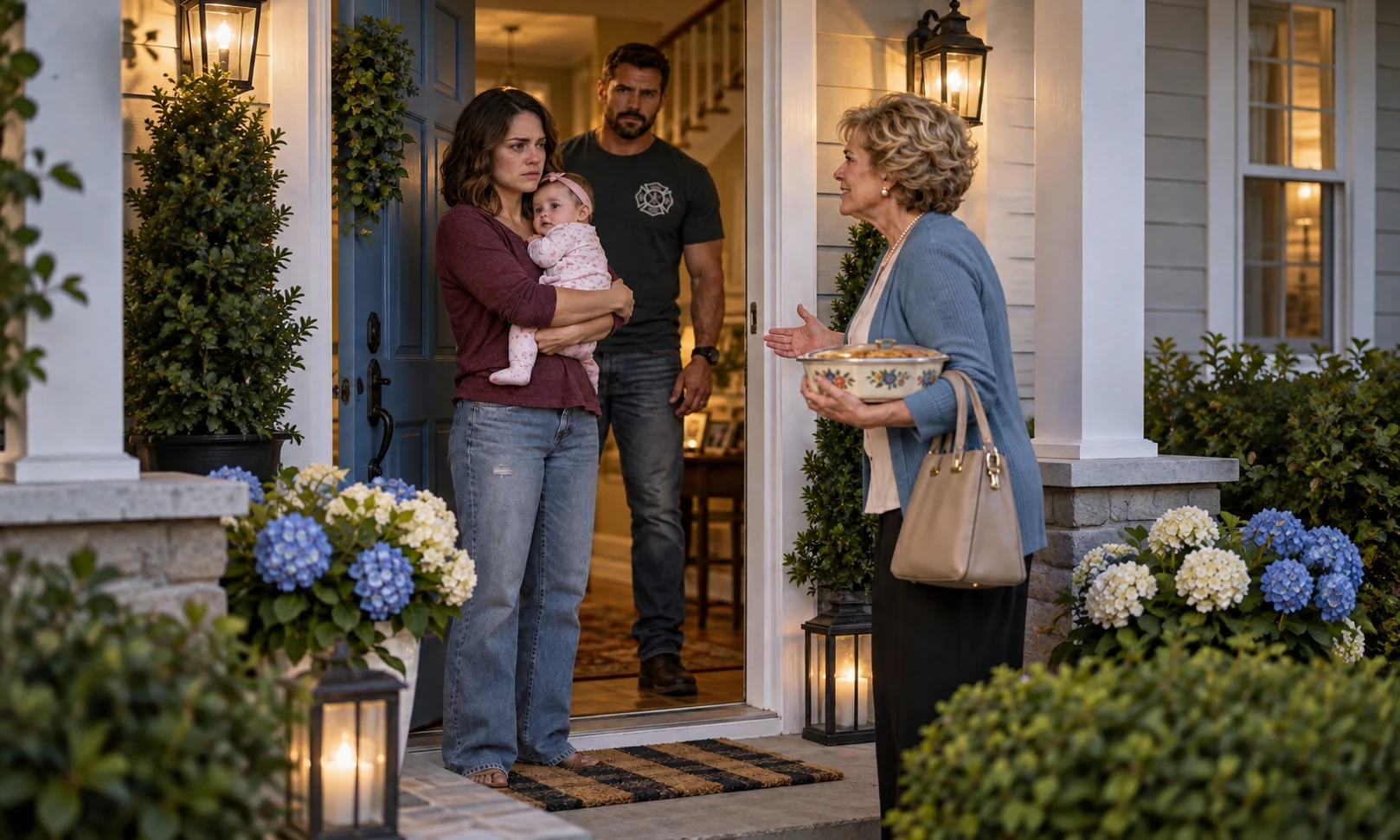
Grant looked down.
“She came because the bank froze the deal four days after he collapsed.”
I sat silently.
For fifteen years, my parents had acted as if I were dead.
Then I became useful.
And suddenly they believed in family.
I looked at the brass key beside Nana Ruth’s letter.
“What does this open?”
Grant’s face changed.
“I’ve never seen it.”
Three mornings later, another piece fell into place.
Silas was making pancakes.
Ren slept in a bassinet nearby.
I had spent half the night searching public records tied to the agency.
Dad’s collapse happened at his house on Sycamore Street.
I looked at Silas.
“Which crew answered the cardiac call on Sycamore?”
His spatula stopped.
His shoulders stiffened.
My skin prickled.
“Silas.”
He turned slowly.
“That was my crew.”
For a second, I couldn’t breathe.
“What?”
He switched off the burner.
“That was me, Colleen.”
“You were there?”
“Yes.”
“You knew it was him?”
“Not until I walked into the kitchen.”
I stared.
Silas leaned against the counter.
“He was on the floor. No pulse. Your mom was screaming.”
“What did you do?”
His expression barely changed.
“My job.”
CPR.
Defibrillation.
Medication.
More CPR.
Silas had knelt on my parents’ kitchen floor until Dad’s heart started beating again.
The man my father had called trailer trash had brought him back from the dead.
“Why didn’t you tell me?”
“Because you had just given birth. Because you were exhausted. Because I didn’t want his emergency becoming another way your family entered our house.”
I started crying.
Not because Dad nearly died.
Not entirely.
Because Silas had every reason to hate him.
And saved him anyway.
“What did Dad say when he recognized you?”
Silas was quiet.
Finally, he said, “He said my name.”
That hurt more than expected.
After fifteen years refusing to speak it, my father had looked at Silas from a hospital stretcher and whispered:
“Callahan.”
Pastor Nylin arranged a family meeting the following week.
My parents arrived believing they were walking toward reconciliation.
Mom brought tears.
Dad brought his cane.
Aunt Deborah sat beside them.
Grant sat near the back.
Ren stayed with Silas’s father.
I entered alone.
Mom began almost immediately.
“We forgive her for everything, Pastor. We only want our daughter back.”
I looked at her.
“For everything?”
She blinked.
“What exactly are you forgiving me for?”
Dad shifted.
“Colleen—”
“No.”
I turned to him.
“You threw me out at nineteen. I didn’t run away. I didn’t abandon this family. You removed me from it.”
Nobody spoke.
Then I asked what I had waited fifteen years to ask.
“Say his name.”
Dad frowned.
“What?”
“My husband.”
His jaw tightened.
“Say his name.”
Mom whispered, “This is ridiculous.”
“No. It isn’t.”
Dad stared at me.
He couldn’t do it.
For fifteen years, Silas had been “that man.”
“That Callahan.”
“Trash.”
Anything except himself.
I leaned forward.
“His name is Silas Callahan.”
Dad’s hand tightened around his cane.
I took a breath.
“And the night your heart stopped in that kitchen, Silas Callahan was the man who brought you back.”
Mom stopped crying.
Aunt Deborah’s mouth fell open.
Pastor Nylin looked sharply at Dad.
My father went white.
“Is that true?” Deborah whispered.
Dad looked at the floor.
“Yes.”
The word barely existed.
I waited.
Then Dad finally raised his head.
“Silas Callahan saved my life.”
Fifteen years.
That was all it took.
One sentence.
And hearing it somehow didn’t heal me.
It only proved he had always been capable of saying the name.
Then I placed the forged guaranty on the table.
Mom’s face changed before Dad’s.
That told me everything.
“What is this?” Pastor Nylin asked.
“My signature,” I said.
Then I looked directly at Mom.
“Except I didn’t sign it.”
Her lips parted.
Dad whispered, “Margaret.”
Interesting.
Not Colleen.
Not calm down.
Margaret.
I turned to him.
“You knew?”
Dad looked older than five minutes earlier.
“I knew about the shares.”
“The forged transfer?”
He didn’t answer.
“That’s a yes.”
Mom stood abruptly.
“This is private family business.”
“No,” I said. “You made it public when you brought half the church to my hospital.”
Grant spoke behind us.
“Tell her why you needed the signature.”
Mom spun around.
“Grant, stop.”
He walked forward.
“The bank won’t recognize the refinancing unless Colleen ratifies the old transfer.”
Dad closed his eyes.
Mom’s face hardened.
No tears this time.
“You have no idea what it takes to hold a family together.”
I laughed.
“You threw one of your children away.”
“I was protecting this family.”
“From Silas?”
“From instability.”
I looked around the fellowship hall.
Then back at her.
“My husband has never missed a mortgage payment. You forged my name for more than a million dollars.”
Mom flinched.
For the first time, I saw shame.
But then Grant said something strange.
“Ask her about the payments to Hawthorne Consulting.”
Mom went completely still.
Dad looked confused.
“What payments?”
And just like that, the room changed again.
Grant removed another stack of documents.
Transfers.
Dozens of them.
Thousands of dollars each.
Hawthorne Consulting.
“What is that?” Dad asked.
Mom didn’t answer.
Grant looked at me.
“I found these after Dad collapsed.”
Something bothered me.
Grant sounded nervous.
Not sad.
Not angry.
Nervous.
I looked at the transfers.
Then at him.
“You said the agency was collapsing because Dad made bad decisions.”
“It is.”
“But you already knew money was disappearing.”
“Yes.”
“How long?”
Grant hesitated.
Too long.
The brass key in my pocket suddenly felt heavy.
I stood.
“I’m done.”
Mom called after me.
“Colleen!”
I turned at the door.
“You wanted me back in the tent.”
My voice shook, but not from fear.
“You should’ve made sure there wasn’t a fire inside it first.”
The next morning, I called the law firm listed on Nana Ruth’s old correspondence.
When I gave my name, the receptionist went silent.
Then she transferred me directly to a senior partner.
“Mrs. Callahan,” he said, “we have been waiting nearly eleven years for you to call.”
The brass key opened a safe-deposit box.
Nana Ruth had arranged everything.
The box contained original trust documents.
Stock certificates.
Letters.
And a small digital recorder wrapped in one of her scarves.
There was also a note.
Colleen—
If you are opening this, then someone finally needed something badly enough to remember you exist.
My hands trembled.
I played the recorder.
Nana Ruth’s voice filled the tiny bank consultation room.
Older.
Weaker.
But unmistakably hers.
She explained the trust.
The shares.
Dad’s anger.
Then she said something that stopped me cold.
“Your father thinks I changed the trust because of what he did to you.”
A pause.
“I did not.”
My skin prickled.
“I changed it because I discovered what was happening inside the agency.”
She mentioned irregular accounts.
False vendors.
Missing premium payments.
Thousands disappearing.
Then hundreds of thousands.
“I confronted your father,” Nana said. “He denied stealing anything. For once, I believed him.”
My heart thudded.
If not Dad—
Then who?
Nana continued.
“I became suspicious of Margaret.”
My mother.
But another pause followed.
Longer this time.
“I was wrong about her too.”
I stopped breathing.
“Colleen, if this recording has reached you, do not trust the person who brings you the truth too easily.”
Grant.
I replayed the sentence.
Then again.
Nana continued.
“Your brother learned very young that honest people hesitate. Liars arrive prepared.”
The room seemed to tilt.
Grant had appeared at my door.
With documents.
With answers.
With exactly enough truth to stop me asking who assembled it.
I called an attorney.
Then a forensic accountant.
Forty-eight hours later, we knew.
Hawthorne Consulting belonged to Grant.
Not directly.
Through two shell companies and an LLC registered under his wife’s maiden name.
For eleven years, Grant had siphoned money from the family agency.
Small amounts first.
Then larger ones.
When Dad noticed cash-flow problems, Grant blamed market losses and bad investments.
When the business needed loans, Grant prepared the paperwork.
When the forged share transfer became an obstacle, Grant forged my signature.
Mom knew the transfer was questionable.
Dad knew I had never willingly signed away the shares.
They were guilty.
But not of everything Grant claimed.
They had agreed to let Grant “fix” the documentation rather than contact me.
Why?
Pride.
Fear.
And because contacting the daughter they disowned meant admitting what they had done.
Then came the final discovery.
Dad’s cardiac arrest hadn’t happened randomly.
He collapsed during an argument with Grant.
A neighbor’s doorbell camera showed Grant leaving my parents’ house eight minutes before the 911 call.
Mom found Dad on the kitchen floor minutes later.
When I confronted Grant, he laughed.
We were in the agency conference room.
My attorney sat beside me.
Silas waited outside.
“You think Nana made you some kind of hero?” Grant said.
“No.”
“You weren’t here, Colleen. You got to leave.”
I almost couldn’t believe him.
“Leave?”
“You escaped all of it. Dad’s expectations. Mom’s control. This business. Everything landed on me.”
“So you stole from them?”
“I took what I was owed.”
“Then why come to me?”
His smile vanished.
Because now we had reached the part he hadn’t planned for me to understand.
The agency wasn’t beyond saving.
Its property alone was worth more than its debts.
If I had signed Grant’s ratification documents, the refinancing would have gone through.
My controlling interest would have been legally surrendered.
And within thirty days, Grant planned to sell the building and agency book.
He would pay the bank.
Pay my parents enough to keep them quiet.