
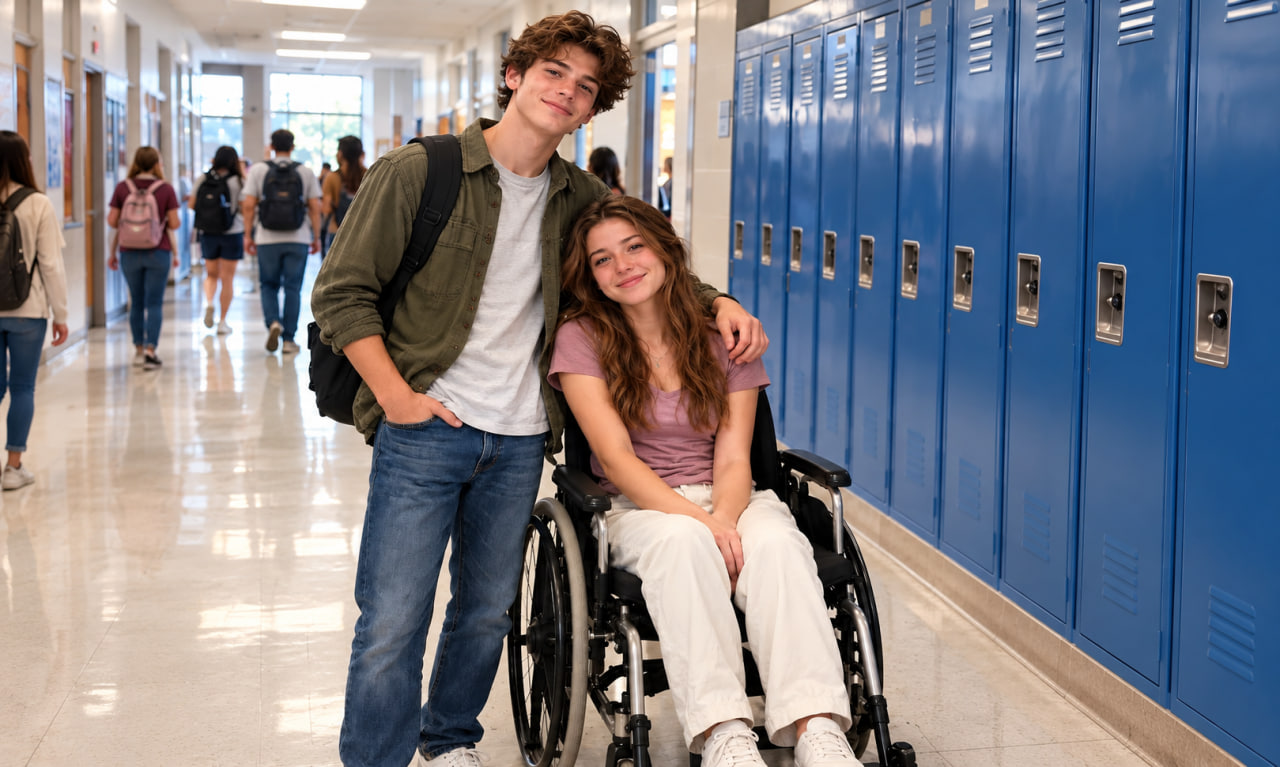
Three people, connected by one simple desire.
And somewhere in the middle of it all, someone had stolen a wheelchair intended for a girl who desperately needed it.
I was beginning to understand why the police had looked so troubled.
This was no longer just a case of fraud.
It was a chain of good intentions that a cruel person had tried to turn into something ugly.
And I was determined not to let him have the last word.
FINAL PART: THE GIFT THAT COULD NEVER BE STOLEN
Daniel arrived home forty minutes later, carrying a thick envelope and looking as though he hadn’t slept in days.
Julian was sitting on the living room sofa, staring at the empty space where his guitar had once stood.
His father crossed the room and knelt in front of him.
“Hey, buddy.”
Julian looked up.
“Dad, I’m sorry.”
Daniel frowned. “For what?”
“I should’ve asked you before I sold the guitar. I should’ve told Mom about the man. And now Maya might lose the chair, and Uncle Michael’s money—”
“Stop.”
Daniel placed both hands on Julian’s shoulders.
“Look at me.”
Julian reluctantly met his eyes.
“You made a mistake by trusting someone you shouldn’t have trusted. That’s something you’ll learn from. But you did not make a mistake by caring about Maya.”
“But I lost my guitar.”
“I know.”
“I can’t buy it back.”
Daniel’s eyes shone.
“No, son. You can’t.”
Julian’s face crumpled again.
His father pulled him into an embrace.
“But listen to me. A guitar is an extraordinary thing. It can make people feel understood when they don’t have the words to explain themselves. You used something you loved to try to make someone else’s life better. That tells me more about the musician you’re becoming than any song you could play.”
Julian buried his face in his father’s shoulder.
I turned away, wiping tears from my cheeks.
For several moments, nobody spoke.
Then Daniel opened the envelope.
“I need to show you both something.”
Inside were copies of the insurance documents, the wheelchair purchase agreement, and a letter written in Michael’s unmistakable handwriting.
Daniel unfolded it carefully.
“I found this with his personal papers after the insurance company approved the claim. I think it’s time you both read it.”
The letter was addressed to Daniel.
Danny,
If you’re reading this, then I’ve probably managed to leave you with one final responsibility. Don’t let that worry you. I’ve always trusted you with the things that matter.
I want part of my insurance money to help children whose families can’t afford the medical equipment they need. Not because I think money can fix everything, but because sometimes a little help at the right moment can give someone back a piece of their life.
Please don’t put my name on a building. Don’t hold a ceremony. Don’t make a big deal out of it.
Find someone who needs help, and help them.
And if Julian is old enough to understand, tell him that being a good man doesn’t mean never making mistakes. It means caring enough to learn from them.
Take care of Sarah. Take care of the boy.
And don’t forget to keep making music.
Love,
Michael
By the time Daniel finished reading, Julian was crying openly.
“He wrote about me.”
Daniel nodded.
“He loved you more than you know.”
Julian touched the letter with one finger.
“I wish he were here.”
“So do I,” Daniel whispered.
For a long time, the three of us sat together, holding the memory of a man whose final act of kindness had continued long after he was gone.
Then the telephone rang.
It was Detective Harris.
“We have an update,” he said. “We’ve identified the seller as Marcus Reed. He has previous arrests for theft and fraud, and we’re working with investigators to locate him.”
“Have you found the wheelchair?” Daniel asked.
“Yes. We have reason to believe it’s still intact.”
I gripped the telephone.
“And Maya? Will she be able to keep it?”
There was a pause.
“We’re coordinating with the medical supplier and the district attorney’s office. We can’t promise what will happen with that particular chair until the evidence has been processed. But your son’s cooperation has helped us establish how it changed hands.”
“Thank you,” I whispered.
Before ending the call, Detective Harris added something that made me sit straighter.
“One more thing, Mrs. Vance. The seller didn’t choose Julian at random.”
My stomach tightened.
“What do you mean?”
“We recovered messages from the phone number used to arrange the sale. One of them referred to a boy who had been trying to raise money for a classmate’s wheelchair.”
Daniel went still beside me.
“Who sent the message?” I asked.
“We’re tracing it. At this stage, we don’t know whether the sender was connected to the theft itself or simply knew about the situation.”
After the call, I looked at Daniel.
“Someone knew about Maya’s situation before Julian ever contacted the seller.”
Daniel nodded grimly.
“We need to tell Maya’s parents everything.”
That afternoon, we drove to the Collins home.
Maya’s mother, Elena, opened the door. Her face was swollen from crying, and behind her, Maya sat in the living room beside the wheelchair Julian had purchased.
Two officers had allowed the family to keep it temporarily while arrangements were made for a safe replacement and the investigation continued. The chair had been inspected and secured, but its ownership still had to be resolved.
Maya looked up as we entered.
“Julian?”
He stood awkwardly in the doorway.
“Hi.”
Her gaze moved to his empty hands.
“Where’s your guitar?”
He swallowed.
“I sold it.”
“I know. You told me yesterday.”
“To buy your wheelchair.”
Maya nodded slowly.
“Why are you saying it like that?”
“Because I don’t know if you can keep it.”
Her face fell.
Elena placed a comforting hand on her daughter’s shoulder.
“Julian, sweetheart, we appreciate what you did. But the police explained that this chair may belong to someone else, and we can’t keep equipment that might have been stolen.”
“I know.”
He looked at Maya.
“I’m sorry.”
She frowned.
“Why are you apologizing to me?”
“Because I wanted to help, and now everything’s a mess.”
Maya’s eyes filled with tears.
“Julian, do you know what happened when you brought that chair to my house yesterday?”
He shook his head.
“For the first time in years, my mom didn’t spend the whole evening worrying about how she was going to get me to school. She just sat beside me and talked about what I wanted to do when I grew up.”
Elena covered her mouth.
Maya continued.
“I drove it around the living room for an hour. I made my little brother move every cushion out of my way. I felt like I could actually go somewhere without having to ask someone to push me.”
She looked directly at Julian.
“You gave me that feeling. Nobody can take it away.”
Julian wiped his eyes.
“But if they take the chair—”
“Then we’ll figure out what comes next.”
Maya tilted her head.
“You told me once that you wanted to be a musician because music made you feel free. Remember?”
Julian nodded.
“Well, yesterday you made me feel free. So don’t tell me you did nothing.”
For the first time since the police had arrived, Julian smiled.
It was small and fragile, but it was real.
Then Elena turned toward Daniel.
“I owe you an apology,” she said.
Daniel looked surprised.
“Why?”
“Because I knew someone had been trying to arrange a wheelchair for Maya, but I assumed it was the school district. I received a call last week from a man who claimed he worked with a charitable medical organization. He asked for details about Maya’s equipment and our financial situation.”
The room went silent.
“What did he call himself?” Detective Harris’s warning echoed in my mind.
Elena thought for a moment.
“Marcus, I believe. He said he might be able to find a chair at a reduced price.”
Daniel’s face drained of color.
“Did you give him any money?”
“No. I told him we couldn’t pay for anything. He said that wasn’t a problem and asked for Maya’s school schedule so he could arrange a demonstration.”
“Did you give it to him?” I asked.
Elena nodded reluctantly.
“I thought he was legitimate. He knew the name of the school and some details about her condition.”
Daniel sat down heavily.
“He used that information to find someone who would pay for the chair.”
Julian stared at the floor.
“So he knew I wanted to help Maya?”
“Possibly,” Daniel said. “Or he simply recognized an opportunity.”
Maya’s hands tightened around the wheelchair controls.
“I hate him,” she whispered.
Elena pulled her daughter close.
“You have every right to be angry.”
For a moment, nobody spoke.
Then Maya looked at Julian.
“But I don’t want him to be the reason we stop trusting people.”
Julian raised his eyes.
She gave him a watery smile.
“If we let one bad person decide what everyone else is allowed to do, he wins twice.”
Those words stayed with me long after we left the Collins home.
Because Maya, who had spent years being stared at, underestimated, and pitied, understood something the rest of us were still struggling to learn.
Kindness was not the same as recklessness.
And caution did not have to mean giving up on people.
We could learn to protect our generosity without letting fear destroy it.
Three days later, Detective Harris called with the news we’d been waiting for.
Marcus Reed had been arrested.
The investigation revealed that he had worked briefly for a medical equipment contractor and knew how to obtain information about deliveries. He had stolen several pieces of equipment and advertised them online using false documents.
He had learned about Maya through the fraudulent charitable scheme he had used to approach her family.
After Elena refused to pay, he had moved on.
When he discovered that Julian had saved money from years of gifts and small jobs, he saw an easy target: a child with a generous heart and no experience recognizing a convincing lie.
He had stolen the wheelchair, fabricated a receipt, and sold it to Julian for cash.
But the discovery that brought the greatest relief was that the warehouse had recovered the original order documents, confirming that Daniel’s purchase had been legitimate and that the wheelchair had been intended for Maya all along.
The medical supplier agreed to provide a replacement of the same model at no additional cost to Daniel, while the stolen chair was retained as evidence.
The company also reviewed its security procedures and agreed to work directly with Maya’s rehabilitation specialist to ensure the replacement met her needs.
A week after the police first knocked on our door, a delivery truck pulled up outside the Collins home.
Julian and I were waiting on the pavement with Elena and Maya.
Two technicians carefully unloaded a new wheelchair.
It was sleek, lightweight, and designed to navigate the tight corners of the school hallways where Maya had struggled for years. The seat was custom-fitted, the controls were adjusted to her reach, and the battery had enough capacity for a full day of classes and activities.
Maya stared at it as though she couldn’t believe it was real.
“Is it really mine?” she whispered.
Elena knelt beside her.
“Yes, sweetheart. It’s yours.”
Maya looked at Daniel.
“Did you buy it?”
Daniel shook his head.
“Your uncle Michael did, in a way.”
He explained the insurance money, the letter, and the promise he had made to his brother.
Maya listened quietly.
Then she looked at Julian.
“And you sold your guitar.”
Julian nodded.
She reached for his hand.
“I don’t know how to repay you.”
“You don’t have to.”
“But I want to.”
She thought for a moment.
“Then you have to promise me something.”
“What?”
“Don’t stop playing music.”
Julian laughed softly through his tears.
“I don’t have a guitar.”
“Then get another one someday.”
She squeezed his hand.
“And when you do, you have to teach me how to play.”
Julian smiled.
“Deal.”
The technicians helped Maya into her new chair.
Elena stood behind her, crying silently as her daughter adjusted the controls. Maya moved forward, then backward, then turned in a smooth circle.
A laugh burst from her chest.
Not a polite laugh.
Not the quiet, embarrassed sound she sometimes made when other students stared.
A full, unrestrained laugh of pure delight.
She drove down the pavement toward the street, turned around, and came back.
“Mom! Look!”
Elena clapped her hands over her mouth.
“I see you, baby!”
Maya grinned.
For years, her mother had been the one pushing her forward.
Now Maya could decide where she wanted to go.
I glanced at Julian.
He was watching Maya with tears shining in his eyes, but this time he wasn’t ashamed of them.
He was proud.
And I realized that the story had never really been about a guitar or a wheelchair.