
I looked at her.
“What about them?”
“Your wife claims you had been planning to leave her for months.”
“I had.”
“Why?”
I hesitated.
“I was afraid.”
Detective Morgan leaned forward.
“Afraid of her?”
“Afraid of what she was becoming.”
“Did you document anything?”
“Some things.”
“What kind of things?”
“Messages. Photographs. Notes.”
Her expression sharpened.
“Do you still have them?”
“Yes.”
“Where?”
“On my computer.”
“Don’t delete anything.”
“I won’t.”
She nodded.
“There’s another issue.”
“What?”
“Your wife told officers that you had been emotionally abusive toward her.”
I stared at the detective.
“That’s a lie.”
“Perhaps.”
She remained calm.
“We’re going to investigate every allegation. That’s how this works.”
“I understand.”
She studied me.
“Do you?”
“Yes.”
“Because if this goes to court, nobody is going to care about what you feel. They’re going to care about evidence.”
I nodded.
“I understand.”
She stood.
“Then start gathering everything.”
She reached the door.
Then turned back.
“One more thing.”
“What?”
“Your daughter may eventually be asked questions.”
My heart tightened.
“Do you have to?”
“We’ll use a child specialist. We won’t interrogate her.”
I nodded.
“But Mr. Carter…”
“Yes?”
“Children often protect the parent they’re afraid of.”
I looked at my daughter.
“What does that mean?”
“It means don’t pressure her to tell you what happened.”
I nodded.
“Let trained professionals handle that.”
Then she left.
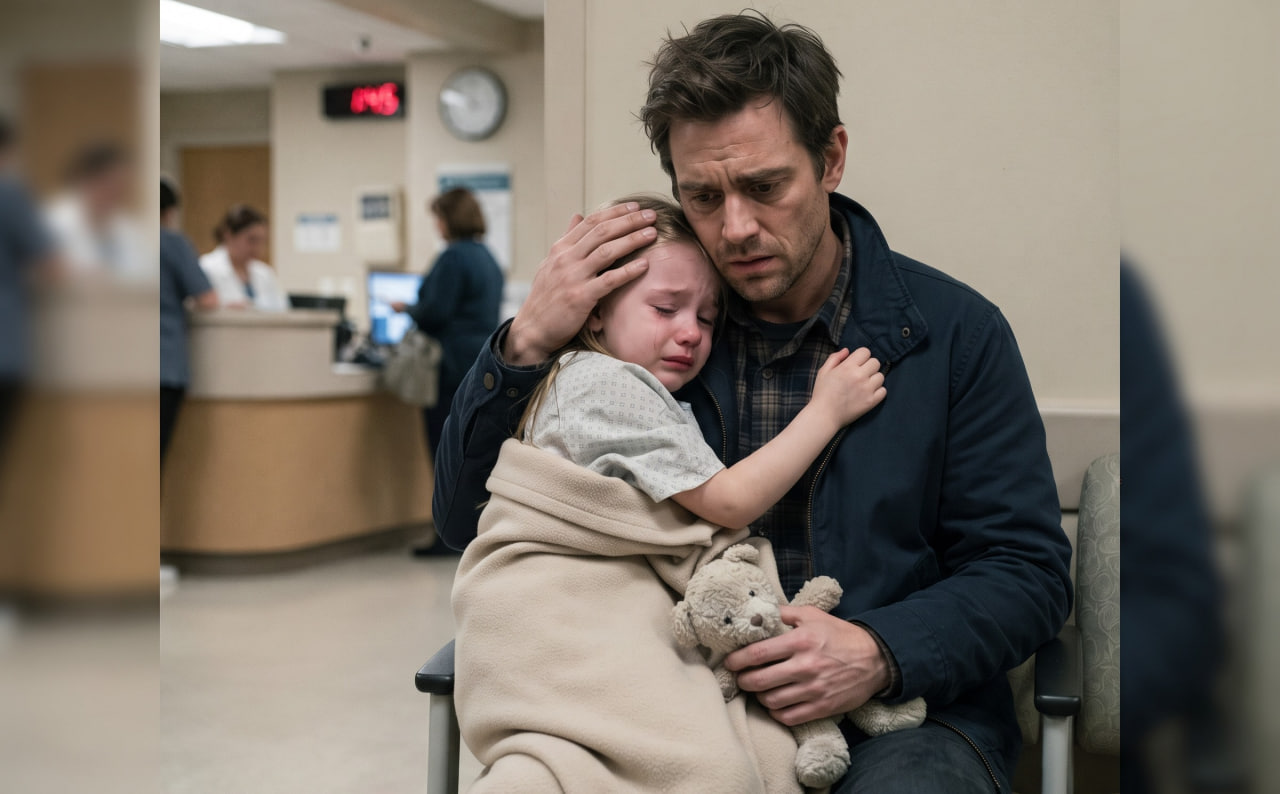
I sat beside my daughter’s bed until midnight.
At 12:17 a.m., her eyes opened.
“Daddy?”
“I’m here.”
She looked around.
“Is Mommy coming?”
I didn’t know what to say.
So I told her the truth.
“No.”
She stared at me.
“Promise?”
I took her hand.
“I promise you’re safe.”
She closed her eyes.
Then she whispered,
“Daddy?”
“Yes?”
“Can I tell you something?”
“Anything.”
She hesitated.
“Mommy told me not to tell you.”
My entire body went still.
“What did she tell you?”
My daughter swallowed.
“She said if I told Daddy, you’d leave.”
I felt tears fill my eyes.
“Leave where?”
“Us.”
She looked frightened.
“She said you would hate me.”
I leaned closer.
“Listen to me.”
Her eyes met mine.
“Nothing you say will ever make me hate you.”
She started crying.
“I spilled the food.”
“I know.”
“I’m sorry.”
“You don’t have to apologize.”
“I tried to clean it.”
“I know.”
“She said I was bad.”
I shook my head.
“You are not bad.”
“She said bad girls don’t deserve warm houses.”
I closed my eyes.
My hands were shaking.
“She was wrong.”
My daughter looked at me.
“Are you going to send me away?”
“No.”
“Are you sure?”
“Yes.”
“Where?”
“Home.”
She looked confused.
“With Mommy?”
I looked at her.
“No.”
I brushed the hair from her forehead.
“With me.”
For the first time since I had entered that hospital, my daughter smiled.
It was tiny.
Barely there.
But it was the first smile I’d seen from her in weeks.
Then she fell asleep again.
I stayed beside her.
And somewhere deep inside me, something changed.
I wasn’t fighting my wife anymore.
I wasn’t trying to save our marriage.
I wasn’t trying to prove that I was right.
I was fighting for my daughter’s right to grow up without being afraid of the people who were supposed to protect her.
The next morning, Detective Morgan returned.
She had a folder in her hand.
She placed it on the chair beside me.
“We searched your home.”
I looked at her.
“What did you find?”
She didn’t answer immediately.
Then she said,
“We found the journal.”
My heart began pounding.
“And there’s something inside it.”
She opened the folder.
There were photographs.
Dozens of them.
Some were old.
Some were recent.
And one photograph showed my daughter standing in the kitchen three months earlier.
There was a bruise on her arm.
I remembered that bruise.
My wife had told me our daughter fell off her bicycle.
I had believed her.
Detective Morgan placed another photograph beside it.
Then another.
And another.
I stared at the growing pile.
My wife hadn’t started hurting our daughter yesterday.
Yesterday was simply the first time I had finally seen the truth.
Then Detective Morgan turned to the last page.
Her expression became serious.
“Mr. Carter, there’s something in the journal that changes this case.”
“What?”
She pushed the page toward me.
I read the words.
And this time, I couldn’t breathe.
Because my wife’s handwriting filled the page.
And the final sentence said:
If he ever finds out what I’ve been doing, I’ll make sure he never gets to take her away from me.
PART 4
For several seconds, I couldn’t move.
I read the sentence again.
Then again.
If he ever finds out what I’ve been doing, I’ll make sure he never gets to take her away from me.
My fingers went numb.
“What does that mean?” I asked.
Detective Morgan didn’t answer immediately.
“We’re still investigating.”
I looked up at her.
“Investigating?”
She nodded.
“We found several pages like this.”
“How many?”
“Enough to establish a pattern.”
My stomach turned.
“What kind of pattern?”
“Control. Threats. Punishment. And repeated references to your daughter being afraid of you leaving.”
I closed my eyes.
Everything suddenly made sense.
Every time I had tried to discuss my wife’s behavior, she had somehow turned the conversation into an argument about my commitment to the family.
Every time I questioned a bruise, she accused me of mistrusting her.
Every time our daughter cried when her mother entered the room, my wife said she was manipulating me.
I had been looking at individual moments.
My wife had been building a pattern.
Detective Morgan turned another page.
“There is something else.”
“What?”
“Your wife wrote about the divorce.”
My eyes opened.
“What did she say?”
“She knew you were considering leaving.”
I felt a coldness spread through my chest.
“How?”
“She apparently found a draft of your divorce documents.”
I looked down.
“I kept them in my desk.”
“She knew.”
I swallowed.
“Then she knew I was going to leave.”
“Yes.”
“Was yesterday…”
I couldn’t finish.
Detective Morgan understood.
“We don’t know her exact motivation yet.”
“But she knew.”
“Yes.”
I stared at the floor.
For the first time, I wondered whether what happened to my daughter wasn’t simply an explosion of anger.
Maybe my wife had known I was coming home.
Maybe she knew I had signed the papers.
Maybe she had wanted to frighten me into staying.
Or perhaps she’d simply lost control.
Whatever the reason, my daughter had paid the price.
And I refused to let anyone turn that fact into another argument.
Two days later, my daughter was finally discharged.
She still had pain when she moved.
The doctor gave us strict instructions.
No running.
No rough play.
No school for several days.
And, most importantly, no contact with the person who had hurt her until the investigation was complete.
I carried her out of the hospital.
She had her arms around my neck.
Her head rested against my shoulder.
When we reached the car, she whispered,
“Daddy?”
“Yes?”
“Are we going home?”
“Yes.”
She looked through the window.
“Which home?”
I understood what she meant.
I had already decided.
“Not the old one.”
She was quiet.
“Are you sad?”
“A little.”
“Because of Mommy?”
I thought for a moment.
“I’m sad about what happened to our family.”
She rested her cheek against my shoulder.
“Are you sad because I spilled the food?”
I felt my heart break.
“No.”
I looked directly into her eyes.
“Listen carefully.”
She watched me.
“Nothing you did caused this.”
“But I spilled it.”
“Spilling food is a mistake.”
I touched her cheek.
“Breaking someone’s bones is a choice.”
She stared at me.
“And none of that was your fault.”
She nodded slowly.
Then she asked,
“Can we get pancakes?”
I smiled.
“Absolutely.”
It was the first normal request she had made in days.
And I promised myself I would never take normal moments for granted again.
We stayed at my brother’s house for several weeks.
During that time, the investigation continued.
My wife was charged.
Her attorney immediately claimed the injuries were accidental.
Then they claimed I had manipulated the evidence.
Then they claimed our daughter had exaggerated.
But the video existed.
The medical records existed.
The photographs existed.
The journal existed.
And slowly, more evidence appeared.
The neighbor who had recorded the video gave investigators several other recordings.
One showed my wife shouting at our daughter in the backyard.
Another showed her forcing our daughter to stand outside while she cried.
None of those recordings showed the worst thing.
But together, they showed something unmistakable.
A pattern.
A child repeatedly being frightened by the person who was supposed to make her feel safe.
Then came the testimony that changed everything.
Our daughter’s teacher.
She told investigators that my daughter had started behaving differently months earlier.