
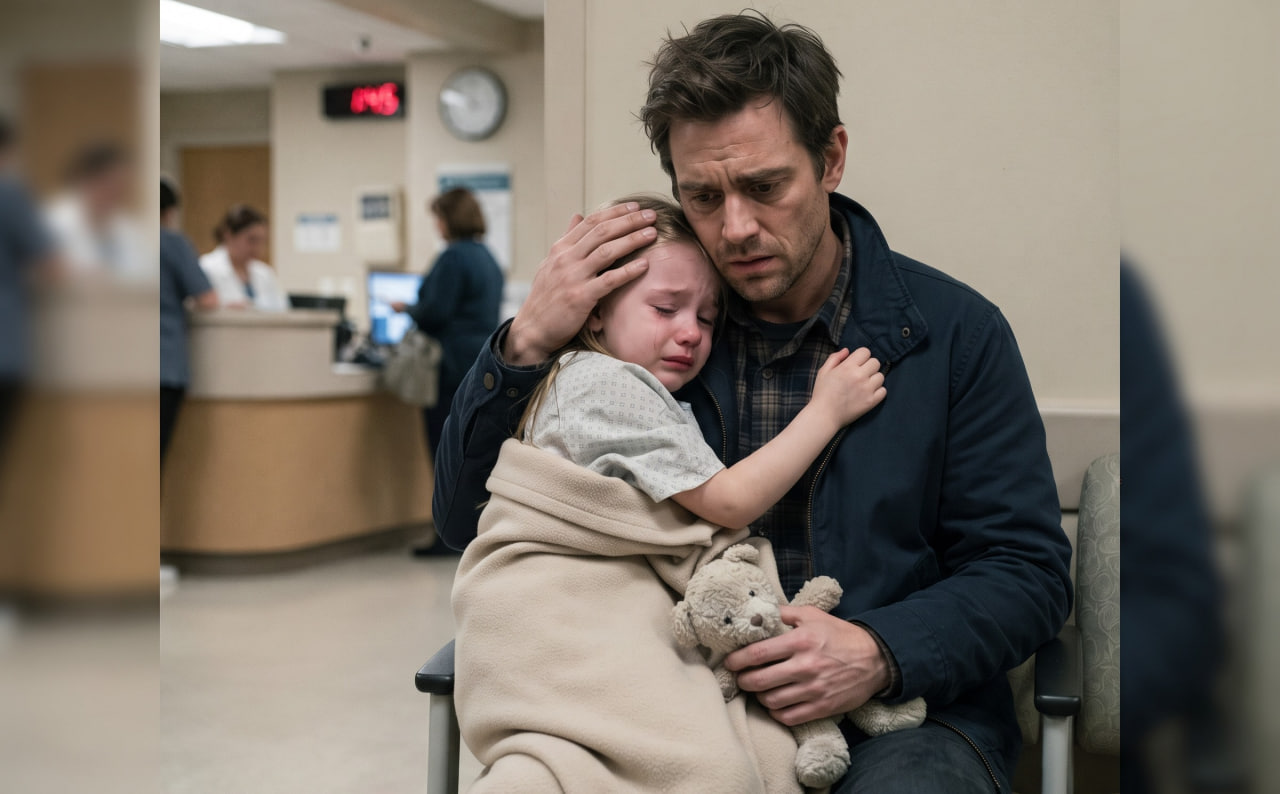
She had stopped participating in class.
She startled whenever adults raised their voices.
She had begun asking teachers whether she could stay at school after dismissal.
One afternoon, she had asked her teacher a strange question.
“Can a mommy get arrested if she doesn’t love you?”
The teacher hadn’t known what to say.
She had reported the concern.
My wife had explained it away.
Again.
And everyone had accepted the explanation.
Everyone except the evidence.
The custody hearing took place three months later.
I sat outside the courtroom with my daughter beside me.
She held a stuffed rabbit against her chest.
She had named it Snowball.
I had bought it for her after the hospital.
She had taken it everywhere.
The courthouse doors opened.
My wife walked in.
She looked different.
Not weaker.
Not remorseful.
Just angry.
Her eyes immediately found mine.
Then she looked at our daughter.
My daughter moved closer to me.
That tiny movement said more than any argument could.
My wife’s attorney noticed.
The judge noticed.
Everyone noticed.
During the hearing, my wife’s attorney argued that she had never intended to seriously injure our daughter.
They described the incident as a moment of poor judgment.
They argued that my wife loved her child.
They argued that families could heal.
Then our attorney presented the video.
The courtroom became silent.
No one needed to explain what was happening.
The judge watched.
My wife’s face became pale.
Then came the medical records.
The photographs.
The teacher’s testimony.
The journal.
Page after page.
The words my wife had written herself.
One entry said:
She cries too easily.
Another:
He always takes her side.
Another:
If he leaves me, she will go with him.
Then the final entry.
The one written only days before the incident.
If he thinks he can take my daughter away, he will learn what happens when someone takes everything from me.
I looked down.
My daughter was holding my hand.
I squeezed it gently.
The judge eventually ruled that my wife would have no unsupervised contact with our daughter.
The divorce would proceed.
And temporary sole custody was granted to me.
I expected to feel victorious.
I didn’t.
I felt exhausted.
Because this wasn’t a competition.
My daughter hadn’t won.
She had survived.
There was a difference.
Months passed.
Healing was slow.
There were nights when my daughter woke screaming.
Sometimes she couldn’t explain why.
Sometimes she simply crawled into my bed and held onto my shirt.
I never asked her to be brave.
I never told her to forget.
I simply stayed.
We started therapy.
At first, she barely spoke.
Then, little by little, she began talking.
About school.
About cartoons.
About pancakes.
About the weather.
About things children are supposed to talk about.
One afternoon, she came home carrying a drawing.
“Daddy!”
“What?”
“Look.”
She handed it to me.
It was a picture of a house.
There were two people standing outside.
Me.
And her.
Above us was a bright yellow sun.
I smiled.
“Who’s that?”
“Us.”
“Where’s Mommy?”
My daughter paused.
Then she pointed toward the edge of the paper.
There was a small gray door.
“She’s there.”
I nodded.
“Okay.”
She looked at me.
“Is that bad?”
“No.”
I hugged her.
“Sometimes people have to be far away so other people can be safe.”
She thought about that.
Then she nodded.
“Okay.”
A year after the night everything changed, we moved into a small house.
Nothing fancy.
Three bedrooms.
A little backyard.
A kitchen with yellow cabinets that my daughter chose herself.
On the first night, she ran from room to room laughing.
“Daddy!”
“What?”
“There’s no scary patio!”
I smiled.
“No.”
“And nobody can hang me upside down!”
“No.”
“And we can eat on the floor if we want!”
I laughed.
“We probably shouldn’t.”
She giggled.
Then she ran toward me.
I caught her carefully.
She wrapped her arms around my neck.
“Daddy?”
“Yes?”
“Is this really our home?”
I looked around.
The boxes weren’t unpacked.
The furniture was mismatched.
The walls were empty.
But she was smiling.
“Yes.”
She rested her head against me.
“I like it.”
“So do I.”
The criminal case continued for another several months.
My wife eventually accepted responsibility for what she had done.
The court ordered extensive counseling and imposed restrictions regarding contact with our daughter.
There were no dramatic courtroom speeches.
No satisfying revenge.
No moment where everything suddenly became easy.
Real life didn’t work that way.
There were legal bills.
Therapy appointments.
Difficult conversations.
Bad dreams.
And days when my daughter still asked questions I didn’t know how to answer.
But there were also good days.
Lots of them.
Her laugh came back.
She started playing soccer.
She made friends.
She stopped flinching whenever someone dropped something loudly.
And eventually, she stopped asking whether I was going to leave.
That question had once broken my heart.
Then one evening, years after the incident, she asked me something completely different.
We were sitting on the porch.
She was older now.
Her hair had grown long.
She was doing homework while I cooked dinner.
“Dad?”
“Yeah?”
“Can I ask you something?”
“Sure.”
“Why didn’t you leave Mommy sooner?”
I stopped chopping vegetables.
It was the question I had been afraid of for years.
I sat beside her.
“Because I was confused.”
She looked at me.
“I thought if I tried harder, things would get better.”
“Did they?”
“No.”
“Why?”
“Because some problems aren’t fixed by trying harder.”
She nodded.
I continued.
“I also made the mistake of believing that keeping a family together was always better than breaking one apart.”
She looked down at her homework.
“But you broke it.”
“Yes.”
“Was that bad?”
I took a breath.
“Sometimes breaking something is how you stop it from hurting someone.”
She was quiet.
Then she said,
“Like when you broke the old table?”
I laughed.
“That was completely different.”
She smiled.
Then she leaned against my shoulder.
“You saved me.”
My heart tightened.
“I should have protected you sooner.”
She shook her head.
“But you did.”
I looked at her.
She was no longer the frightened little girl from the hospital.
She was strong.
Not because she had forgotten.
Because she had healed.
“I love you, Dad.”
“I love you too.”
She smiled.
“Can we order pizza?”
I laughed.
“After all that emotional conversation, that’s what you want?”
“Yes.”
I stood.
“Fine.”
She smiled.
“Extra cheese.”
“Obviously.”
Years later, I found the old divorce papers.
They were still in a folder.
The same papers I had shoved into my wife’s face the night I came home.
I almost threw them away.
Then I stopped.
I realized those papers weren’t really about divorce.
They represented the moment I finally stopped pretending.
I kept them.
Not because I wanted to remember my marriage.
But because I wanted to remember the promise I had made that night.
Never again would my daughter have to beg someone to protect her.
Never again would I confuse silence with peace.
Never again would I call fear “discipline.”
And never again would I ignore the small signs simply because the truth was painful.
I put the papers back in the folder.
Then I walked downstairs.
My daughter was sitting at the kitchen table, laughing with her friends.
The house was loud.
Messy.
Warm.
Normal.
I stood there for a moment and listened.
There was laughter.
There were dishes clattering.
Someone was arguing about which movie to watch.
And nobody was afraid.
That was all I had ever wanted.
Not revenge.
Not victory.
Not even an apology.
Just a home where a child could spill a glass of juice and know that the worst consequence would be grabbing a towel.
A home where mistakes were mistakes.
Where love didn’t require fear.
Where a child could sleep at night knowing someone would come when she called.
My daughter looked over.
“Dad!”
“Yeah?”
“Come here!”
I walked toward her.
She reached for my hand.
And I took it.
Because sometimes the most important thing a parent can do isn’t say the perfect words.
It isn’t make the perfect decision.
It isn’t fix everything immediately.
Sometimes it’s simply recognizing the moment when a child needs you—
and choosing, without hesitation,
to stand between her and the thing that is hurting her.
That night, I had come home too late to prevent what happened.
But I had arrived in time to make sure it never happened again.
And for the rest of my life, that would be the promise I kept.
My daughter would never again have to whisper, “Don’t let Mommy take me.”
Because she finally knew something she should have known all along:
Home was not the place where she had to be afraid.
Home was the place where she was safe.
THE END