
Instead, underneath our marriage certificate and the title to Arthur’s old pickup truck, there was a single folded document with a blue county clerk stamp on the top right corner.
I unfolded it on the edge of the bed and read the title across the top: Quitclaim Deed and Right of Survivorship Affidavit, dated October 14, 2022.
Four years ago, right after Arthur’s brother passed away and left his widow tangled up in probate court for eighteen months, Arthur had gone down to the county recorder’s office. He had transferred the property title from his sole name into both of our names as Joint Tenants with Right of Survivorship.
At the bottom of the page, printed in plain black ink, was the legal clause Arthur had made sure the clerk verified: Upon the death of either joint tenant, full title and sole ownership of the property shall vest immediately and automatically in the surviving spouse, outside of probate.
I sat on the edge of the mattress and read that paragraph three times.
Chloe didn’t own half the house. She didn’t own a single shingle on the roof.
The house was mine, completely and legally, the second Arthur took his last breath in the hospital.
I folded the deed carefully, slipped it into the pocket of my cardigan, and went downstairs to make myself a cup of tea. Part of me wanted to march straight down the hallway, throw the paper on the guest bed, and tell her to pack her bags before dark.
Then I heard Chloe’s voice coming through the thin door of the guest room. She wasn’t crying over her marriage. She was pacing the floor, talking rapidly on her phone.
“I told you, Brent, I’m inside the house right now,” she said, her voice muffled but clear enough through the heating vent near the kitchen wall. “She doesn’t know anything about real estate.
Once I show her the probate paperwork and tell her she’ll lose half the equity in court fees, she’ll sign the listing agreement just to avoid a fight.”
There was a pause while the person on the other end spoke.
“No, Mark doesn’t know I’m here,” Chloe continued, lowering her voice slightly. “If I put my share of the sale proceeds into your LLC before Mark files the divorce papers, he can’t touch a dime of it as marital assets. Look, the realtor already said we can list it at $640,000 and probably get a cash offer within two weeks. That’s over three hundred grand for us.”
I stood next to the kitchen counter with the kettle whistling softly on the stove.
So she wasn’t just trying to take my home out from under me eleven days after her father died.
She was trying to force a quick sale so she could hide money from her husband in another man’s business account.
And she thought I was too old, too grieving, and too helpless to check a single piece of paper.
I turned off the burner under the kettle. I didn’t knock on her door that evening. Instead, I let her unpack her clothes into the guest closet, order takeout for dinner without asking if I had eaten, and leave her dirty containers on my kitchen island.
The next morning at nine o’clock sharp, while Chloe was still asleep, I drove down to the county courthouse myself.
I paid twelve dollars at the recorder’s desk for two certified copies of the recorded survivorship deed, along with a certified copy of Arthur’s death certificate that I had picked up from the funeral home earlier in the week.
From the courthouse, I drove three blocks over to the office of Mr. Henderson, the attorney Chloe claimed she had called.
His receptionist recognized me right away and showed me into his office within ten minutes. Mr. Henderson, who had known Arthur since they played softball together in their thirties, read through the certified deed, shook his head slowly, and let out a long breath.
“Arthur brought this by my office four years ago just to make sure he filled out the survivorship wording properly,” Mr. Henderson said, handing the paper back to me. “You own this house free and clear, Evelyn.
Your daughter has zero legal claim to it, and she certainly has no right to bring a realtor onto your property.”
“What if she refuses to leave?” I asked. “She moved two suitcases into my guest room yesterday and told me she’s staying until the house sells.”
“Since she doesn’t live there, doesn’t receive mail there, and just arrived yesterday as an uninvited overnight guest, she has no tenant rights,” Mr. Henderson explained. “If you tell her to leave and she refuses, you can have a sheriff’s deputy escort her off the property. Better yet, let me draft a formal notice on my firm’s letterhead right now stating that you are the sole legal owner of record, and that any attempt to list or encumber the property will result in immediate legal action.”
I waited in the lobby while his secretary typed it up.
When I walked back out to my car with the stamped deed and the attorney’s letter inside my purse, my hands weren’t shaking anymore.
When I pulled into my driveway just after noon, a silver SUV was parked behind my sedan.
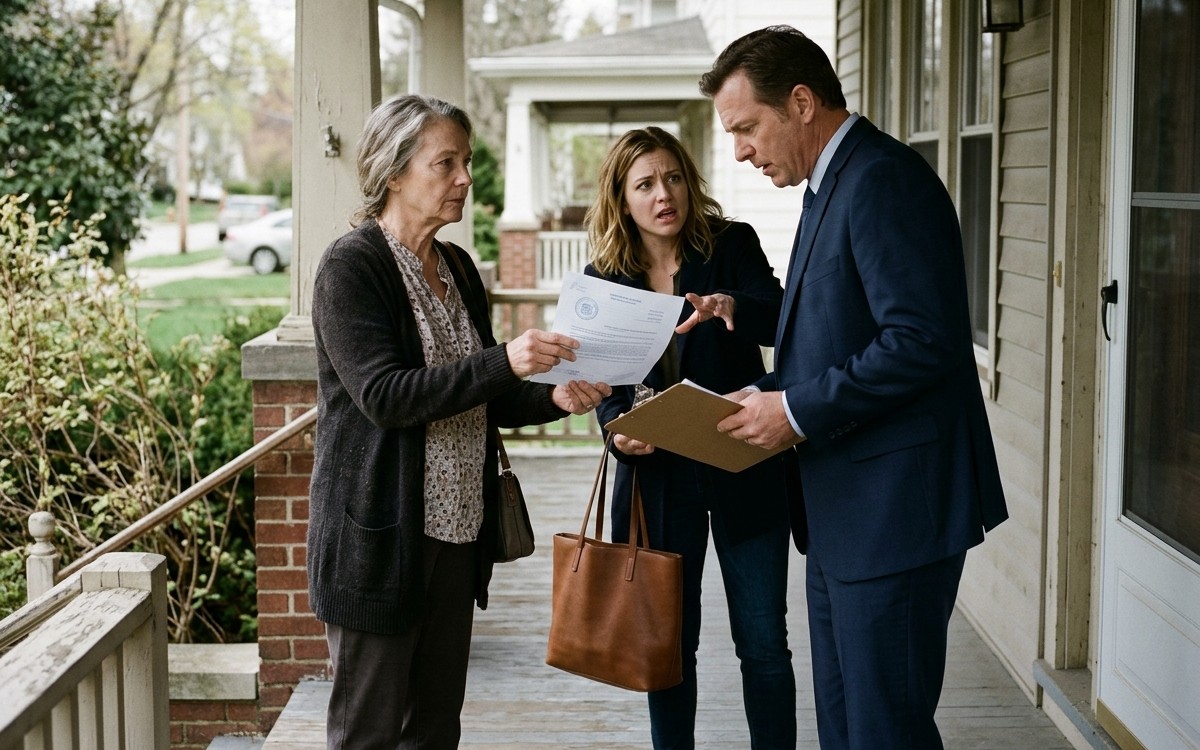
Greg Vance, the real estate agent, was standing on my front porch holding a clipboard and a digital measuring laser, while Chloe stood next to him pointing toward the garage.
PART 3
I parked at the end of the driveway, blocking the silver SUV in, and walked up the front steps.
Chloe spun around when she heard my footsteps. “Mom, where have you been? Greg came back with the neighborhood comps, and we need to measure the square footage of the sunroom before we take photos tomorrow.”
Greg Vance gave me an awkward, tight-lipped smile. “Good afternoon, Mrs. Miller.
Chloe assured me you two had talked things over.”
“We didn’t,” I said, reaching into my purse. “And you are trespassing on private property.”
Chloe rolled her eyes and stepped between me and the agent. “Mom, stop embarrassing yourself in front of him. I already explained the law to you yesterday. Half of this house is mine. Either we list it peacefully with Greg, or I hire a litigation attorney on Monday and half your equity gets eaten up in court costs.”