
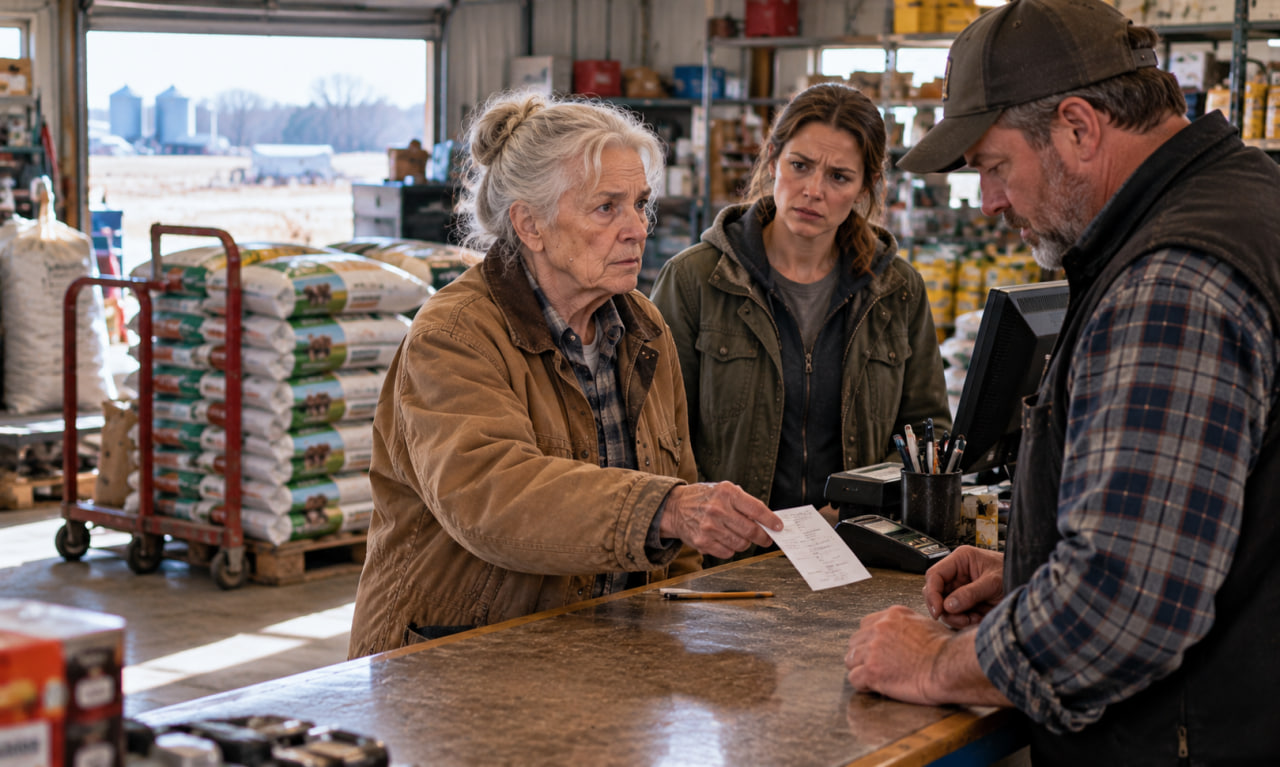
“That’s impossible. Your father told me he had appointed a committee.”
The manager shook his head.
“The committee was supposed to supervise the account. But the authority to protect it belonged to one person.”
He took a folded sheet of paper from his pocket.
At the bottom was my father’s signature.
Beneath it was a sentence written in his familiar handwriting.
If the reserve is ever threatened, authority shall pass to my surviving spouse, who alone may determine whether the original agreement has been violated.
Mom stared at the page.
For the first time that day, she looked genuinely shaken.
My father hadn’t simply left her an old account.
He had left her the responsibility of deciding what happened to it.
And someone had already tried to take that responsibility away.
The next morning
At eight-thirty, Mom and I returned to the farm supply store.
The manager was waiting in the office with a woman in her fifties wearing a navy suit. She introduced herself as Margaret Bennett, the attorney who had reviewed the old agreements.
On the desk lay three thick folders, a stack of bank statements, and a sealed envelope bearing my father’s name.
Margaret invited Mom to sit down.
“Mrs. Carter, before we discuss the account, I need to explain something. The reserve was established to protect independent farmers during supply shortages. Over the years, it grew through contributions, investment returns, and the purchase of agricultural property.”
“Property?” I asked.
Margaret nodded.
“Your husband and the original contributors purchased several parcels of land decades ago. The properties were held for the benefit of the reserve.”
Mom looked at her.
“How many parcels?”
“Seven.”
I stared at the attorney.
Seven parcels of land, purchased thirty years earlier, had somehow become part of an account my family had never discussed.
Margaret opened the first folder.
“Some were sold to finance emergency purchases. Others were leased to local farmers. But three parcels remain under the reserve’s ownership.”
She slid a document across the desk.
One of those parcels contained the land where the farm supply store now stood.
Another was a small warehouse on the edge of town.
The third was a large tract of farmland outside Redfield.
I recognized the description of the last property immediately.
It bordered our farm.
For years, I had assumed the neighboring field belonged to an elderly couple who had moved away long ago.
I turned to Mom.
“Dad owned that land?”
She shook her head slowly.
“Not personally.”
Margaret explained that the reserve held the property in trust. My father had contributed money toward its purchase, but he had never claimed individual ownership.
The land had been leased to local farmers, with the rental income returned to the reserve.
Then the attorney opened the second folder.
Her expression became serious.
“Unfortunately, someone recently attempted to sell that property.”
Mom’s hands tightened around the arms of her chair.
“Who?”
Margaret looked toward the store manager.
He lowered his eyes.
“My father appointed an administrator to manage the records after he retired,” he said. “That administrator continued handling the paperwork for years. When he passed away, the responsibility was transferred to his son.”
Margaret corrected him gently.
“The transfer was never properly authorized.”
She placed another document on the desk.
The name of the administrator appeared at the top.
Richard Harlan.
I felt a chill run through me.
The same man who had tried to claim the twenty bags of cattle feed.
The same man who had insisted that his grandfather’s agreement gave his family priority.
He had also been managing the reserve’s property records.
Margaret continued.
“The documents suggest that Mr. Harlan attempted to sell the neighboring farmland to his own company. The sale was never completed, but a deposit was accepted, and the transaction may have involved assets he had no authority to transfer.”
Mom sat perfectly still.
“How much?”
“Two hundred and eighty thousand dollars.”
I could hardly believe what I was hearing.
Richard had been trying to purchase land that might not belong to him, using an agreement that he had interpreted in his own favor.
But Margaret wasn’t finished.
She opened the final folder and removed a bank statement.
“The reserve also appears to have held a substantial investment account. Its last verified balance was recorded several years ago.”
She turned the paper toward us.
The amount was more than I had ever seen associated with my family’s name.
Mom stared at it without speaking.
Then she looked up.
“Where is the money now?”
Margaret folded her hands.
“That is the question we need to answer. Some of the funds appear to have been moved between accounts. We haven’t yet established whether those transfers were legitimate.”
The room became silent.
Outside the office, employees continued moving boxes and loading supplies as if nothing unusual were happening.
Inside, my mother was discovering that a promise made decades earlier had grown into something much larger than any of us understood.
Margaret reached for the sealed envelope.
“Your husband left specific instructions for this moment. He asked that the envelope be opened only if someone attempted to misuse the reserve or interfere with its original purpose.”
Mom took it from her.
Her fingers trembled slightly as she broke the seal.
Inside was a single handwritten letter.
She began reading silently.
Then she stopped.
She read the first paragraph again.
A tear rolled down her cheek.
I had seen my mother cry at my father’s funeral. I had seen her grieve in the quiet months afterward.
But this was different.
“What does it say?” I asked softly.
She passed me the letter.
The handwriting was unmistakably Dad’s.
If you are reading this, then someone has forgotten why we built the reserve.
It was never meant to make our family powerful. It was meant to make sure no family in this county would ever have to choose between feeding its cattle and feeding its children.
If the people entrusted with protecting it begin serving themselves, do not fight for the money.
Fight for the farmers.
The money can be replaced. Trust cannot.
I lowered the letter.
For a moment, I could almost hear my father speaking in the kitchen, reminding us that a person’s word mattered more than the size of their bank account.
Mom wiped her eyes.
Then she straightened in her chair.
“Mrs. Bennett, what do we need to do?”
The attorney smiled faintly.
“First, we need to secure the remaining assets. Then we’ll review every transaction and determine whether the reserve’s rules were violated.”
“And the land?”
“We can seek to prevent any unauthorized sale while the review proceeds.”
Mom nodded.
“Do that.”
“And the investment account?”
“Find every dollar.”
Her voice was quiet, but there was no hesitation in it.
Finally, she looked toward the manager.
“As for those twenty bags of cattle feed, I still intend to buy them. At the listed price.”
The manager lowered his head.
“Of course, Mrs. Carter.”
“No special treatment,” she added. “Just the same fair treatment you should have given us yesterday.”
He nodded.
And for the first time since I had known him, he looked ashamed.
But as we stood to leave, Margaret’s phone rang.
She answered, listened briefly, and then looked at Mom with a troubled expression.
“Mrs. Carter, we’ve just received an update from the county recorder.”
Mom paused.
“What is it?”
Margaret slowly lowered the phone.
“The neighboring farmland was never legally transferred. But someone has filed a new claim against the property.”
“Who?” I asked.
Margaret looked at the document on her screen.
Then she gave us a name none of us expected.
My younger brother.
My own brother had filed a claim against the very land Dad had spent decades protecting.
And suddenly, I understood that the greatest threat to our family’s legacy might not be the wealthy businessman who had tried to take it.
It might be someone sitting at our own kitchen table.
PART 5
For several seconds, I couldn’t speak.
My younger brother, Daniel, had filed a claim against the neighboring farmland.
The same brother who had worked beside me for years.
The same brother who had stood beside Mom at Dad’s funeral and promised he would always protect the farm.
I turned toward Mom.
“Do you know anything about this?”
She slowly shook her head.
Margaret Bennett, the attorney, explained that Daniel’s claim was based on a document allegedly signed by our father shortly before his death. The document stated that Dad had promised Daniel the right to purchase the land at a discounted price.
But there was a problem.
The signature didn’t look right.
And the document had never appeared in the original estate records.
Mom didn’t cry. She didn’t shout. She simply asked Margaret to make a copy.
“Don’t accuse anyone until we know the truth,” she said.
Then she turned to me.
“Let’s go home.”
The drive back to the farm felt longer than usual. I kept thinking about Daniel, wondering how long he had known about the land and why he had never mentioned it.
When we arrived, his pickup was parked beside the barn.
He was standing near the equipment shed, pretending to inspect a tractor.
“Where have you been?” he asked.
Mom walked past him.
“Town.”
Daniel glanced at me.
“Everything all right?”
I wanted to confront him immediately, but Mom touched my arm.
“Not yet,” she whispered.
That evening, after dinner, Mom asked Daniel to sit with us at the kitchen table.
She placed the copied document in front of him.
His face changed the moment he saw it.
“Where did you get that?” he asked.
“From the attorney handling your father’s reserve,” Mom replied.
Daniel looked at the document again.
“I don’t know what this is.”
“Then explain why your name appears on a claim against the neighboring farmland.”
He pushed his chair backward.
“Dad promised me that land!”
“Did he?” Mom asked.
“Yes! He said I could have it because I’ve done more work on this farm than anyone else.”
I stared at him.
“You filed a legal claim without telling us?”
“It’s not your business.”
“It’s our family’s business!”
Daniel slammed his palm against the table.
“You always get everything! You were Dad’s favorite. He trusted you with the books, the equipment, the decisions. I was the one outside in the rain fixing fences while you sat inside talking about money.”
The accusation hurt because it contained a piece of truth.
Dad had often asked me to help with the farm’s finances. Daniel had spent more time operating machinery and working with the cattle.
But that didn’t mean Dad had loved one of us more.
Mom waited until Daniel finished.
Then she asked one question.
“Did your father sign this document?”
Daniel looked away.
“I told you. He promised me the land.”
“That wasn’t my question.”
Silence filled the kitchen.
Finally, Daniel muttered, “I got the document from Richard Harlan.”
My stomach tightened.
Richard had given my brother the document.
Mom closed her eyes briefly.
“And what did Richard ask you to do in return?”
Daniel didn’t answer.
That was answer enough.
He had apparently been told that if he helped secure the farmland, Richard would pay him for his assistance. Daniel had accumulated debts after purchasing machinery he couldn’t afford, and Richard had offered him a way out.
Daniel insisted he had never intended to steal anything.
He believed the land would eventually belong to him.
But when Mom asked whether he had checked the original agreement or consulted a lawyer before filing the claim, he had no answer.
For the first time, I saw the fear beneath his anger.
He had made a terrible decision, and now he was realizing that someone might have used his desperation to manipulate him.
Mom stood.
“Tomorrow, you will come with me to see Margaret. You will tell her exactly what happened.”