
I grew up very poor.
When I was thirteen, I went to a classmate’s house to work on a school project and ended up staying for dinner.
Everyone at the table kept staring at me.
The following afternoon, I came home from school and discovered my friend’s mother sitting in our living room.
My mother’s face was flushed red.
She turned toward me.
“Emily, there is something Mrs. Henderson needs to tell us.”
My stomach tightened.
I immediately thought I’d done something terribly wrong.
What I didn’t realize was that a simple decision I’d made at dinner had uncovered a connection between our families that went back fourteen years.
And it would continue changing lives long after that afternoon.
Growing Up in Poverty
Growing up in a small town in Ohio, I understood poverty long before I understood multiplication.
My father passed away when I was six, leaving my mother to raise my younger brother, Samuel, and me alone.
She cleaned offices at night and worked at a laundromat during the day.
Despite working so hard, she struggled to provide everything we needed.
Sometimes, dinner consisted of boiled potatoes sprinkled with salt.
On other evenings, my mother insisted she wasn’t hungry so Samuel and I could have seconds.
I knew she was lying.
But I never challenged her.
At school, I wore donated clothes and shoes that were slightly too small.
I avoided birthday parties because we couldn’t afford presents.
My closest friend was Rebecca Henderson.
Her father owned a successful hardware business, and her family lived very differently from ours.
But Rebecca never seemed concerned about how much money my family had.
She shared her pencils with me, invited me to sit beside her, and never laughed when other children made comments about my clothes.
Being around her made me feel like an ordinary girl.
One Thursday afternoon, Rebecca invited me to her house so we could finish our geography project.
I had never been inside a home quite like hers.
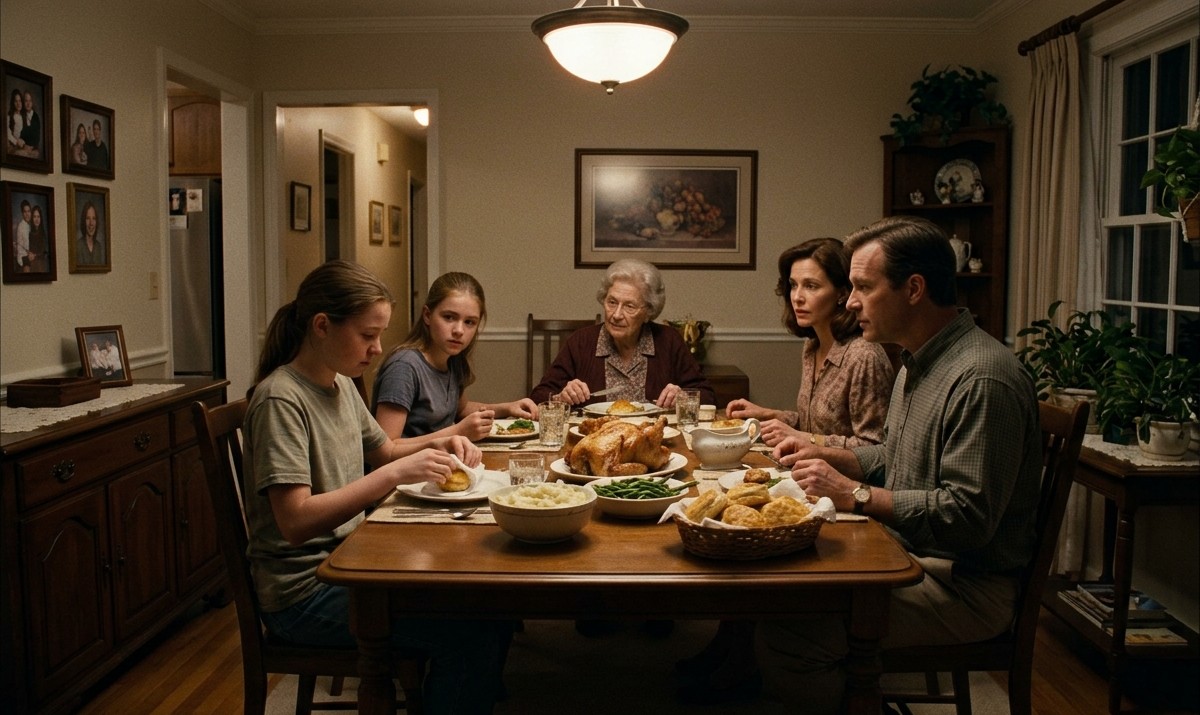
Family photographs covered the walls. There were thick carpets, bookshelves, and a refrigerator filled with food.
When Mrs. Henderson invited me to stay for dinner, I hesitated.
Then I accepted.
I hadn’t eaten anything since breakfast.
The Half Biscuit That Made Everyone Go Quiet
Mrs. Henderson served roasted chicken, mashed potatoes, green beans, warm biscuits, and homemade gravy.
I couldn’t remember the last time I’d seen so much food on one table.
Before we began eating, Mr. Henderson offered a prayer.
Then Rebecca passed me the potatoes.
Although I was extremely hungry, I took only a small spoonful.
My mother had taught me never to appear greedy when visiting someone else’s home.
As dinner continued, I noticed Rebecca’s parents exchanging glances.
Her grandmother, who was sitting across from me, suddenly stopped eating.
She had noticed me carefully wrapping half my biscuit in a paper napkin.
“Are you saving that for later, sweetheart?” she asked.
My face grew warm.
I nodded.
“It’s for my little brother. He likes biscuits.”
The table went quiet.
Mrs. Henderson asked whether Samuel had already eaten dinner.
I told her I wasn’t sure.
Then, without thinking, I added something I immediately regretted.
“Sometimes Mom waits until tomorrow when there isn’t enough.”
Rebecca lowered her fork.
Her father looked toward his wife.
I wished I could take back what I’d said.
I hadn’t meant to tell them about our problems.
I finished eating quickly, thanked everyone, and asked if I could go home.
Mrs. Henderson offered to drive me, but I insisted on walking.
Before I left, she handed me a paper bag filled with leftover chicken, biscuits, and vegetables.
I carried that bag home as though it contained something precious.
Samuel practically danced when he saw the food.
My mother asked where it had come from.
I explained that Rebecca’s family had invited me to dinner and given me some leftovers.
She smiled.
But there was something uncomfortable in her expression.
An Unexpected Visitor in Our Living Room
The following afternoon, I walked home expecting everything to be normal.
Instead, Mrs. Henderson’s expensive station wagon was parked outside our shabby rental house.
Inside, my mother sat stiffly on our worn sofa, holding a faded handkerchief.
Mrs. Henderson was seated across from her.
Several grocery bags and a large brown envelope stood between them.
“I’m sorry,” I blurted out. “I didn’t mean to tell them anything about us.”
My mother shook her head.
“You haven’t done anything wrong.”
Mrs. Henderson reached for my hand.
“Emily, yesterday you reminded my family of something we had forgotten. But that isn’t the only reason I’m here.”
She turned toward my mother.
Then she asked whether Mom remembered working at Mercy Hospital fourteen years earlier.
My mother’s face suddenly became pale.
Before my father died, she had worked as a nursing assistant.
She rarely talked about those years.
Mrs. Henderson opened her handbag and removed an old photograph.
It showed a young woman holding a newborn baby in a hospital room.
Standing beside her was my mother.
She looked younger and happier than I’d ever seen her.
“That baby is Rebecca,” Mrs. Henderson explained.
My mother stared at the photograph.
Her hands began trembling.
“I wondered whether you would ever recognize me,” Mrs. Henderson continued. “Yesterday, when Emily told me your name, everything finally made sense.”
She placed the brown envelope in my mother’s lap.
“Fourteen years ago, you saved my daughter’s life. But there’s something about that night nobody ever told you.”
What My Mother Had Done Fourteen Years Earlier
My mother looked at Mrs. Henderson as though someone from another lifetime had suddenly appeared in our living room.