
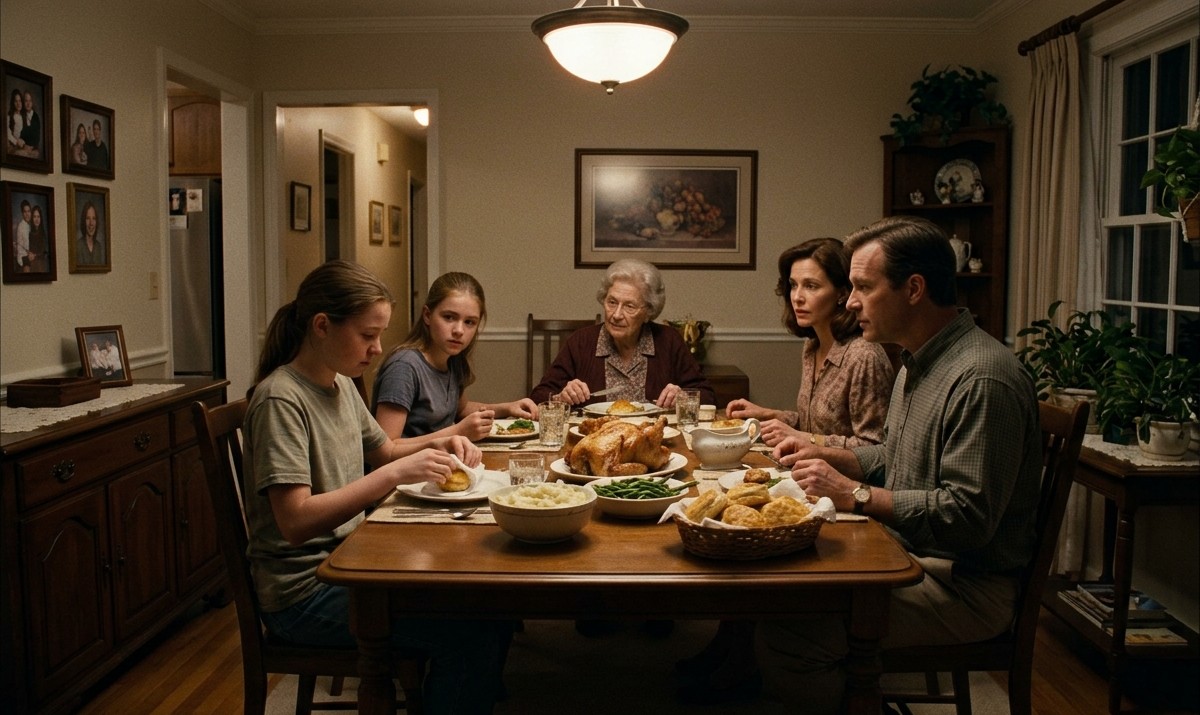
Rebecca opened the door.
Her eyes were swollen from crying.
She led me upstairs.
Mrs. Henderson was resting beside a window overlooking the garden where Rebecca and I had played as children.
She looked frail.
But her smile was unmistakable.
“There’s my little biscuit thief,” she whispered affectionately.
I laughed through my tears.
She motioned toward a chair beside her bed and asked Rebecca to retrieve a wooden box from the dresser.
Inside were photographs, handwritten letters, and several neatly folded documents.
Mrs. Henderson handed me a photograph taken on my nursing graduation day.
Behind it was a letter written in my mother’s familiar handwriting.
“Your mother asked me to keep this,” she explained.
I carefully unfolded the letter.
What I read changed my understanding of my mother’s life.
The Secret My Mother Had Kept for Decades
My mother had written the letter shortly before her death.
She thanked Helen for offering her employment when she desperately needed an opportunity.
She was grateful that Helen had helped her without making her feel ashamed of needing assistance.
But the letter also revealed something I’d never known.
Before my college graduation, my mother had established a small savings account for children from struggling families.
Every month, regardless of her expenses, she deposited whatever she could afford.
Sometimes it was twenty dollars.
Sometimes fifty.
She had named the account the Biscuit Fund, in honor of the dinner that changed our lives.
Mrs. Henderson had privately contributed to it over the years.
So had her husband.
When Mr. Henderson passed away, part of his estate went toward expanding the fund.
“Your mother didn’t want recognition,” Helen explained. “She just wanted another hungry child to have the opportunities you received.”
I struggled to speak.
Rebecca handed me a second document.
It contained records showing that the fund had grown into a substantial charitable endowment through decades of contributions and investment.
Helen wanted Rebecca and me to oversee its future together.
The money would provide educational assistance, emergency groceries, and other necessities for struggling families.
“Why didn’t anyone tell me?” I asked.
Helen squeezed my fingers.
“Because your mother wanted you to understand generosity by living it, not by learning how much money was involved.”
She passed away peacefully nine days later, surrounded by her family.
Why Everyone Had Been Staring at Me
At Helen’s funeral, I shared the story of that unforgettable childhood dinner.
I described how embarrassed I’d felt when everyone stared at me wrapping half a biscuit for Samuel.
Rebecca gently interrupted me.
“Emily, we weren’t staring because we thought you were greedy or strange.”
She explained what her family had actually been thinking.
“We were staring because none of us could understand how a hungry thirteen-year-old could be more worried about feeding her brother than feeding herself.”
For the first time in thirty-four years, I understood what that silence had truly meant.
I’d spent so much of my childhood worrying that poverty made me different.
I’d believed that needing help was something to hide.
But the Hendersons hadn’t looked down on me that evening.
They had witnessed a hungry child trying to care for someone she loved.
Shortly afterward, Rebecca and I officially expanded the Biscuit Fund into a community assistance program.
We partnered with schools, social workers, and healthcare providers to identify families needing support.
Above all, we wanted every person receiving assistance to be treated with dignity.
That was how my mother had been helped.
And it was how we wanted to help others.
Another Little Girl Who Saved Her Food
Several years later, a teacher contacted us about a thirteen-year-old girl named Abigail.
She regularly saved portions of her school lunch for her younger siblings.
When I met Abigail and her mother, I recognized the embarrassment I’d carried throughout my own childhood.
Her mother had recently lost her job.
She was struggling to keep their apartment.
Through the Biscuit Fund, we helped cover their immediate necessities and connected her mother with employment opportunities.
Abigail eventually received educational assistance through our program.
Last spring, she graduated from college.
She invited Rebecca and me to attend her graduation ceremony.
Afterward, she approached us carrying a small paper bag.
Inside were three homemade biscuits and a handwritten note.
I opened it.
“Thank you for giving my family more than food. Thank you for giving us hope.”
I am sixty-three now.
That note remains framed beside my mother’s photograph.
Whenever my grandchildren complain about something they don’t have, I tell them about a little girl who once wrapped half a biscuit in a napkin.
I remind them that poverty never determines a person’s worth.
My mother had very little money when I was growing up.
Yet she gave me something more valuable than anything money could buy.
She taught me that kindness should never be treated as a debt.
She taught me that accepting an opportunity doesn’t diminish a person’s dignity.
And through the Biscuit Fund, she showed me that even someone who once struggled to feed her own children could eventually help change the lives of others.
The Hendersons gave our family an opportunity.
My mother quietly passed that kindness forward.
Rebecca and I continued what they had begun.
And Abigail’s graduation reminded us that the smallest acts of generosity can have consequences far beyond anything we imagine.
The greatest inheritance isn’t money. It’s kindness passed from one generation to the next.
Sometimes, changing someone’s entire future begins with something as simple as inviting them to dinner.