
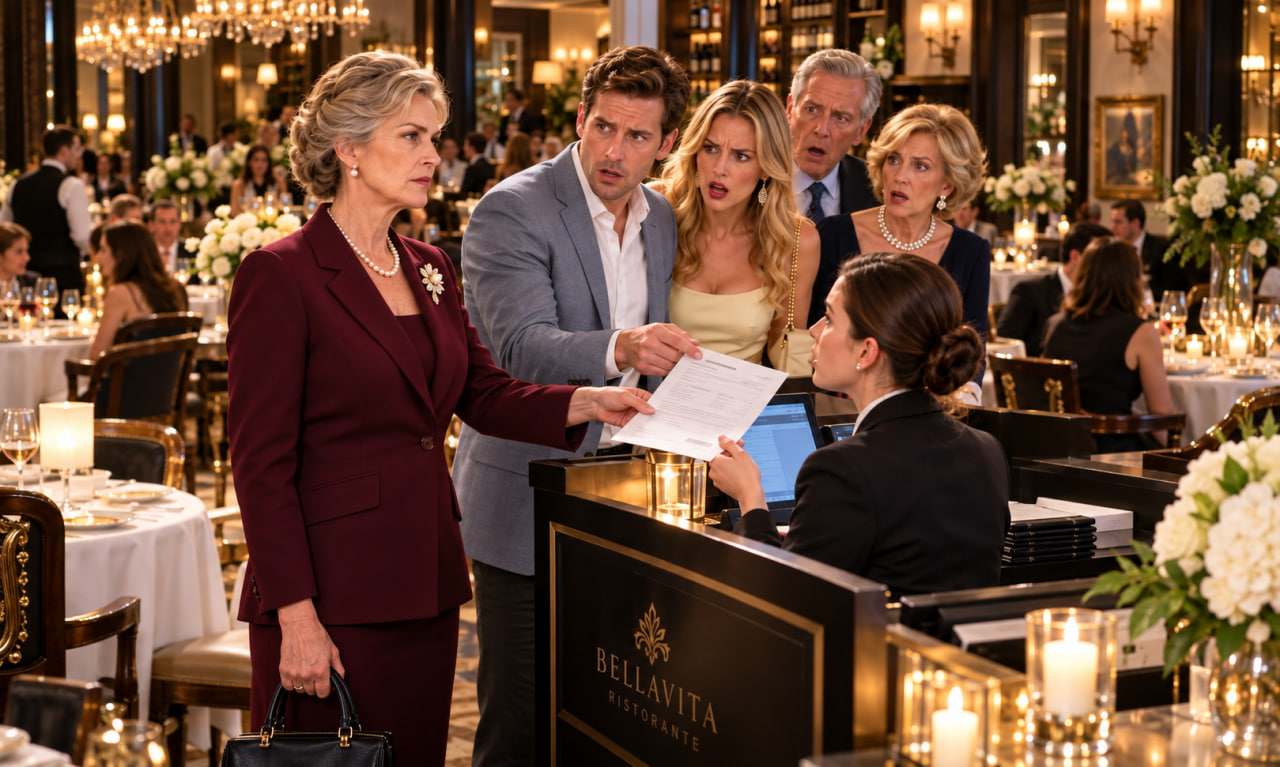
“You think this makes you untouchable, Margaret? You have no idea what you’re stepping into.”
“Then enlighten me.”
He leaned toward me.
“Your son isn’t the only person who has been looking into your finances.”
My fingers tightened around the pearl brooch pinned to my lapel.
“What does that mean?”
Graham’s eyes moved toward Vanessa.
She had gone very still.
Then he said the words that changed everything.
“Ask your daughter-in-law what happened to the original copy of your husband’s will.”
I looked at Vanessa.
She didn’t deny it.
She didn’t even look surprised.
Instead, she whispered, “I was trying to protect Adam.”
And suddenly, the restaurant, the forged signature, the thirty-eight-thousand-dollar party—all of it seemed smaller than the secret sitting across the table.
Because Richard’s will had been settled twelve years ago.
Or so I had believed.
Final Part
“Vanessa,” I said, “what did you do with my husband’s will?”
She sat down slowly, as if her legs had stopped supporting her.
“I didn’t destroy it.”
“That’s not what I asked.”
Adam looked from his wife to me.
“What is she talking about?”
Vanessa’s eyes filled with tears.
“Your father left something out of the final estate documents.”
I stared at her.
“Richard had an attorney. We went through every page together.”
“I know.”
“Then explain.”
She looked toward Graham, but he was watching the door, calculating his chances of leaving.
“I found a letter,” she said. “A sealed letter attached to an older copy of the will. It was in a box of your husband’s papers.”
My husband’s handwriting had been unmistakable: firm, slightly slanted, with the final letters of his name sweeping beneath the line.
“What did the letter say?”
Vanessa pressed her palms together.
“That the original investment in Bellavita was supposed to pass to Adam eventually.”
For a moment, I could hear only the distant clink of dishes outside the room.
Bellavita had been Richard’s first major restaurant investment. He’d put money into it when the owner was close to bankruptcy. Over the years, that single investment had grown into a portfolio of restaurants and hospitality properties.
After Richard died, I had assumed control of the shares he left me. I expanded the business, bought out other investors, and built the group into something neither of us could have imagined when we were young.
Adam had always known his father helped establish Bellavita.
He had never known the full details of the estate.
“Where is the letter now?” I asked.
Vanessa hesitated.
“Daniel has it.”
Graham swore under his breath.
I turned to him.
“So your nephew didn’t simply help forge documents. He also obtained a private letter from my late husband’s estate.”
Graham’s expression was stone.
“I have no idea what Daniel has done.”
“You knew enough to use his name when it suited you.”
He said nothing.
Adam leaned toward his wife.
“You told me Dad wanted me to inherit the restaurant group.”
“I believed that was what the letter meant.”
“Did you read it?”
Vanessa looked down.
“Yes.”
“And?”
Her silence was answer enough.
I felt the room tilt beneath me—not physically, but in that awful way the world changes when a familiar face reveals itself to be someone you never truly knew.
“You read the letter,” I said, “and decided not to tell me.”
“I was afraid.”
“Of what?”
“That you’d never give Adam anything. That you’d leave everything to strangers or charities. Adam was struggling, and my father was desperate to save his company. Daniel said we could use the letter to establish Adam’s interest in the group before you changed your estate plans.”
I watched my son absorb the words.
“So this was about an inheritance?”
“Partly,” she whispered.
“What was the other part?”
She looked at Graham.
“My father told me that if the reception went ahead, his investors would release enough money to keep his company afloat. He said Adam’s connection to Bellavita would make the deal look secure.”
I understood then.
The thirty-eight-thousand-dollar reception wasn’t the real prize. It was supposed to create the appearance of wealth and backing that Graham’s company no longer possessed.
My account was to become their guarantee.
My husband’s name was to become their leverage.
And my son had been willing to help them.
I stood.
“I’m going to call my attorney. Until he arrives, no one leaves with a document, and no one contacts Daniel about what we’ve discussed.”
Graham gave a bitter smile.
“You can’t detain us.”
“No,” I said. “But I can preserve the evidence of what happened here, and I can make certain the appropriate authorities receive it.”
I turned to the security director.
“Please make copies of everything. And cancel the proposed reception.”
Graham’s face darkened.
“You’ll destroy my company.”
“No, Mr. Price. Your financial decisions did that. I’m simply refusing to finance them.”
He took a step toward me.
Adam rose between us.
“Don’t.”
It was the first time that evening my son had stood between me and someone else’s threat.
It should have comforted me.
Instead, it made me wonder how many years of his life had been spent waiting for someone else to tell him what kind of man to be.
Graham stared at him.
“You owe me.”
Adam’s voice trembled, but he didn’t move.
“I know.”
“You signed the papers.”
“I know.”
“You think your mother will protect you now?”
Adam looked at me.
“No,” he said. “I think I have to stop asking her to.”
Graham left the room with Celeste close behind him. Vanessa remained seated, crying silently, while the security director accompanied them to the lobby.
I didn’t stop her when she reached for Adam’s hand.
He withdrew it.
“Please,” she whispered.
“I need to understand what you’ve done.”
“I was trying to help you.”
“You helped yourself to my mother’s life.”
The words landed harder than any accusation I could have made.
Vanessa looked at me, and for the first time that evening, she seemed less concerned about being caught than about what she had become.
“I am sorry, Margaret.”
I believed that she was sorry.
I simply didn’t know whether remorse would be enough.
An hour later, my attorney, Helen Brooks, arrived.
She had handled Richard’s estate and worked with me for nearly twenty years. When I explained what had happened, she listened without interrupting, then examined the documents.
At the sight of the proposed transfer, her expression grew grave.
“This is more serious than an unauthorized restaurant charge,” she said. “We’ll need to notify the bank, secure the corporate records, and have the disputed documents examined.”
“And Richard’s will?”
Helen looked at Vanessa.
“If there’s an undisclosed letter, we need to see it before anyone draws conclusions about its meaning.”
Adam rubbed his face.
“Can we get it back?”
“We can request it. If necessary, we can seek its recovery through the appropriate legal process.”
I looked at my son.
“You will cooperate fully. No more secret meetings, no more private promises, no more telling yourself that you’re doing something for the family when you’re actually protecting your pride.”
He nodded.
“And if the evidence shows you knowingly participated in fraud,” Helen added, “you’ll need independent legal advice. I can’t promise there won’t be consequences.”
“I understand,” Adam said.
For once, he didn’t ask me to make those consequences disappear.
Over the following two days, Helen and I worked through the records.
The restaurant’s internal files showed that Adam had asked detailed questions about the Founder’s Reserve account. The attempted transfer had never been completed, but the request had gone far enough to require a formal investigation.
My bank froze the affected transaction while the disputed authorization was examined.
The restaurant canceled the reception before a single dollar was charged to my account.
And Helen sent a formal demand for the return of Richard’s letter.
Daniel Price didn’t respond.
Instead, on Wednesday morning, he sent Helen a scanned copy.
The first page appeared to be a letter from Richard, written several months before his death.
Helen read it carefully.
Then she turned to the second page.
Her eyes narrowed.
“Margaret,” she said, “I need you to look at this.”
I took the pages.
Richard’s handwriting was unmistakable.
But the letter didn’t say what Vanessa had claimed.
It read:
To my son, Adam,
If you are reading this, your mother has decided the time is right for you to understand what we built together.
The shares in Bellavita and the related businesses are Margaret’s to manage. She has earned that right through her work, her judgment, and the years she has devoted to building something that will outlive us.
I hope that one day Adam will be ready to take on responsibility within the company. But he must understand that an inheritance is not a prize for being born into a family. It is a responsibility earned through character.
Your mother will decide whether you are ready. Do not pressure her, and do not mistake love for an obligation to surrender what she has built.
If she decides you are not ready, respect her decision. I trust her completely.
Richard.
I read it twice.
The words blurred.
Richard had known his son might struggle. He had known I would spend the rest of my life trying to protect him from disappointment.
And he’d written the one warning I had never been able to give Adam without feeling cruel.
I sat down.
“He knew,” I whispered.
Helen placed a hand over mine.
“He knew you would love Adam enough to give him too much.”
I thought of the land I’d sold to cover Adam’s debts. The business opportunities I’d arranged. The apologies I’d made on his behalf.
For years, I’d treated every failure as something I had to repair.
Richard had left me a different instruction.
Trust your judgment.
Don’t surrender what you’ve built simply because someone you love asks you to.