
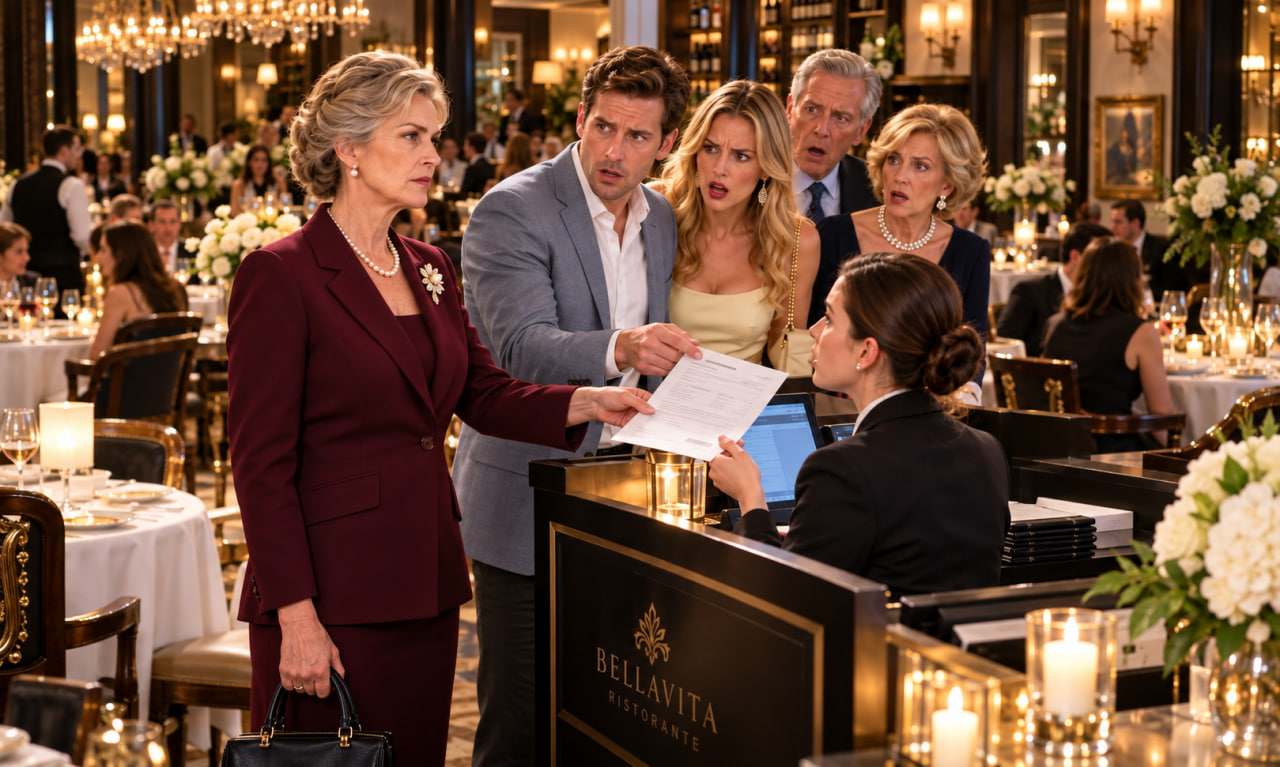
The final page of the scan contained a note from Daniel.
He claimed the letter proved Adam had a beneficial interest in the company. He demanded a payment of two million dollars in exchange for returning the original and agreeing not to challenge the estate.
Helen read the note, then set it down.
“That demand is important evidence. Don’t respond to him directly. We’ll preserve everything and refer it to the authorities.”
I nodded.
The letter had been used as a weapon, but it had also exposed the truth.
Adam wasn’t entitled to the company.
He was entitled to the chance to become someone his father would have trusted with it.
Those were very different things.
By the end of the week, Daniel’s role in the forged documents and the demand for payment had been referred for investigation. The restaurant and bank supplied the relevant records. Graham’s company began facing difficult questions from its investors, and he could no longer use my name as proof of financial backing.
The legal process would take time.
I couldn’t decide its outcome, and I wouldn’t try.
What I could decide was what happened next in my own family.
On Saturday afternoon, Adam came to my house alone.
He stood on the porch holding a small paper bag from a bakery we used to visit when he was a child.
“I didn’t know what to bring,” he said.
“You didn’t have to bring anything.”
“I know.”
He looked older than he had a week earlier. Not physically, exactly. The polished confidence had gone. In its place was a man who seemed uncertain of what he was allowed to ask for.
I opened the door.
“Come in.”
We sat in the kitchen where Richard used to read the Sunday paper. Adam put the bag on the table and took out a small lemon cake.
“You used to make this on Mother’s Day,” he said.
“I did.”
“I haven’t thought about that in years.”
Neither had I.
For a while, we sat without speaking.
Then Adam placed both hands on the table.
“I knew the signature wasn’t real.”
I looked at him.
“I suspected the paperwork wasn’t legitimate, but I knew you hadn’t signed that authorization. I told myself it didn’t matter because I was going to pay the money back.”
“That’s not an explanation.”
“No. It’s the truth.”
His eyes reddened.
“I wanted Graham to respect me. I wanted Vanessa to think I could provide the life she expected. I wanted to stop feeling like the son who always needed help.”
“So you decided to take what you thought was yours.”
“Yes.”
“Without asking me.”
“Yes.”
I waited.
He swallowed.
“And when you caught me, my first thought wasn’t that I’d hurt you. It was that you’d make me look foolish.”
The admission hurt more than his excuses would have.
“Thank you for telling me the truth.”
“I don’t expect you to forgive me.”
“Good. Because forgiveness isn’t a receipt you hand someone after they’ve apologized.”
He nodded, accepting the words.
“I’ve hired my own attorney. I’ll cooperate with the investigation. I’ll repay any legitimate costs caused by my actions, and I won’t ask you to protect me from the consequences.”
“That is what you should do.”
He stared at the cake.
“Do you hate me?”
I reached across the table, then stopped before touching his hand.
“No, Adam. But I don’t trust you right now.”
He nodded again, and a tear slipped down his cheek.
“I don’t blame you.”
I let the silence remain between us. It was not punishment. It was room for the truth to exist without being hurried away.
After a while, I asked, “What do you intend to do now?”
“Find a job that doesn’t depend on your money. Get help understanding why I keep making promises I can’t afford to keep. And figure out whether my marriage can survive what we’ve done.”
“Those are sensible plans.”
“They’re not very impressive.”
“Neither is a forged signature.”
For the first time, he gave a faint, broken laugh.
Then he looked at me.
“Dad was right about you, wasn’t he?”
I thought of the letter.
“He believed I could make difficult decisions.”
“Can you?”
I held his gaze.
“Yes.”
He lowered his head.
“Then I suppose I have to live with yours.”
That was the moment I realized there might still be a future for us—not because I had rescued him again, but because he had finally stopped asking me to.
Vanessa’s future was less certain.
She moved out of their apartment while she considered her next steps. She gave Helen the messages she had exchanged with Daniel and agreed to cooperate with the investigation. Whether her marriage would survive was a decision neither Adam nor I could make for her.
When she came to see me, she didn’t ask for money or forgiveness.
She stood in my living room with her hands clasped tightly together.
“I spent so long believing that if I could just make everything look successful, nobody would discover how frightened I was,” she said. “My father taught me that appearances were the only thing people respected.”
“And did you respect them?”
She looked down.
“No. I was afraid of what would happen if I didn’t.”
I understood that fear more than I wanted to.
But understanding was not absolution.
“You helped deceive me,” I said. “You used my husband’s memory to justify it. I cannot pretend that didn’t happen.”
“I know.”
“If you want to make amends, keep telling the truth, even when it costs you something.”
She nodded.
“I will.”
I didn’t promise that we would become close. I didn’t tell her everything would be fine.
I simply opened the door for her when she was ready to leave.
It was the first honest kindness I had offered her in years.
The months that followed were difficult.
The investigation continued, and the forged documents became part of a formal legal process. Graham’s company restructured under pressure from its creditors. Daniel faced legal scrutiny over the documents and his demand for money. I left the resolution of those matters to the authorities and the courts.
Adam found work with a small accounting firm, starting at a salary far below the lifestyle he had once tried to maintain. He rented a modest apartment and began paying his own expenses.
He and Vanessa separated.
They didn’t turn their marriage into a public war, and they didn’t pretend their problems had vanished. They attended counseling and began confronting the choices they had made, one difficult conversation at a time.
I didn’t finance their reconciliation.
I didn’t finance Adam’s new life.
But when he called to tell me about a mistake he’d made at work, I listened. When he wanted advice, I gave it. And when he asked whether he could visit, I answered honestly instead of making him guess.
Trust returned in small increments, not grand gestures.
Almost a year after that Mother’s Day, Adam came to Bellavita again.
This time, he arrived alone.
I was sitting at the same table where I’d eaten my pasta the year before. My navy suit hung neatly on the chair beside me, and Richard’s pearl brooch rested against my lapel.
Adam approached slowly.
“Is this seat taken?”
I looked at the empty chair.
“No.”
He sat down.
For a moment, neither of us mentioned the past.
Then he placed a small envelope on the table.
“What’s this?” I asked.
“A letter. Not a request. Not a contract. Just something I wanted you to have.”
I opened it.
Inside was a handwritten note.
Mom,
I used to think you loved me because you always fixed things for me. I understand now that I was confusing your love with permission.
Dad trusted you because you knew the difference.
I can’t undo what I did. I can only become someone who would never do it again.
Thank you for letting me begin again without pretending I hadn’t hurt you.
Love, Adam.
I read it once.
Then I read it again.
When I looked up, my son was crying quietly.
I reached across the table and took his hand.
“I loved you before you knew how to deserve it,” I said. “That will never change.”
He squeezed my fingers.
“But trust,” I continued, “is something we build from here.”
“I know.”
A waiter arrived, and Adam ordered two dinners.
Then he hesitated.
“Mom, would you like me to pay?”
I looked at him, surprised.
He smiled faintly.
“I mean my own bill. Yours too, if you’d let me. No account numbers. No favors. Just dinner.”
I studied his face.
“All right, sweetheart.”
He nodded, visibly relieved.
We ate slowly. We talked about his work, the books he was reading, and a neighbor who had adopted an elderly dog. We talked about Richard, too, and for the first time in years, Adam told stories about his father without turning them into a defense of himself.
When dinner ended, he paid the bill with his own card.
It was a small thing.
But it was honest.
After he left, I remained at the table for a few minutes, looking out at the river.
Bellavita had survived. My business remained mine. Richard’s letter had found its rightful meaning, and my son had begun to understand that love was not the same as rescue.
I had lost the comforting illusion that I could protect my family from every painful consequence.
In its place, I had gained something harder and more valuable.
The freedom to love them without surrendering myself.
I touched the pearl brooch at my lapel and thought of Richard.
For the first time in a long while, I felt no need to ask what he would have done.
I knew what I had to do.
And that was enough.
THE END