
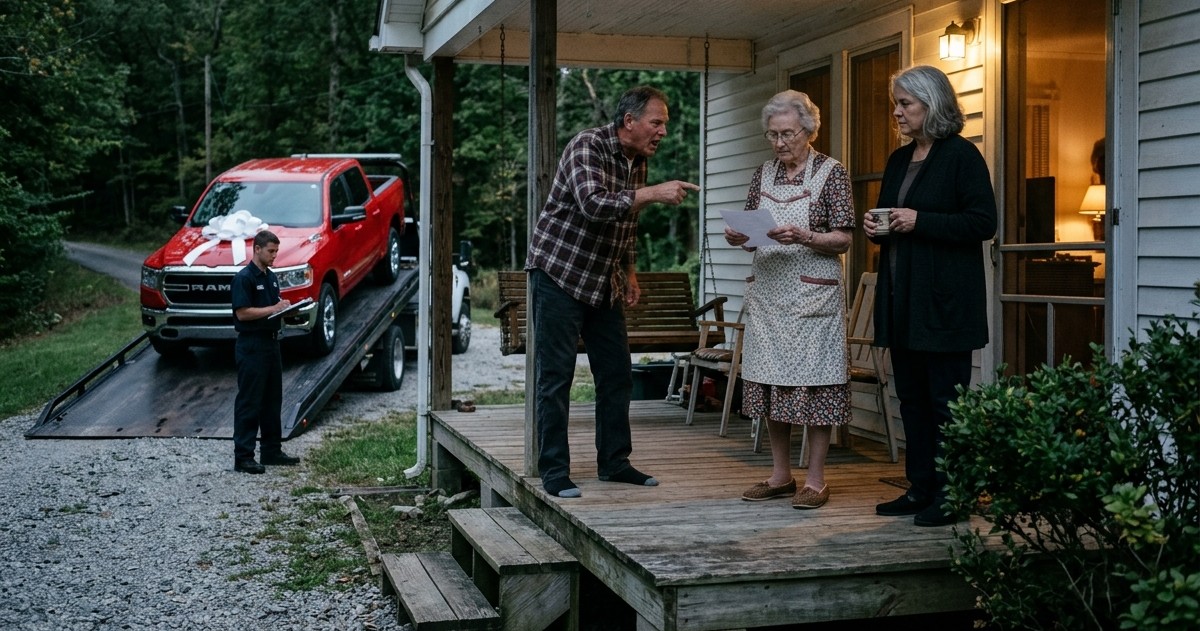
“I remember.”
“You remember giving Delmas money?”
I nodded.
“Twenty thousand dollars.”
“Your mama gave you that money, didn’t she?”
My hands tightened around the cup.
“Yes.”
“She sold some timber off the back acreage and gave you the money for a savings account. She wanted you to have something of your own.”
I remembered that summer.
Delmas had come home talking about an opportunity.
He said his brother had found a good deal.
He said we would have something to retire on.
He asked me to put the money into the business.
I had believed him.
“What happened to it?” I asked.
Ethelene looked down.
“Your mama found out the business never happened.”
I felt my throat tighten.
“Where did the money go?”
“Some of it went to pay off Delmas’s debts. Some went to Raymond. And some went into a truck.”
I stared at her.
“Another truck?”
“An old one. Not a new one like this red thing.”
I sat back.
“Did Mama know?”
“She found out a year later. She wanted to tell you, but you were so determined to keep your marriage together.”
I covered my face.
For a moment, I was twenty-eight again.
I could see myself standing in Mama’s kitchen, telling her that Delmas was going to make something of himself.
I remembered Mama’s expression.
She hadn’t argued.
She had just said:
“Stell, a man who loves you won’t need you to go broke proving it.”
I thought she was being hard on him.
Now I understood.
Ethelene pushed the photograph toward me.
“Your mama kept copies of everything.”
“Why didn’t she tell me?”
“She said you’d have to find the truth yourself. Otherwise, you’d spend the rest of your life thinking she was trying to turn you against your husband.”
I wiped my eyes.
“She knew me too well.”
Ethelene reached across the table.
“She loved you too much to lie to you.”
I stayed until lunchtime.
Before I left, Ethelene gave me another envelope.
“This one is mine,” she said. “Not your mama’s.”
I opened it.
Inside was a handwritten statement.
It described what she knew about the old business arrangement, including dates and the money Delmas had received.
At the bottom, she had signed her name.
“Why are you giving me this?”
“Because I’m eighty-nine years old, and I don’t intend to spend whatever time I’ve got left pretending my son has never done anything wrong.”
I hugged her.
She hugged me back.
And for the first time in years, I felt like I wasn’t standing alone.
When I got home, Delmas was in the living room.
He had been drinking coffee.
He looked at me.
“Where have you been?”
“Ethelene’s.”
His expression changed.
“What did she tell you?”
“Enough.”
He stood up.
“She’s old. She gets confused.”
“She seemed clear to me.”
He walked closer.
“You need to stop letting people put things in your head.”
I took off my coat.
“Delmas, I don’t need anybody to put anything in my head. I have my own.”
He shook his head.
“You’re making a big mistake.”
“No. I think I made a few mistakes a long time ago.”
He stared at me.
Then he lowered his voice.
“What do you want?”
I thought about that question.
For most of my marriage, I had wanted simple things.
A little peace.
A little kindness.
A husband who asked how my day had been.
A man who didn’t treat my hard work like it belonged to him.
I looked at him.
“I want you to stop spending money you don’t have and stop making promises with money that isn’t yours.”
He laughed bitterly.
“That’s it?”
“That’s a start.”
He walked away.
I thought the conversation was over.
But I was wrong.
Because two days later, I received a letter from the dealership.
It wasn’t addressed to Delmas.
It was addressed to me.
Inside was a copy of the purchase paperwork.
And a note explaining that the dealership had received a call from someone claiming to be my husband, requesting that they contact me about payment.
There was another document attached.
A financial application.
My name was printed on it.
My signature appeared at the bottom.
I stared at it.
I had never signed that paper.
I took it straight to Mr. Caldwell.
He looked at the document and then at me.
“Did you authorize anyone to sign this?”
“No.”
“Did you give your husband permission?”
“No.”
He examined the signature.
“I can’t determine whether it’s forged just by looking at it. But we can preserve the original and address this properly.”
He explained the steps I could take, including notifying the dealership that I disputed the signature and making sure my credit records were protected.
I did exactly that.
Then I went home.
Delmas was sitting on the porch.
I put the papers on the table in front of him.
“What is this?”
He glanced down.
His face changed.
“Where’d you get that?”
“From the dealership.”
He said nothing.
“Did you sign my name?”
“No.”
“Then tell me who did.”
He rubbed his forehead.
“I was going to explain.”
“When?”
He didn’t answer.
“Before or after they took money out of my account?”
He stood up.
“Stell, listen to me.”
I held up my hand.
“No. You listen to me.”
My voice was quiet.
But I had never been more certain of anything.
“You bought a truck with money you didn’t have. You told people I promised to pay. You tried to borrow against land that belongs to me. And now there’s paperwork with my name on it that I never signed.”
He looked toward the window.
“Raymond said it would be fine.”
I felt something inside me go still.
“Raymond?”
“He said it was just paperwork. He said once the money came through, nobody would care.”
I shook my head.
“You’re a grown man, Delmas.”
“I know.”
“Then start acting like one.”
He sat down.
For the first time, he looked frightened.
Not angry.
Not offended.
Frightened.
And I realized that the thing he was most afraid of losing wasn’t me.
It was the life he’d become accustomed to having at my expense.
PART 5 — THE WOMAN WHO FINALLY SAID NO
The next week was the longest week of my life.
I changed the passwords on my accounts.
I spoke with the bank.
I gave the dealership a written statement disputing the signature.
Mr. Caldwell helped me understand the legal options and what documents needed to be preserved.
I didn’t shout.
I didn’t threaten.
I simply stopped allowing people to use my name without my permission.
Delmas spent most of those days in the garage.
He barely ate.
One evening, he came into the kitchen while I was making soup.
“Stell?”
“Yes?”
“Can we talk?”
I turned off the burner.
He pulled out a chair.
“I’ve been thinking.”
“That’s good.”
He looked at the floor.
“I shouldn’t have bought that truck.”
“No.”
“I shouldn’t have told people you were paying.”
“No.”
“And I shouldn’t have signed those papers.”
I folded my dish towel.
“Did you sign them?”
He took a long breath.
“Raymond helped me.”
“That’s not what I asked.”
He looked up.
“Yes.”
I nodded.
The truth was painful.
But it was still better than another lie.
“Why?”
He rubbed his hands together.
“I wanted something nice. Everybody around here has new trucks. I figured after all those years, I deserved one.”
“Then you should’ve saved for one.”
“I thought you had plenty.”
“I did have plenty. It was Mama’s.”
He looked away.
“She was your mother. You were going to inherit it anyway.”
I stared at him.
“Do you hear yourself?”
He didn’t answer.
“She worked for what she had. She saved it. She left it to her daughter. And you decided that meant you could spend it?”
His eyes watered.
“I’m sorry.”
I believed he was sorry.
But I wasn’t sure what he was sorry for.
Losing the truck?
Being caught?
Or hurting me?
Those are three different things.
I sat down across from him.
“Delmas, I don’t know what happens next.”
He nodded.
“I know.”
“I’m not paying for that truck.”
“I know.”
“I’m not signing the land over to you.”
“I know.”
“And I’m not pretending that paperwork didn’t happen.”
He stared at his hands.
“What do you want me to do?”
I took a breath.
“I want you to tell the truth. I want you to cooperate with the bank and the dealership. I want you to stop blaming your brother. And I want you to understand that saying sorry doesn’t erase what happened.”
He nodded slowly.
For once, he didn’t argue.
The following Monday, we met with Mr. Caldwell.
Delmas gave his account of what had happened with the truck paperwork.
The attorney advised him to obtain independent legal advice about his own responsibilities.
Raymond was contacted as well.
He was furious.
He called me twice.
The first time, I didn’t answer.
The second time, I picked up.
“Stell, you’ve got this all wrong.”
“Then explain it.”
“Delmas and I were trying to make something happen.”
“With my money?”
“Family money.”
I closed my eyes.
“Raymond, Mama left that money to me.”
“You’re his wife.”
“And you’re his brother.”
He went quiet.
I continued.
“That doesn’t mean either of you owns what I own.”
He hung up.
Two days later, Ethelene called.
“He’s been here.”
“Who?”
“Raymond.”
“What did he want?”
“Money.”
I sighed.
“Of course he did.”
“He wanted me to tell Delmas to stop talking.”
I leaned against the counter.
“What did you say?”
“I told him to go home.”
I smiled.
Ethelene was eighty-nine years old, but she could still put a grown man in his place with six words and a look.
Then she said something that surprised me.
“I want you and Delmas to come for supper Saturday.”
I hesitated.
“Are you sure?”
“Yes.”
“Will Raymond be there?”
“No.”
“Then we’ll come.”
Saturday arrived.
I wore my blue dress.
Delmas wore his Sunday shirt.
We drove to Pine Branch Road in the old sedan.
The driveway looked strangely empty without the red truck.
Ethelene was standing at the kitchen window.
When we came in, she had fried chicken, mashed potatoes, green beans, biscuits, and apple pie waiting.
She looked at her son.
“Sit down.”
He sat.
She placed a plate in front of him.
Then she looked at me.
“Stell, I want you to hear something.”
I set down my fork.
Ethelene took a breath.
“I knew what Delmas was doing years ago. I knew about the money from your mama. I knew about the business that never happened.”
Delmas stopped chewing.
“Mother.”
She raised one finger.
“Not one word.”
He looked down.
She continued.
“I didn’t tell Stella because I thought I was protecting my son. I was wrong. I should’ve told her.”
Her eyes filled.
“Your mama was a better woman than me in that regard.”
I reached across the table and held her hand.
“You did what you thought was right.”
“No,” she said. “I did what was easy.”
Nobody spoke for a moment.
Then she looked at Delmas.
“Son, I love you. But loving you doesn’t mean helping you lie.”
Delmas put down his fork.
“I know.”
Ethelene nodded.
“Good. Then perhaps there’s hope for you yet.”
We finished supper quietly.
When I got up to help with the dishes, Ethelene stopped me.
“Leave them.”
“Who’ll wash them?”
“I’ll get to them.”
I smiled.
“You’re eighty-nine.”
“And you’re sixty-six. Between us, we ought to manage a few plates.”
We laughed.
It was the first real laugh I’d had in weeks.
PART 6 — WHAT MAMA REALLY LEFT ME
Three months passed.
The legal and financial matters took time.
Delmas cooperated with the process, and the disputed paperwork was addressed through the appropriate channels.
The dealership had its truck back.
The red pickup was eventually sold to another buyer.
I never found out who bought it.
I didn’t care.
What mattered was that my inheritance remained mine.
Mr. Caldwell helped me review Mama’s property documents.
The additional twenty acres were properly confirmed as belonging to me.
I also learned that Mama had left a small savings account specifically for repairs to the creek house.
It wasn’t a fortune.
But it was enough to fix the roof, repair the porch, and replace the old windows.
One Saturday, I drove out to the property.
The little white house stood beside the creek, just as it had when I was a girl.
The porch needed painting.
The screen door still squeaked.
A few boards on the steps were loose.
But the place was beautiful.
I walked through every room.
Mama’s bedroom.
The kitchen where she’d taught me to make biscuits.
The little living room where she used to sit and sew while the radio played.
I opened the window.
The sound of the creek came through.
And for a moment, I could almost hear her.
“Don’t stand there looking sad, Stell. There’s work to do.”
I laughed.
Then I cried.
Not because I was unhappy.
Because I finally understood that Mama hadn’t left me just a house.
She’d left me a place where I could remember who I was before I spent forty-four years trying to make everybody else happy.
I hired a local carpenter to repair the porch.
I had the kitchen painted a soft yellow.
I planted flowers along the walkway.
I kept Mama’s old rocking chair.
And I put the brass key from the bank in a little wooden box on the mantel.
A reminder.
Not of money.
Of the truth.
Delmas and I continued living in the house we’d shared.
But things were different.
I opened my own mail.
I kept my own financial records.
I made my own decisions.
And when Delmas asked for money, I no longer handed it over without questions.
Sometimes he complained.
Sometimes he was quiet.
But I didn’t return to the old ways.
One afternoon, he came into the kitchen.
“Stell, I was thinking about getting another truck.”
I looked up from my sewing.
“What kind?”
“Used one. Something reasonable.”
“How much?”
“Maybe fifteen thousand.”
“Do you have fifteen thousand?”