
He hesitated.
“Not all of it.”
I put my sewing down.
“Then you don’t have fifteen thousand.”
He nodded.
“I figured you’d say that.”
I almost smiled.
“Well, at least one of us is learning.”
He went outside.
I returned to my sewing.
And that was that.
I didn’t have to yell.
I didn’t have to explain.
I simply didn’t give away what I couldn’t afford to lose.
By October, I had finished fixing the creek house.
I invited Juanice over for lunch.
She brought a pie.
We sat on Mama’s porch, listening to the water.
She looked around.
“Stell, your mama would be proud.”
I looked at the white curtains moving in the breeze.
“I hope so.”
Juanice took a bite of pie.
“Do you think you’ll keep it?”
I nodded.
“I think so.”
“What’ll you do with it?”
I smiled.
“Something Mama would’ve liked.”
The next spring, I started a little sewing group.
Nothing fancy.
Just a few women from the county who came on Thursday afternoons.
We repaired old quilts.
We made curtains.
We taught younger women how to sew buttons and mend hems.
Sometimes we sat around the kitchen table and talked.
Sometimes we cried.
Sometimes we laughed so hard that somebody nearly dropped a cup of coffee.
I called it Mama’s Table.
It started with four women.
Then eight.
Then twelve.
A widow from Jenkins came.
A retired teacher from Whitesburg came.
Juanice brought her granddaughter.
Nobody paid anything.
If a woman needed help with fabric or supplies, we found a way.
And every Thursday, I put out cornbread.
Just like Mama used to.
One afternoon, Ethelene came by.
She walked slowly up the porch steps.
I helped her into the kitchen.
She looked around.
“Well, I’ll be.”
“What?”
“This place feels like home.”
I smiled.
“It is.”
She sat down.
I poured her coffee.
Then she looked at the old photograph of her and Mama, now sitting in a frame on the shelf.
“Your mama would’ve liked this.”
I sat beside her.
“She would’ve liked you coming, too.”
Ethelene reached over and patted my hand.
“Stell, I’ve been meaning to tell you something.”
“What is it?”
“Delmas has been asking about you.”
I raised an eyebrow.
“He lives with me.”
“I know. But he’s been asking what you’re doing out here. He says you seem happier.”
I looked out the window.
The creek was shining in the afternoon sun.
“I am happier.”
Ethelene nodded.
“Good.”
Then she said something I never expected.
“He told me he misses the woman you used to be.”
I laughed softly.
“The woman I used to be spent forty-four years saying yes when she wanted to say no.”
Ethelene smiled.
“Then perhaps he ought to get acquainted with the woman you’ve become.”
We both laughed.
And for the first time, I didn’t feel guilty about it.
PART 7 — THE LAST LETTER
The following March, one year after Mama passed, I went to the cemetery.
I took flowers.
White ones.
Mama’s favorite.
I cleaned the little stone and sat beside it.
The grass was wet.
The wind was cold.
I placed the flowers in the vase.
“Well, Mama,” I said, “you certainly left me a mess to sort out.”
I smiled.
Then I told her about the truck.
About the bank.
About the twenty acres.
About Ethelene.
About the sewing group.
I told her that I had finally learned to say no.
And that saying no didn’t mean I had stopped loving people.
It just meant I had started loving myself, too.
I sat quietly for a while.
Then I remembered the final page of the notebook.
There was another sentence I’d never paid much attention to.
There is one more letter. Give it to Stella on the anniversary of my passing.
I had found it tucked between the pages.
But I hadn’t opened it.
I brought it with me that morning.
The envelope was small.
My name was on the front.
I opened it carefully.
“Stell,
If you’ve made it this far, then you’ve learned something I tried to teach you all your life.
You cannot make a person respect you by giving them more of yourself.
You cannot buy peace by paying for everybody else’s mistakes.
And you cannot keep a marriage alive by letting one person do all the living.
I know you loved Delmas.
I know you still do, in whatever way a woman loves a man after forty-four years.
I won’t tell you to leave him.
I won’t tell you to stay.
That choice belongs to you.
But I want you to understand something.
You were my daughter before you were anybody’s wife.
You were a little girl before you were anybody’s helper.
You were a person before the world started telling you what you owed it.
Don’t forget her.
Don’t forget yourself.
The house was never the most important thing I left you.
The land was never the most important thing.
Even the money wasn’t.
It was the freedom to choose what happens next.
Use it wisely.
And when you make your biscuits, don’t forget the salt.
You always did forget the salt.
Love you forever,
Mama.”
I laughed.
Then I cried.
Because even from the grave, Mama could still find a way to tell me I was doing something wrong in the kitchen.
I folded the letter and put it back in my purse.
Before I left, I touched the top of her headstone.
“I love you, Mama.”
Then I stood up.
I had somewhere to be.
Twelve women were waiting at the creek house.
And I had cornbread to make.
PART 8 — THE RED TRUCK CAME BACK
That summer, something happened I never expected.
I was sitting on the porch at Mama’s house when I heard an engine coming up the gravel road.
A red pickup.
Not the same one.
An older model, with a dent in the driver’s door.
It stopped near the gate.
Delmas got out.
He walked toward me slowly.
I set down my sewing.
“Well, look who’s here.”
He looked at the house.
“Looks nice.”
“Thank you.”
He stood there for a moment.
Then he looked at the chair beside mine.
“Can I sit?”
I nodded.
He sat down.
For a while, we listened to the creek.
Then he spoke.
“I bought a truck.”
“I see that.”
“Used one. Paid cash.”
“That’s good.”
He rubbed his hands together.
“I sold some tools. Took extra work. Saved for it.”
I looked at him.
“Well, congratulations.”
He nodded.
Then he looked down.
“I wanted you to know I paid Raymond back some of the money.”
“That’s between you and him.”
“I know.”
He was quiet.
Then he said:
“I’ve been thinking about what your mama wrote.”
I turned toward him.
“You read Mama’s letter?”
“No. Ethelene told me some of it.”
I smiled.
“She talks too much.”
“She sure does.”
We both laughed a little.
Then Delmas looked at me.
“Stell, I know I hurt you.”
I didn’t answer.
“I know I acted like everything you had belonged to me.”
I folded my sewing.
“I did a lot of things wrong.”
He swallowed.
“I don’t expect you to forget.”
“Good.”
“I just wanted to tell you I’m sorry.”
I looked at him.
There was a time when those words would’ve been enough to make me forgive everything.
But I wasn’t that woman anymore.
“Delmas, I appreciate you saying that.”
He nodded.
“But trust isn’t something you get back just because you ask for it.”
“I know.”
“And I don’t want to go back to the way things were.”
He looked toward the creek.
“I don’t either.”
I studied him.
He looked older.
His shoulders were lower.
The anger that used to sit on his face had softened.
Maybe losing that truck had taught him something.
Maybe the years had.
Maybe it was both.
I poured another cup of coffee.
“Do you want some?”
He nodded.
I brought him a cup.
He took a sip.
Then he looked at me.
“Your mama made good coffee.”
“She did.”
“She never liked me.”
I laughed.
“She liked you fine when you behaved.”
He smiled.
For a little while, we sat there like two ordinary people.
Not a husband and wife fighting over money.
Not a man and woman trying to win an argument.
Just two people who had shared a long life and were trying to figure out what came next.
Before he left, Delmas stood at the gate.
“Stell?”
“Yes?”
“Are you coming home tonight?”
I looked at the house.
Then at him.
“I’ll come home when I’m ready.”
He nodded.
“All right.”
And he drove away.
I watched the red truck disappear down the road.
Then I went back inside.
The women would be arriving soon.
There were quilts to finish.
Coffee to make.
And a pan of cornbread waiting to go into the oven.
FINAL PART — WHAT $214,000 COULDN’T BUY
It’s been two years since the day I sold Mama’s house.
The closing check was $214,000.
I remember the number because I thought it would change my life.
It did.
Just not in the way Delmas expected.
He thought that money would buy him a brand-new red truck.
He thought it would make him the talk of Main Street.
He thought he’d finally have something shiny enough to show everybody that he was doing well.
But that money bought me something far more valuable.
It bought me the chance to stop being afraid.
I still live with Delmas, though our marriage is different now.
We have separate financial accounts.
We talk about major decisions.
And I don’t agree to things just to keep the peace.
Some days are good.
Some days are difficult.
I don’t pretend that forty-four years of habits disappear overnight.
But I don’t make excuses for him anymore.
He works.
He pays his bills.
He drives his used truck.
And when he wants something expensive, he saves for it.
Sometimes he even asks me what I think.
I suppose that’s progress.
Ethelene is still with us.
She’s ninety-one now.
She still makes supper on Saturdays, though her granddaughter helps with the cooking.
She keeps Mama’s photograph on her living room shelf.
And every time I visit, she says the same thing.
“Your mama knew.”
I always answer:
“Yes, she did.”
The sewing group at the creek house has grown.
We now have seventeen women.
We made quilts for three families who lost their homes in a fire.
We repaired curtains for the senior center.
We taught six young girls how to sew.
And last Christmas, we made little cloth angels and gave one to every woman who came through the door.
I kept one for Mama.
It sits on the windowsill beside her old rocking chair.
Sometimes, when the afternoon light comes through the curtains, I sit there and think about the woman I used to be.
The woman who never wanted to upset anybody.
The woman who apologized when someone else hurt her.
The woman who believed that keeping a marriage meant keeping her mouth shut.
I wish I could go back and tell that younger Stella something.
I’d tell her that being a good wife doesn’t mean being an unpaid bank.
I’d tell her that love doesn’t require a woman to surrender every dollar she earns or inherits.
I’d tell her that a man can be disappointed without her being responsible for fixing it.
And most of all, I’d tell her that sixty-six is not too old to begin again.
Last Saturday, Delmas came with me to Mama’s grave.
He carried the flowers.
He stood beside me while I cleaned the stone.
Then he looked down at the inscription.
“She was a strong woman.”
I nodded.
“Yes, she was.”
He was quiet for a minute.
Then he said:
“She raised one, too.”
I looked at him.
He wasn’t smiling.
He meant it.
I didn’t say anything.
I just put my hand on his arm.
When we got back to the car, he opened the passenger door for me.
I climbed in.
He walked around to the driver’s side.
And before he started the engine, he said:
“You know, Stell, I never did get that new red truck.”
I looked out the window.
“Well, honey, you sure did get to see one.”
He laughed.
I laughed, too.
And for the first time, the memory didn’t hurt.
That evening, I sat on Mama’s porch with a cup of coffee.
The creek was running high from the rain.
The little white curtains were moving in the breeze.
I took Mama’s letter from my purse and read the last line again.
Don’t forget the salt.
I smiled.
Then I heard Juanice calling from the driveway.
“Stell! You got that cornbread ready?”
I stood up.
“Coming!”
I went into the kitchen.
The pan was on the counter.
The women were arriving.
And there was enough food for everybody.
I thought about the day I sold Mama’s house.
I thought about that $214,000 check.
I thought about the red truck with the big white bow.
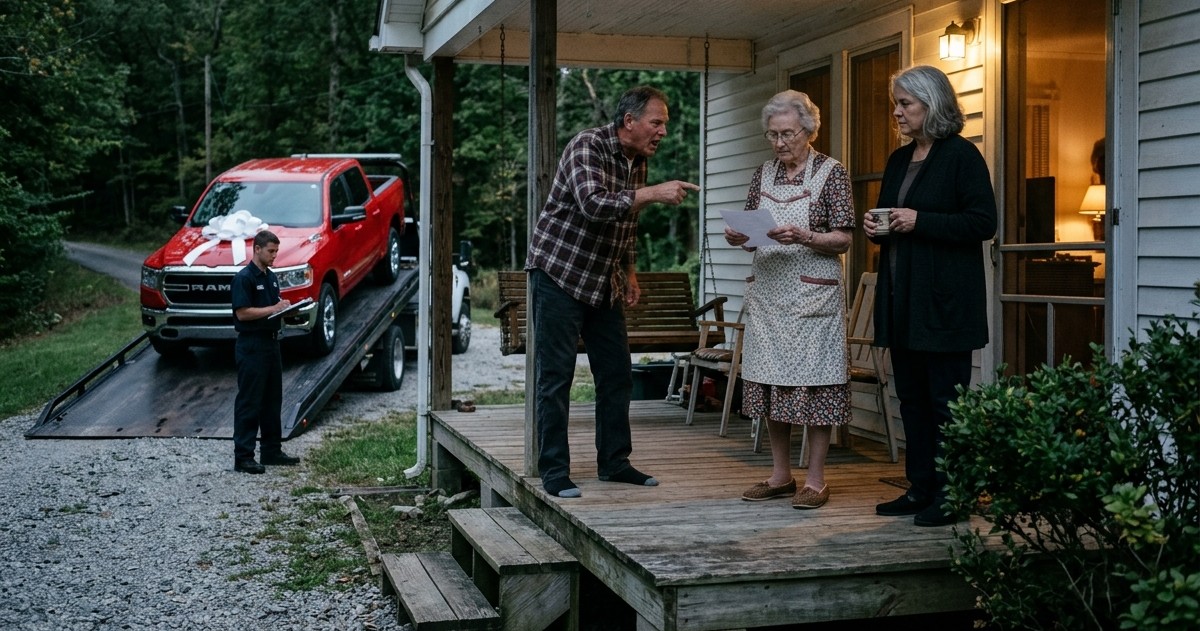
And I thought about Ethelene standing on her porch, reading those papers while her son shouted that his wife would pay.
If I could go back to that day, I wouldn’t change a single thing.
Not the truck being taken.
Not the argument.
Not even the tears.
Because sometimes the thing that gets taken away from you is the very thing that shows you what was never yours to begin with.
Delmas thought the truck was the prize.
I thought the money was the inheritance.
But Mama knew better.
The real inheritance was the freedom to stand on my own two feet.
And if there’s one thing I’ve learned at sixty-eight years old, it’s this:
A woman can spend forty-four years making a home for somebody else and still have time to build one for herself.
So I locked the screen door, put the kettle on, and set another plate at Mama’s table.
Because the house was quiet no longer.
And neither was I.
THE END.